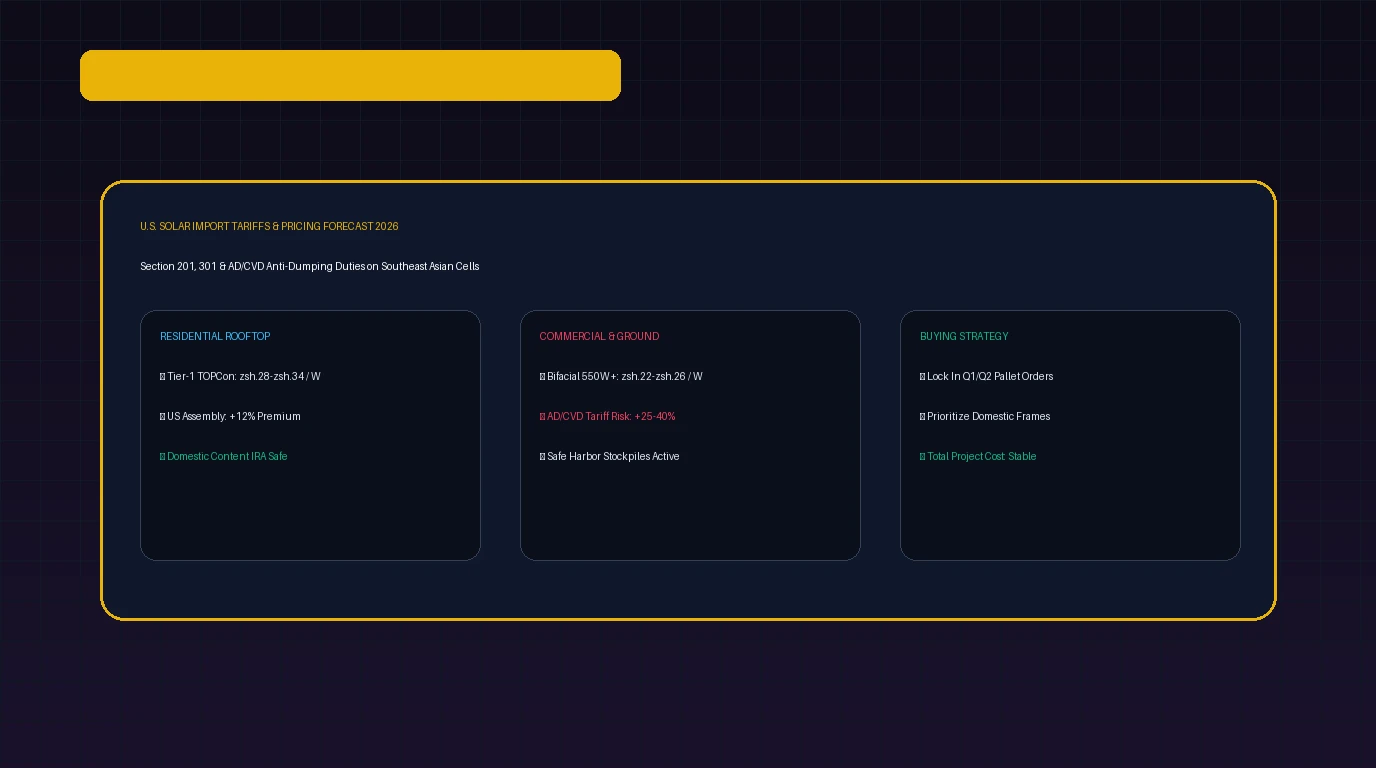
For the past decade, solar energy enjoyed a historic, unbroken deflationary curve. Thanks to global manufacturing scale and automated polysilicon processing, the wholesale price of photovoltaic (PV) solar panels plummeted from over $2.00 per Watt in 2010 to under 25¢ per Watt in 2024.
However, that historic downward price trajectory has reached a dramatic geopolitical crossroads.
A convergence of international trade disputes, expanded federal tariff regimes, and aggressive trade enforcement actions has triggered urgent questions across the clean energy industry: Will solar equipment prices skyrocket in 2026? How will new import duties affect rooftop installations, portable solar generators, and DIY home battery kits?
At GridSpecLab, our supply chain analysts and hardware engineers monitor US Department of Commerce trade rulings, international shipping manifests, and wholesale component spot pricing.
Here is an objective, data-backed analysis of the 2026 Solar Tariff Outlook, what equipment is most vulnerable to price spikes, and how savvy homeowners can protect their clean energy budgets.
Solar prices will not quadruple, but wholesale equipment costs are experiencing a 15% to 35% localized price surge on imported solar modules and stationary LiFePO4 batteries. DIY builders and kit buyers face the most direct exposure. Homeowners planning an installation should lock in existing distributor inventories before mid-year or select domestic-content Tier-1 panels that are fully exempt from AD/CVD penalties.
View Current In-Stock Solar Kits →
The Three Tariff Catalysts Reshaping Solar Pricing
To understand why prices are shifting, you must understand the three distinct trade mechanisms currently intersecting in the US market:
Southeast Asian AD/CVD Actions
Following petitions by the American Solar Manufacturers Commission, the US Department of Commerce imposed preliminary Antidumping (AD) and Countervailing Duties (CVD) on solar cells and modules imported from Cambodia, Malaysia, Thailand, and Vietnam.
Duties Range from 21% to 271%
Section 301 Battery Tariff Hikes
Federal trade actions increased Section 301 tariffs on Chinese stationary energy storage lithium-ion batteries from 7.5% to 25%. Because China produces over 80% of global LiFePO4 cells, this directly raises wholesale battery costs.
Impacts 48V Server Racks & Wallmounts
UFLPA Supply Chain Traceability
US Customs and Border Protection aggressively enforces the Uyghur Forced Labor Prevention Act (UFLPA). Importers must prove complete quartz-to-module traceability, occasionally holding container shipments at ports for months.
Tightens Port Wholesale Inventory
Equipment Breakdown: What Gets More Expensive vs What Stays Stable
Not all clean energy hardware faces the same tariff exposure. Here is our engineering breakdown of how specific components are affected:
| Component Category | Primary Manufacturing Origin | Tariff Risk Level | Expected Price Impact | Why It Is Affected |
|---|---|---|---|---|
| Bifacial / Monocrystalline Solar Panels | Southeast Asia / Overseas | High | +15% to +30% | Directly subject to AD/CVD duties and Section 201 quota caps. |
| 48V LiFePO4 Battery Storage | China (CATL, EVE, Gotion) | High | +12% to +20% | Section 301 stationary battery tariffs tripled to 25%. |
| Hybrid Inverters (EG4, Sol-Ark) | Taiwan / China / US Final Assy | Moderate | +5% to +10% | Electronics component tariffs apply; finished goods routing varies. |
| Solar Racking & Ground Mounts | United States / Mixed | Low | +0% to +5% | Largely domestic structural steel and aluminum extrusions. |
| Domestic US-Assembled Panels | United States (Georgia, Ohio) | Stable | 0% (Protected) | IRA Section 45X domestic credits shield US factories from duties. |
Turnkey Installer Quotes vs DIY Solar Hardware: The Great Divide
A common misconception among homeowners is that a 30% tariff on solar panels will cause their total rooftop installation quote to increase by 30%. In reality, the price impact depends entirely on whether you hire a turnkey installation contractor or purchase equipment directly.
In a standard $25,000 professional turnkey installation ($3.10/Watt), physical solar modules represent only 12% to 15% of the total contract price. The remaining 85% consists of sales commissions, municipal permitting, electrical inspection, and labor.
In a DIY or subcontracted solar installation (such as a $12,000 10kW ShopSolar kit), physical hardware accounts for 85% to 90% of your total budget. Any tariff imposed on panels or batteries flows directly through to your checkout cart.
The Domestic Manufacturing Boom: The IRA Shield
While import tariffs present short-term pricing friction, the federal policy landscape was deliberately designed to incentivize domestic manufacturing.
Under the Inflation Reduction Act (IRA) Section 45X Advanced Manufacturing Production Credit, manufacturers receive substantial tax credits for producing clean energy hardware on American soil:
- Solar Cells: 4¢ per Watt credit for US-manufactured cells.
- Solar Wafers: $12 per square meter credit.
- Battery Cells: $35 per kilowatt-hour for domestic battery cell production.
Major manufacturers have brought massive US gigafactories online:
- Qcells (Dalton & Cartersville, Georgia): Expanded to 8.4 GW of domestic solar module and ingot capacity—the largest integrated solar campus in the Western Hemisphere.
- First Solar (Ohio, Alabama, Louisiana): Cadmium-telluride thin-film panels completely immune to crystalline silicon tariffs.
- Silfab & Heliene (Washington, Minnesota): Expanding North American module assembly for residential and commercial rooftops.
As domestic supply chains ramp to full capacity, domestic modules will provide a tariff-immune supply buffer, stabilizing pricing for mainstream residential systems.
Strategic Buyer Guide: How to Protect Your Budget
If you are planning to install rooftop solar, an off-grid cabin array, or emergency battery backup, use these three strategies to avoid tariff price spikes:
Secure Existing Warehouse Inventories Early Distributors like ShopSolar and Signature Solar warehouse large inventories imported prior to new tariff duty enforcement dates. Purchasing in-stock kits locks in pre-tariff pricing before wholesale inventory replenishes at higher duty rates.
Pair Panels and Batteries to Maximize the 30% Tax Credit The 30% Federal Clean Energy Credit (Section 25D) applies to the full gross cost of your equipment. A 20% hardware price increase on an $8,000 battery bank is significantly softened by claiming an additional $480 in federal tax credits.
Specify Domestic Tier-1 Modules for Turnkey Projects If hiring a contractor, request domestic Qcells or Silfab panels in your contract scope. Specifying domestic modules prevents the contractor from issuing surprise change orders or tariff surcharges during permitting.
Top Recommended Complete Solar Equipment Packages
For homeowners and DIY builders seeking reliable, pre-engineered solar systems with locked-in pricing:
1. Pre-Tariff Inventory Complete Kit: ShopSolar Turnkey Packages
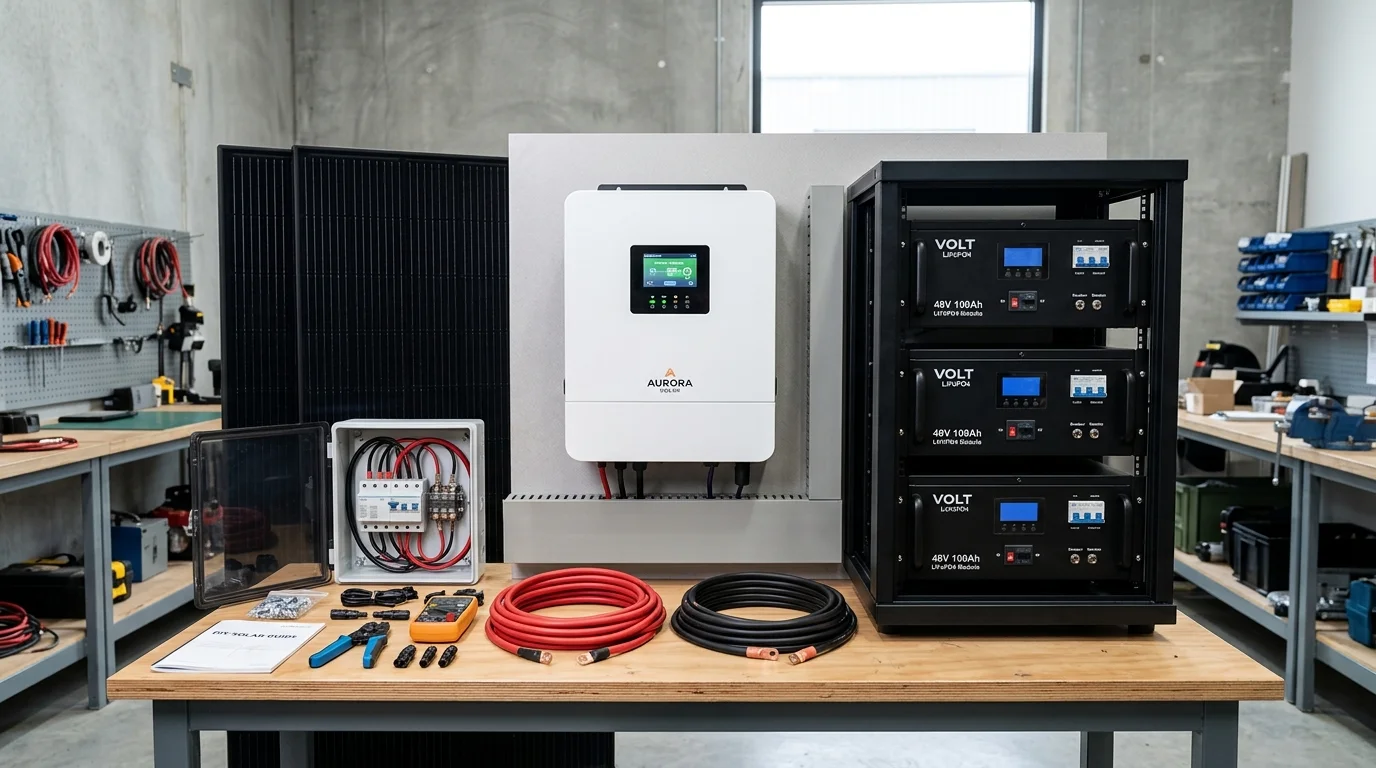
ShopSolar Complete Home Solar Packages (5kW – 15kW)
Features high-efficiency bifacial monocrystalline panels, pre-wired hybrid inverters, solar cabling, and complete permit-ready engineering plans.
Explore ShopSolar Inventory Packages →
2. High-Capacity Hybrid Inverter: EG4 18kPV
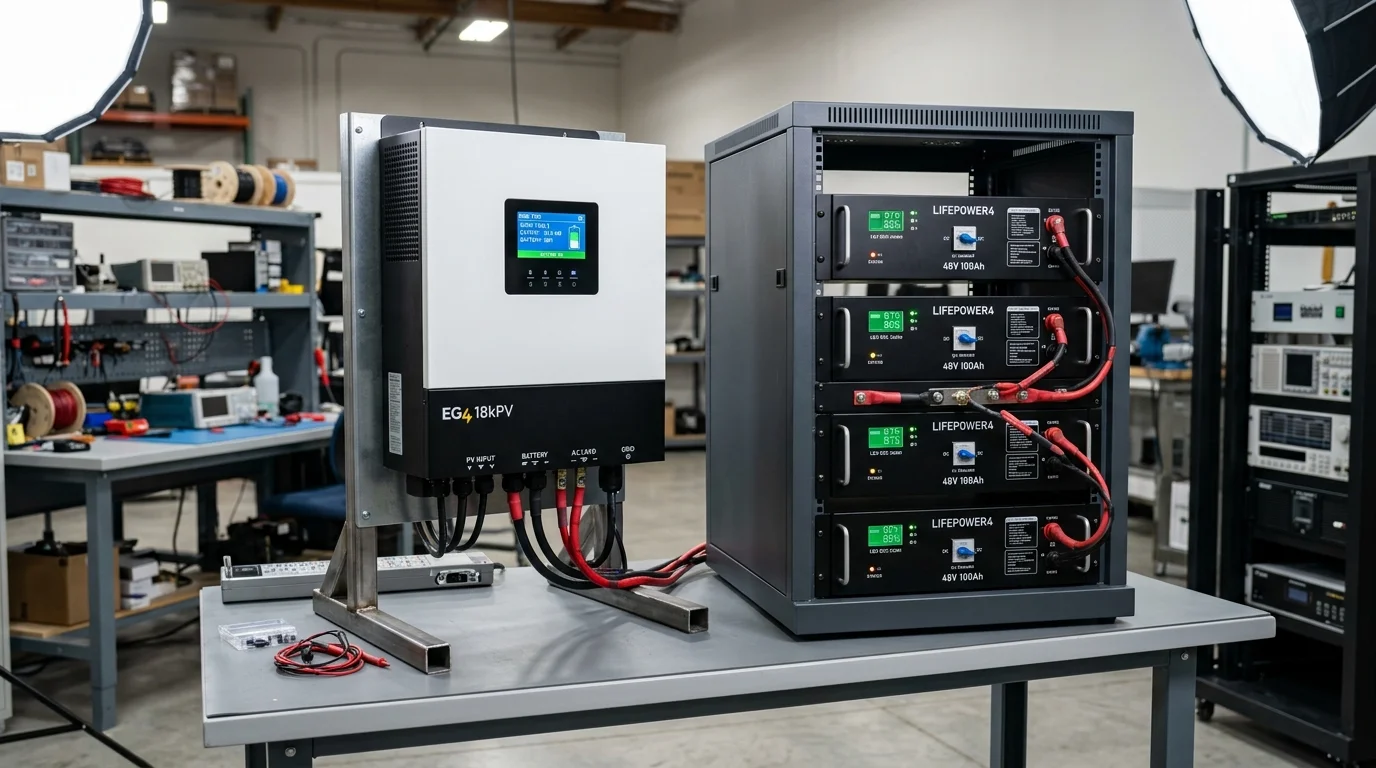
EG4 18kPV All-In-One Hybrid Inverter
Combines an 18kW solar PV input, 12kW split-phase 120V/240V inverter, and a 200A whole-home transfer switch in one UL1741SB certified enclosure with open-protocol 48V battery integration.
Check EG4 18kPV Availability →
Interactive Sizing and Battery Storage Calculators
To determine how much battery capacity your home requires to hedge against peak utility rates, test your appliances with our interactive tools:
Calculate Your Required LiFePO4 Battery Capacity
Determine how many kilowatt-hours of battery storage your home or off-grid cabin needs to power essential circuits through multi-day grid blackouts.
Open Battery Capacity Calculator →
Frequently Asked Questions (FAQ)
Will solar panel prices double because of the new tariffs?
No. While preliminary AD/CVD duties on certain overseas manufacturers exceed 100%, wholesale solar modules represent only a fraction of total installation costs. In wholesale markets, panels are increasing by roughly 6¢ to 12¢ per Watt. On an average 8kW residential system, this translates to a modest $500 to $1,000 increase in wholesale panel costs, which does not double total installation pricing.
Are portable power stations affected by the Section 301 battery tariffs?
Yes, but to a lesser degree than stationary home batteries. Section 301 tariffs on Chinese stationary energy storage lithium-ion batteries increased to 25%. However, many consumer electronics and portable power station manufacturers (EcoFlow, Anker, Bluetti) distribute their manufacturing footprint across multiple assembly facilities in Southeast Asia and North America to optimize duty classifications.
Does the 30% Federal Clean Energy Tax Credit offset tariff increases?
Yes. The 30% Residential Clean Energy Credit (Section 25D) is uncapped and calculated against the total final price you pay for equipment, installation, and energy storage. If tariff pressures raise a solar kit price by $1,000, your federal tax credit increases by $300, directly softening 30% of the cost increase.
Should I wait for US solar factories to lower prices?
Waiting is generally not advisable if your primary objective is reducing high electric bills. While domestic US solar manufacturing is expanding under IRA subsidies, domestic production costs (labor, domestic steel, clean silicon processing) are structurally higher than historical overseas dumping prices. Electricity rates from local utilities continue to compound at 3.5% to 5% annually, meaning delaying an installation costs you more in lost utility bill savings than any potential future module price decline.