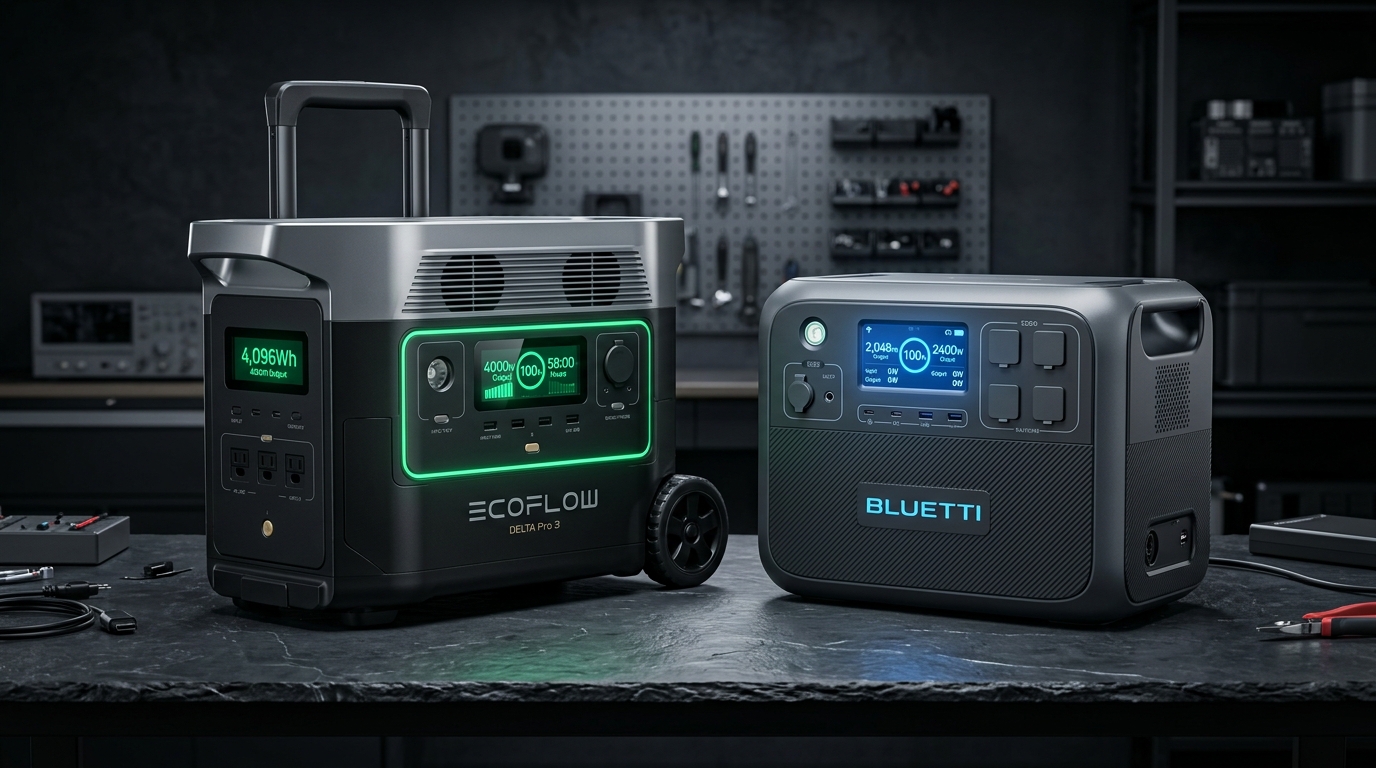
If you have researched portable power stations, clean energy emergency backup, or off-grid solar generators over the last five years, you have seen the distinctive sleek gunmetal-and-black chassis of EcoFlow.
Founded in 2017, EcoFlow evolved from a viral crowdfunding startup into the heavyweight market leader of the portable power sector. Today, the company competes head-to-head with industrial energy titans like Tesla Energy, Generac, and Anker SOLIX.
Yet many buyers still ask: Who is EcoFlow? Where did they come from? How does their proprietary hardware actually perform on the test bench?
At GridSpecLab, our testing laboratory has benchmarked every generation of EcoFlow hardware—from the original Kickstarter DELTA to the modern DELTA 2 Max, DELTA Pro 3, and modular DELTA Pro Ultra.
Here is the complete engineering breakdown of EcoFlow’s origins, their proprietary charging architectures, and how their ecosystem performs when the grid fails.
EcoFlow is not an OEM rebrander. They are a first-tier engineering powerhouse founded by former senior drone battery developers. Their defining market advantages are blistering AC recharge speeds (X-Stream), the industry’s most polished smart mobile app telemetry, and dual-MPPT solar flexibility. For home blackout defense and mobile off-grid power, their modern LiFePO4 DELTA lineup is a top-tier industry benchmark.
Check EcoFlow DELTA 2 Max Deals →
The Origins: The Drone Engineers Who Reinvented Battery Storage
EcoFlow was founded in 2017 by a small team of senior engineers and executives who departed DJI (Da-Jiang Innovations), the world’s preeminent commercial drone manufacturer.
Among the co-founders was Bruce Wang, who previously led battery R&D at DJI. In the drone sector, battery engineering is unforgiving: lithium packs must sustain massive discharge rates without overheating, pack maximum watt-hours into minimal grams, and recharge rapidly between flight sorties.
Wang and his engineering colleagues realized that while drone batteries had advanced at breakneck speed, consumer generators were trapped in the dark ages. In 2017, portable “solar generators” on the market suffered from three crippling limitations:
- The Dreaded “Power Brick”: Units required heavy external AC-to-DC transformer bricks that capped wall charging at 80W to 150W, requiring 8 to 12 hours for a single recharge.
- Fragile Inverters: Peak surges tripped easily, preventing users from starting simple refrigerator compressors or circular saws.
- Clunky User Interfaces: Monochromatic segment LCD displays provided zero remote connectivity, firmware updates, or charge management.
EcoFlow set out to apply aerospace-grade drone battery algorithms and bi-directional inverter topology to portable consumer power. Their breakthrough 2019 Kickstarter campaign for the original EcoFlow DELTA 1300 raised over $2.8 million in 48 hours, establishing them as an overnight disruptor.
Related Reading: Discover how DJI recently entered the portable power station market with their own hardware in our detailed technical review: Who Is DJI? The Drone Giant Behind the Power Stations.
Core Technologies: How EcoFlow Out-Engineered the Market
EcoFlow’s market dominance is built on three patented hardware and firmware innovations:
X-Stream Bi-Directional Fast Charge
Eliminates the external AC power brick. The internal inverter acts bi-directionally, rectifying 120V wall AC directly into DC battery current at up to 1,800W–2,400W. Recharges 0% to 80% in 50–65 minutes.
Standard AC Cable Only
X-Boost Voltage Modulation
Allows a 2,400W inverter to operate high-wattage resistive heating loads (up to 3,400W like space heaters and kettles) by dynamically lowering voltage while sustaining safe amperage, preventing overload trips.
Prevents Overload Blackouts
Dual-MPPT Solar Architecture
Featured on the DELTA 2 Max and DELTA Pro series. Incorporates two completely independent MPPT solar tracking circuits (500W + 500W = 1,000W), allowing panels facing different directions to charge simultaneously without shading loss.
Independent East/West Arrays
The Product Hierarchy: RIVER vs DELTA vs DELTA Pro
EcoFlow segments its catalog into three distinct hardware families tailored for specific energy requirements:
| Product Family | Capacity Range | Continuous Inverter | Chemistry | Primary Target Use Case |
|---|---|---|---|---|
| EcoFlow RIVER Series | 256Wh – 768Wh | 300W – 800W | LiFePO4 (Gen 2/3) | Tent camping, drone photography, weekend road trips, laptop backup. |
| EcoFlow DELTA Series | 1,024Wh – 2,048Wh | 1,800W – 2,400W | LiFePO4 (DELTA 2/Max/3) | Refrigerator survival, power tools, CPAP medical devices, RV dry camping. |
| EcoFlow DELTA Pro Series | 3,600Wh – 6,000Wh | 3,600W – 7,200W | LiFePO4 | Whole-home sub-panel backup, dual-voltage 120V/240V split-phase, EV Level 2. |
| DELTA Pro Ultra System | 6kWh – 30kWh+ | 7,200W – 21.6kW | LiFePO4 | Multi-day grid outage survival, whole-house central air, multi-string solar. |
The Chemistry Revolution: Ditching NCM for LiFePO4
First-generation EcoFlow units (such as the original DELTA 1300 and original RIVER 600) utilized ternary NCM (Nickel Cobalt Manganese) chemistry. While lightweight, NCM cells degraded to 80% capacity after roughly 500 to 800 cycles.
Recognizing this critical limitation, EcoFlow upgraded its entire product line to Lithium Iron Phosphate (LiFePO4) beginning with the DELTA Pro and DELTA 2 generations:
- Cycle Life: Rated for 3,000 to 4,000+ full discharge cycles to 80% health (equivalent to 10 years of daily cycling).
- Thermal Safety: Thermal runaway threshold increased to 270°C (518°F), eliminating the risk of oxygen generation during extreme overcharging.
- Storage Stability: Minimal capacity degradation when left at 100% State of Charge (SoC).
The Broader Smart Ecosystem: Beyond Battery Boxes
What truly distinguishes EcoFlow from generic battery assemblers is their vertically integrated hardware ecosystem:
- Smart Home Panel 2: A 12-circuit smart transfer sub-panel that integrates up to three DELTA Pro Ultra units with your household breaker box, offering automated sub-20ms grid-failure cutover and Time-of-Use (TOU) peak rate arbitrage.
- EcoFlow Smart Generator (Dual-Fuel): A compact gasoline/propane inverter generator that integrates directly with the DELTA series via DC charging. Instead of running inefficiently at partial load, the generator automatically starts, charges the battery at maximum DC efficiency (saving 30% fuel), and turns off automatically when full.
- EcoFlow Glacier & Wave: 12V/24V direct-DC portable refrigeration (with built-in ice maker) and portable air conditioning units that plug directly into the extra battery port, bypassing inverter conversion losses.
Lab Bench Test: Where EcoFlow Excels & Where It Falls Short
After hundreds of hours of instrumented laboratory testing, our engineering staff identified the clear strengths and trade-offs of EcoFlow hardware:
✓ Verified Laboratory Strengths
- Class-Leading Mobile App: Unmatched Wi-Fi/Bluetooth app telemetry. Lets you dial AC charging wattage from 200W to 2,400W in 1W increments, set charge/discharge limits, and monitor individual solar strings.
- Rapid Wall Charging: Truly charges 0% to 80% in under 55–60 minutes, which is invaluable when preparing for an impending hurricane or ice storm.
- Whisper Mode Firmware: Modern DELTA 2 Max and DELTA 3 units run cooling fans at low, steady RPMs (under 30 dB at low loads), resolving fan whine issues from older models.
✕ Known Limitations & Buyer Cautions
- Proprietary Extra Battery Cables: Adding expansion batteries requires expensive, thick proprietary cables rather than universal standard Anderson or 48V connectors.
- Solar MPPT Voltage Limits on Budget Units: The base DELTA 2 has a 60V MPPT ceiling, requiring parallel solar wiring for large panels. (Resolved on DELTA 2 Max with dual inputs).
- Do Not Use X-Boost on Motors: While great for space heaters, X-Boost drops output voltage down to 90V, which can overheat refrigerator compressors and sensitive electronics.
Top Recommended EcoFlow Power Stations
1. EcoFlow DELTA 2 Max: Best Overall 2kWh Home Backup
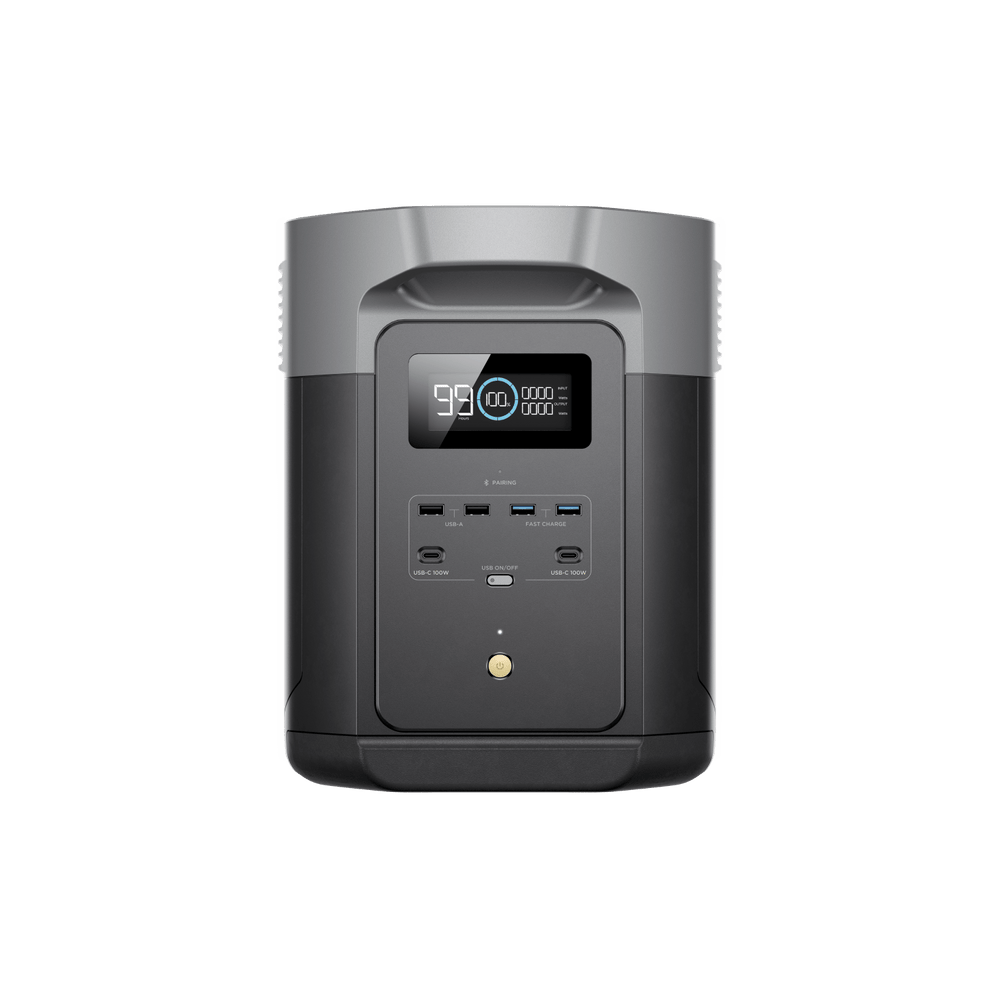
EcoFlow DELTA 2 Max (2,048Wh LiFePO4)
The ultimate balance of high capacity, dual-MPPT solar charging (1,000W total), quiet operation under 30 dB, and expandable storage up to 6,144Wh. Effortlessly runs full-sized refrigerators for over 24 hours.
Check EcoFlow DELTA 2 Max Price →
2. EcoFlow DELTA Pro 3: Heavy-Duty 120V/240V Split-Phase
For homeowners seeking serious blackout immunity, the EcoFlow DELTA Pro 3 packs 4,096Wh of LiFePO4 storage and delivers 4,000W of continuous power with native dual-voltage 120V and 240V output on a single chassis:
- Split-Phase 240V: Powers well pumps, central AC compressors, and electric clothes dryers directly without combining multiple batteries.
- Dual Solar High-Voltage MPPT: Accepts up to 2,600W of solar input (high-voltage port up to 150V, low-voltage port up to 60V).
- Automated EV Recharging: Can be recharged at commercial Level 2 EV charging stations with an optional adapter.
Interactive Sizing and Runtime Calculators
Before purchasing an EcoFlow power station, run your household appliances through our laboratory calculators to see exactly how many hours of blackout protection you can expect:
Simulate Your Appliance Runtimes on EcoFlow Hardware
Input your refrigerator, medical CPAP, microwave, or router wattage into our calibrated simulator to view precise battery duration and expansion pack requirements.
Open Solar Generator Runtime Calculator →
Frequently Asked Questions (FAQ)
Where are EcoFlow power stations manufactured?
EcoFlow designs and engineers its hardware and software in Shenzhen, China (the global epicenter of consumer electronics and drone engineering) and maintains corporate offices, technical support centers, and logistics hubs in North America (San Jose, California), Europe (Düsseldorf, Germany), and Japan.
Is EcoFlow owned by DJI?
No. While EcoFlow was founded by former DJI engineers and executives who utilized their drone battery R&D experience, EcoFlow is an independent private corporation funded by major global venture capital firms, including Sequoia Capital China and GL Ventures.
Can EcoFlow power a full-sized home refrigerator during a blackout?
Yes. A modern refrigerator uses roughly 120W to 180W running power and surges to 1,200W for a split second when starting the compressor. An EcoFlow DELTA 2 Max (2,048Wh) or DELTA Pro effortlessly absorbs the motor startup surge and powers a standard refrigerator for 20 to 28 hours continuously on a single charge.
Does fast charging with X-Stream degrade the battery cells?
No. Modern EcoFlow power stations feature active liquid or high-velocity air-ducted cooling and intelligent BMS temperature throttles. Using automotive-grade LiFePO4 cells, the battery is rated to endure 3,000+ full charge cycles while maintaining at least 80% original capacity, even when frequently fast-charged at high wattages.