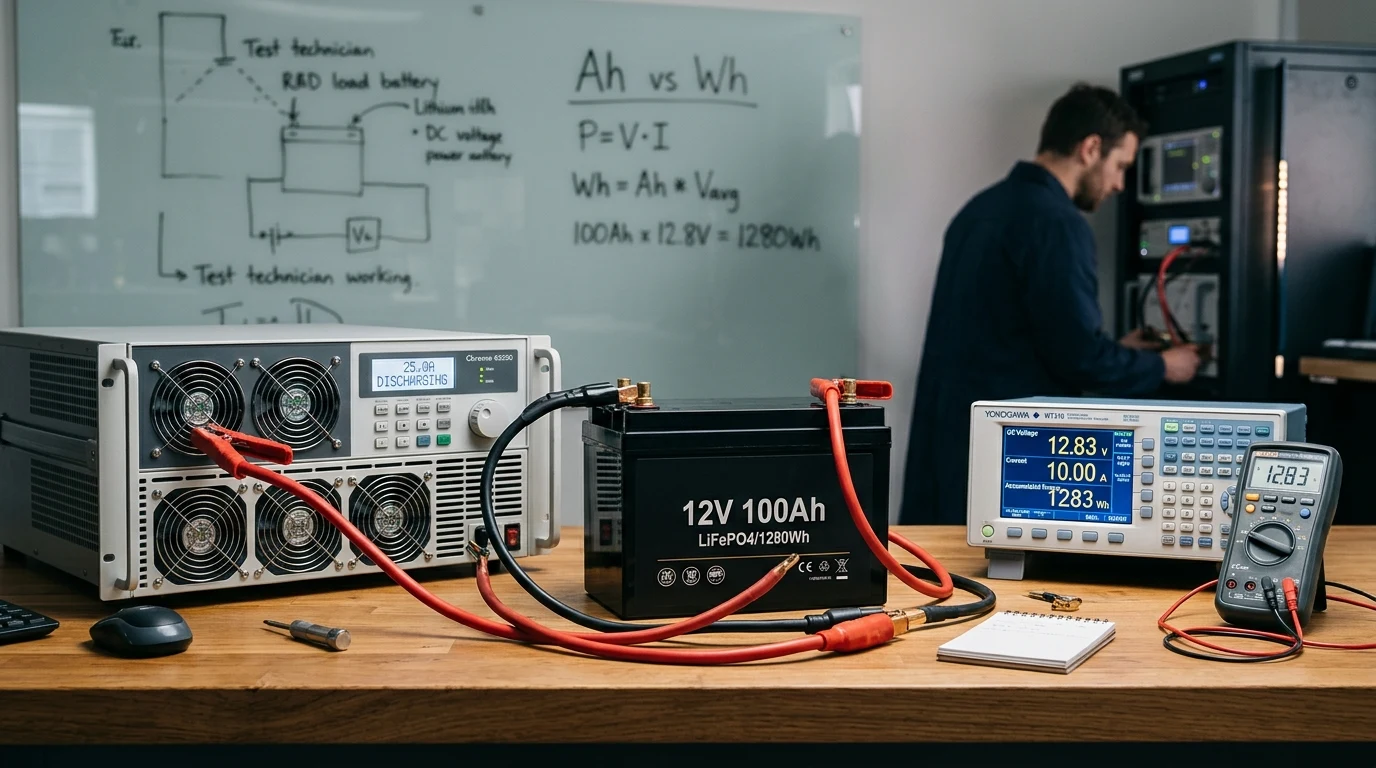
When shopping for portable power stations, sizing off-grid solar panels, or calculating emergency home backup needs, you are immediately bombarded by an alphabet soup of electrical terminology: Watts (W), Watt-Hours (Wh), Amps (A), Volts (V), and Amp-Hours (Ah).
To the uninitiated, these terms seem interchangeable. Sales reps frequently mislabel a 2,000-Watt inverter as a “2,000-Watt battery,” or tell buyers a 100Ah battery can run a refrigerator “for days” without specifying system voltage.
Confusing these metrics is the single most common cause of failed DIY solar installations, undersized battery banks, and tripped circuit breakers.
In this first-principles engineering guide, we break down exactly what Watts are, how they relate to Volts and Amps, how to measure real-world electrical consumption, and how to accurately calculate runtimes for any household appliance.
Electrical Pressure
The force pushing electrons through a circuit. Think of water pressure in a garden hose. Standard US household sockets are 120V.
Formula: V = Watts / Amps
Electron Flow Rate
The volume of electrons passing a given point per second. Equivalent to gallons of water flowing through a pipe per minute.
Formula: I = Watts / Volts
Rate of Doing Work
Instantaneous rate at which energy is consumed or generated. Product of electrical pressure (V) and current volume (A).
Formula: P = Volts × Amps
Power Over Time
The cumulative amount of work done over a specific duration. 1,000 Watt-Hours equals 1 Kilowatt-Hour (kWh).
Formula: Wh = Watts × Hours
The First-Principles Definitions: Volts, Amps, and Watts
To visualize how electricity behaves, engineers use the hydraulic (water pipe) analogy. Imagine water flowing through a closed plumbing system into a water wheel:
Voltage: The Electrical Pressure
Voltage () measures electrical potential difference. It represents the “push” or pressure forcing electrons through a conductor.
- High voltage means high pressure.
- A standard AA alkaline battery provides 1.5 Volts.
- A standard RV or camper van battery bank is 12 Volts.
- A home solar server-rack storage bank is 48 Volts.
- A standard North American household wall outlet delivers 120 Volts AC.
- Heavy electric clothes dryers, well pumps, and EV chargers use 240 Volts AC split-phase.
Amperage: The Rate of Electron Flow
Amperage ( or ) measures electrical current. One Ampere represents electrons flowing past a given point in a conductor each second.
- In the plumbing analogy, Amps correspond to the gallons-per-minute flowing through the pipe.
- A thick wire can carry high amperage with low resistance; forcing high amperage through a thin wire causes severe friction, producing dangerous heat and voltage drops.
Wattage: The Rate of Doing Work
Wattage ( or ) is named after Scottish inventor James Watt. It is the fundamental metric of real electrical power—the rate at which electrical energy is transformed into light, heat, mechanical motion, or magnetic fields.
Under Watt’s Law, Power equals Voltage multiplied by Current:
Real-World Examples:
- A 120V household blender drawing 5 Amps consumes:
  120V × 5A = 600 Watts

- A 12V camper van roof vent fan drawing 3 Amps consumes:
  12V × 3A = 36 Watts

- An electric vehicle fast-charger operating at 400V DC and 150 Amps delivers:
  400V × 150A = 60,000 Watts (60 kW)
Watts vs Watt-Hours: The Speedometer vs Odometer Analogy
The single greatest source of battery sizing failure is confusing Watts (Power) with Watt-Hours (Energy).
To master this distinction, use the automobile analogy:
- Watts (W) = Speedometer (Miles per Hour): Tells you how fast energy is being consumed at this exact second. It is an instantaneous rate.
- Watt-Hours (Wh) = Odometer (Miles Driven): Tells you the total cumulative amount of energy consumed or stored over a period of time.
Where is energy in Watt-Hours, is continuous power in Watts, and is time in hours.
A microwave draws a massive 1,500 Watts while heating a cup of soup, but it runs for only 2 minutes (0.033 hours).
Energy Used: 1,500W × 0.033h = 50 Watt-Hours (Wh)
A medical CPAP draws a modest 60 Watts, but operates continuously through the night for 8 full hours.
Energy Used: 60W × 8h = 480 Watt-Hours (Wh)
Notice that even though the microwave draws twenty-five times more instantaneous wattage than the CPAP, the CPAP consumes nearly ten times more total battery energy because of its prolonged runtime.
AC vs DC Wattage and Power Factor
In direct current (DC) circuits—such as solar panels feeding a charge controller, or a battery feeding a 12V refrigerator—power calculation is linear ().
In alternating current (AC) circuits, the voltage and current oscillate as sine waves 60 times per second (60Hz). While pure resistive loads (like incadescent lightbulbs, electric space heaters, and curling irons) have voltage and current in perfect phase, inductive motor loads (refrigerators, air conditioners, power tools, well pumps) create phase displacement.
This phase displacement introduces Power Factor ():
- Resistive Loads: . Real Power (Watts) equals Apparent Power (Volt-Amps).
- Inductive Compressor Loads: to .
If your refrigerator consumes 150 real Watts at a Power Factor of , the total apparent load on your inverter is:
Your inverter must deliver 200VA of switching capacity to produce 150W of mechanical cooling work.
Starting Surge Watts (Locked Rotor Amps)
Electric motors require a massive burst of energy to break physical inertia and begin spinning from a dead stop. This transient spike is called Locked Rotor Amps (LRA).
During the first 20 to 100 milliseconds of startup, compressor motors draw 3x to 6x their continuous running wattage. A refrigerator that runs continuously on 120W will surge to 600W–900W when the compressor kicks on. Always choose an inverter with 2x to 3x surge headroom to avoid overload lockouts.
Comprehensive Household Appliance Power Reference Table
| Household Appliance | Continuous Running Watts | Starting Surge Watts | Typical Daily Usage | Daily Energy (Watt-Hours) |
|---|---|---|---|---|
| LED Lightbulb (60W Equiv) | 9W | 9W (None) | 6 hours | 54 Wh |
| Smartphone (USB-C Fast Charge) | 20W | 20W (None) | 2 hours | 40 Wh |
| Starlink Satellite Internet | 65W | 100W | 24 hours | 1,560 Wh |
| ResMed AirSense 11 CPAP (DC) | 35W | 35W (None) | 8 hours | 280 Wh |
| Energy Star Refrigerator | 120W (35% duty cycle) | 800W | 24 hours | 1,008 Wh |
| Microwave Oven | 1,400W | 1,600W | 0.3 hours (18 min) | 420 Wh |
| Sump Pump (1/2 HP Submersible) | 900W | 2,700W (LRA) | 1.5 hours | 1,350 Wh |
| Space Heater (High Setting) | 1,500W | 1,500W (None) | 4 hours | 6,000 Wh |
| Inverter Standby Tare Loss | 35W | 35W (None) | 24 hours | 840 Wh |
Top Recommended Power Auditing & Energy Management Gear
Accurately evaluating your wattage needs requires moving past manufacturer nameplate estimates and measuring physical load draws on your bench. Here are three benchmark diagnostic instruments evaluated by GridSpecLab:
1. Klein Tools CL800 Digital AC/DC Clamp Meter (Bench & Inverter Diagnostics)
The Klein Tools CL800 is the gold standard for diagnosing DC battery cables, solar string currents, and AC branch circuits without cutting wires.
Klein Tools CL800 Auto-Ranging Digital Clamp
Features True Root Mean Square (TRMS) measurement technology, dedicated low-impedance (LoZ) mode to eliminate ghost voltages, and measures up to 600A AC/DC current directly through its clamp jaws.
Check Current Price on Amazon →
2. P3 Kill A Watt P4400 Electricity Usage Monitor (Appliance Auditing)
For measuring standard 120V household appliances (refrigerators, televisions, CPAP machines, and microwave ovens), the Kill A Watt P4400 is an indispensable, inexpensive plug-in wattmeter.
P3 Kill A Watt P4400 Electricity Monitor
Plugs directly between your wall outlet and appliance to display real-time Volts, Amps, Watts, and Power Factor. Accumulates Kilowatt-Hours over days to accurately calculate true compressor duty cycles.
Check Kill A Watt Availability →
3. EcoFlow DELTA 2 Max Power Station (Live Digital Wattage Feedback)
If you prefer an all-in-one backup solution that displays real-time input and output wattage with sub-second accuracy, the EcoFlow DELTA 2 Max is a premier learning and resilience station.
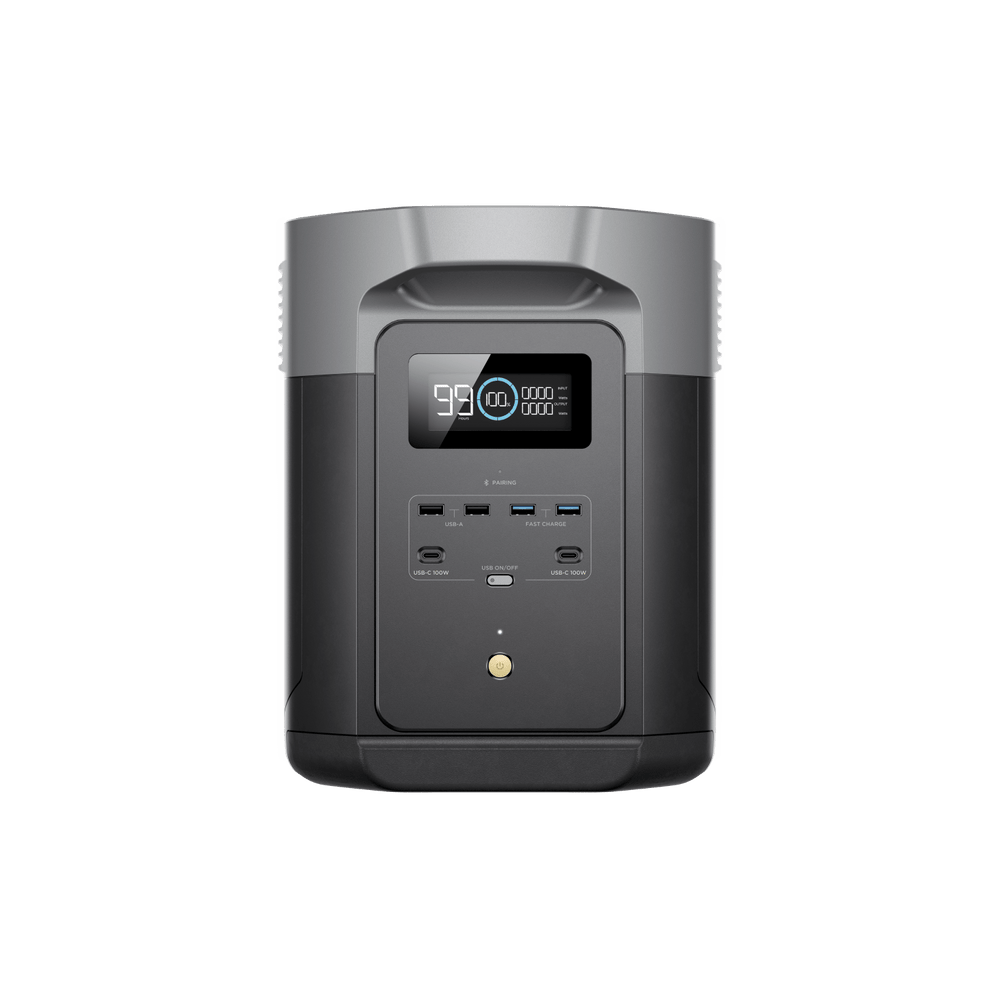
EcoFlow DELTA 2 Max (2,400W Inverter)
Features a vibrant front LCD telemetry screen and smartphone app displaying exact real-time AC/DC discharge wattage, solar charging input, and dynamically calculated time-to-empty hours down to the minute.
Explore EcoFlow DELTA 2 Max Deals →
Critical Power Usage Mistakes to Avoid
Using Rated Nameplate Watts Instead of Measured Watts
A refrigerator’s manufacturer sticker lists maximum electrical safety ratings (e.g. 120V at 6.5A = 780W). However, during continuous operation, the compressor draws only 110W to 140W. Sizing your battery bank off the 780W nameplate label will cause you to spend thousands of dollars on unneeded battery capacity. Always measure real-world consumption with a wattmeter.
Ignoring Inverter Standby Tare Loss
Every AC inverter consumes parasitic tare loss just keeping internal capacitors, MOSFETs, and cooling fans energized. A 3,000W inverter consumes 35W to 55W in standby. Over a single 24-hour cycle, an idling inverter burns 840Wh to 1,320Wh of stored battery power before powering a single household device.
Forgetting Voltage Drop Across Long Extension Cords
Plugging a 1,500W space heater or microwave into an inexpensive 50-foot 16 AWG extension cord causes severe electrical resistance. Voltage at the appliance drops from 120V down to 108V, causing high resistive heating inside the cord, creating an extreme fire hazard and triggering premature inverter low-voltage cutoffs.
Disregarding Inductive Motor Surges
Purchasing a 1,000W continuous inverter to run an 800W well pump or table saw will instantly trip the inverter’s overload breaker. Inductive electric motors demand 3x to 6x their running wattage during the first 100ms of startup. Always select inverters with ample momentary surge headroom.
Frequently Asked Questions (FAQ)
What is the difference between Watts and Volt-Amps?
Watts () measure real, active power that performs physical work (light, heat, motion). Volt-Amps () measure apparent power—the total vector sum of active power and reactive power in an AC circuit. For purely resistive loads (like lightbulbs), Watts equal Volt-Amps. For inductive loads (compressors, motors), Volt-Amps are higher than Watts due to phase displacement.
How do I convert Amp-Hours to Watt-Hours?
To convert Amp-Hours (Ah) to Watt-Hours (Wh), multiply Amp-Hours by the nominal system voltage (). For example, a 12V 100Ah battery contains 1,200 Watt-Hours (), whereas a 48V 100Ah server rack battery contains 4,800 Watt-Hours ().
How many Watts does a typical house use?
An average North American single-family home consumes between 1,000 and 2,500 continuous running Watts during baseline hours (refrigeration, lighting, electronics, Wi-Fi). However, when heavy 240V appliances turn on (central air conditioning, electric clothes dryers, well pumps, or EV chargers), total instantaneous power draw can spike between 8,000 and 15,000 Watts.
Why does my power station show wattage output when nothing is plugged in?
If your power station’s AC button is switched on, the internal pure sine wave inverter is actively transforming low-voltage DC battery power into 120V AC electricity. This baseline parasitic power consumption is called standby tare loss (typically 15W to 45W depending on inverter size).