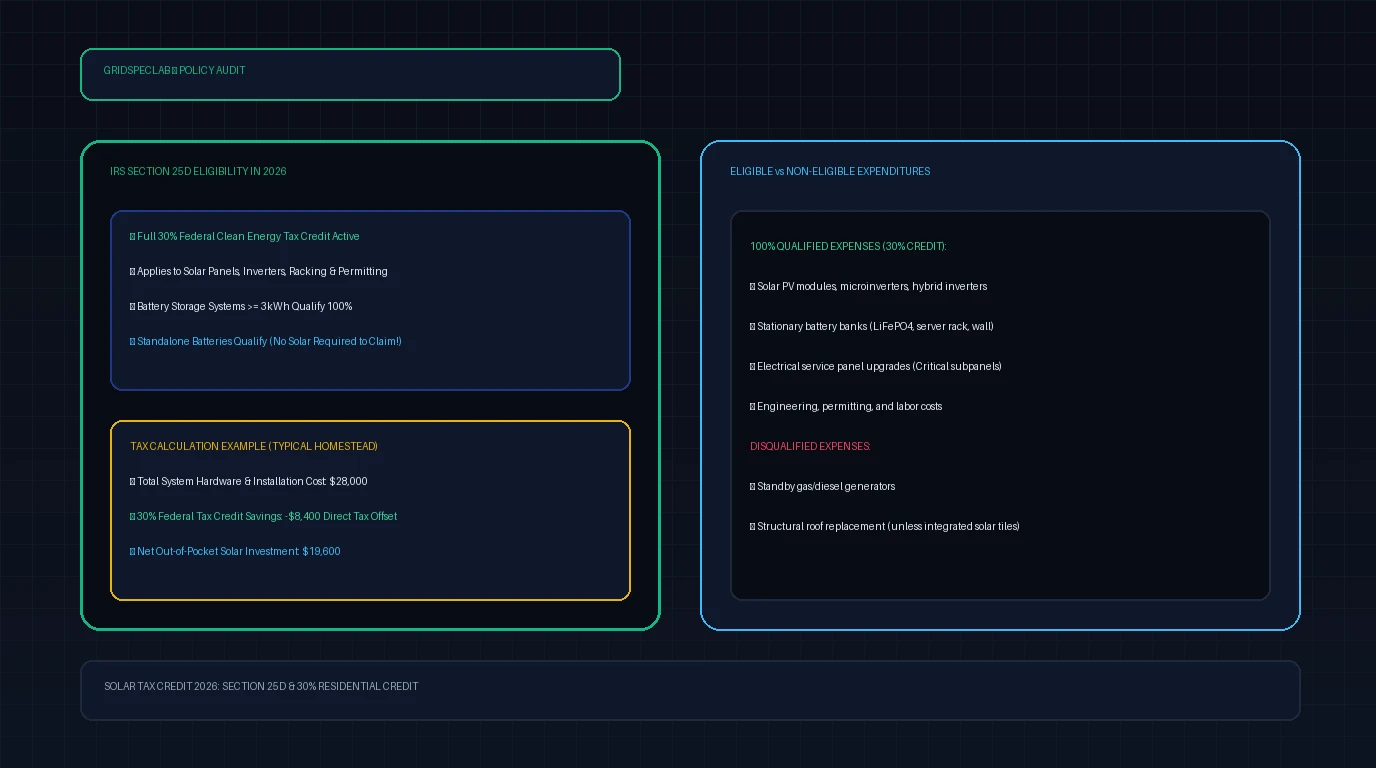
With shifting political administrations, sensationalist social media headlines, and aggressive door-to-door solar sales pitches warning that “incentives end this month,” confusion surrounding the Federal Solar Tax Credit in 2026 is at an all-time high.
Every week, our engineering team receives questions from homeowners, DIY off-grid builders, and emergency prep buyers asking:
- Is the 30% federal solar tax credit dead in 2026?
- Do standalone portable power stations and batteries qualify?
- Can I claim the 30% credit if I purchase and install a DIY solar kit myself?
In this definitive guide, we cut through sales hype and political rumors. We examine the exact statutory language of Section 25D of the Internal Revenue Code (26 U.S.C. § 25D), the 3kWh standalone battery capacity rule, IRS Form 5695 claiming protocols, and which solar hardware qualifies for thousands of dollars in direct tax savings.
2022 – 2032
Full 30% nonrefundable federal tax credit applied to total equipment and installation costs for solar PV and 3kWh+ batteries.
2033 Calendar Year
Statutory step-down takes effect on January 1, 2033, reducing credit value to 26% of qualified expenditure.
2034 Calendar Year
Second step-down reduces credit to 22% for equipment placed in service during the 2034 tax year.
January 1, 2035
The Section 25D residential credit terminates completely on December 31, 2034, unless reauthorized by Congress.
The Big Myth: Is the 30% Solar Tax Credit Dead?
The short answer is NO. The 30% federal solar tax credit is alive, active, and fully codified in federal law.
Under the Inflation Reduction Act of 2022 (Public Law 117-169), Congress amended Section 25D of the Internal Revenue Code, officially titled the Residential Clean Energy Property Credit. This legislation explicitly locked the credit rate at 30% through December 31, 2032.
What Caused the Confusion?
- Misleading Sales Tactics: Unscrupulous solar leasing salespeople routinely use false “urgency closes,” claiming incentives expire at the end of the current quarter to force signatures on high-interest loans.
- Commercial Section 48 vs Residential Section 25D: Some commercial project tax credits (Section 48) feature wage and apprenticeship requirements that shift periodically. However, Section 25D for residential homeowners has zero prevailing wage requirements and remains steady at 30%.
- Political Posturing: While debates over federal spending occur regularly on Capitol Hill, retroactively eliminating enacted tax credits requires bicameral congressional legislation signed by the President. As of 2026, Section 25D remains the law of the land.
The Standalone Battery Storage Rule: The 3kWh Threshold
The single most impactful revision to Section 25D in recent history is the inclusion of standalone residential battery storage.
Prior to 2023, you could only claim the federal tax credit on a battery if it was charged 100% by an on-site solar array. Homeowners who wanted a battery solely for emergency backup or peak-shaving were left out.
Under current IRS guidelines:
IRS Section 25D(a)(6): Qualified battery storage technology property expenditures are eligible for a 30% credit, defined as equipment with a capacity of not less than 3 kilowatt-hours (3kWh) installed in connection with a dwelling unit used as a residence by the taxpayer.
What Does the 3kWh Rule Mean for You?
- No Solar Panels Required for the Battery Credit: You can purchase a 5kWh to 15kWh home energy storage system (such as an EG4 PowerPro, Tesla Powerwall, or Anker SOLIX system), charge it from the utility grid during off-peak hours, and still claim the full 30% federal tax credit on the equipment.
- Portable Power Stations with Expansion Batteries: A single 2,000Wh (2kWh) power station does not meet the 3kWh threshold on its own. However, if you purchase a 2kWh base console bundled with a 2kWh expansion battery (totaling 4,000Wh / 4kWh) and integrate it into your home’s electrical panel via a manual transfer switch, the entire bundle exceeds 3kWh and qualifies.
- DIY 48V Server Rack Batteries: Standard 48V 100Ah server rack batteries are rated at 5.12kWh (5,120Wh). A single server rack battery effortlessly clears the 3kWh threshold.
Claiming the Credit on DIY Solar Kits & Off-Grid Systems
One of the most persistent misconceptions is that you must hire a licensed solar contractor or company to qualify for the 30% tax credit.
The IRS does not require professional installation to claim Section 25D. DIY homeowners who purchase equipment and install it themselves are fully eligible.
Eligible vs Ineligible DIY Expenses
Eligible Equipment (100% Qualified for 30% Credit)
- Solar Photovoltaic Panels: Rigid, portable, or bifacial modules.
- Inverters & Charge Controllers: Off-grid, hybrid, microinverters, and MPPTs.
- Battery Storage (3kWh+): Server racks, wall-mounts, and expansion packs.
- Balance of Systems (BOS): Racking, solar ground mounts, combiner boxes.
- Electrical Hardware: DC breakers, Class T fuses, conduit, and heavy gauge wire.
- Permitting & Engineering Fees: Municipal permit costs and professional blueprint stamps.
Ineligible Expenses (Cannot Be Claimed)
- Your Personal DIY Labor: The IRS strictly forbids claiming the value of your own time or labor hours.
- Tools & Equipment Purchases: Crimpers, torque wrenches, drills, or safety ladders.
- General Roof Replacement: Replacing standard asphalt shingles prior to solar mounting is excluded (unless specific solar shingle technology).
- Fossil Fuel Backup Generators: Dual-fuel or gas/propane generators are ineligible under Section 25D.
- Batteries Under 3kWh: Small camping batteries under 3,000Wh rated capacity.
First-Principles Tax Math: Real-World Savings Scenarios
The federal solar tax credit is a nonrefundable tax credit, not a deduction. A tax deduction simply reduces your taxable income, whereas a tax credit reduces your actual tax liability dollar-for-dollar.
The calculation model is:
Three Real-World Cost Breakdowns
| System Type & Hardware | Gross Capital Cost | 30% Federal 25D Credit | Net Real Cost to You |
|---|---|---|---|
| DIY Off-Grid Homestead (EG4 18kPV + 30kWh Storage + 10kW Solar) | $16,500 | -$4,950 | $11,550 |
| Standalone Home Battery Backup (Anker F3800 + 2 Expansion Packs = 11.5kWh) | $7,499 | -$2,249.70 | $5,249.30 |
| Off-Grid Cabin Bundle (Signature Solar 6000XP + 14.3kWh Battery + 4.8kW Solar) | $8,995 | -$2,698.50 | $6,296.50 |
[!TIP] What if your tax liability is less than the credit? If you earn a $4,950 credit but only owe $3,200 in federal income taxes for the year, you don’t lose the remaining $1,750! Under Section 25D(c), unused solar tax credits carry forward to the following tax year indefinitely until fully exhausted.
Top Equipment Recommendations Qualified for the 30% Credit
To maximize your 30% federal write-off while investing in tier-1 solar hardware, here are three proven systems that effortlessly meet all IRS capacity and efficiency standards:
1. Signature Solar EG4 Complete 48V Off-Grid Kit (30% Equipment Write-Off)
For DIY homesteaders and off-grid builders looking for a complete turnkey whole-home solution, Signature Solar’s pre-matched kits provide itemized invoices that make IRS Form 5695 documentation completely frictionless.
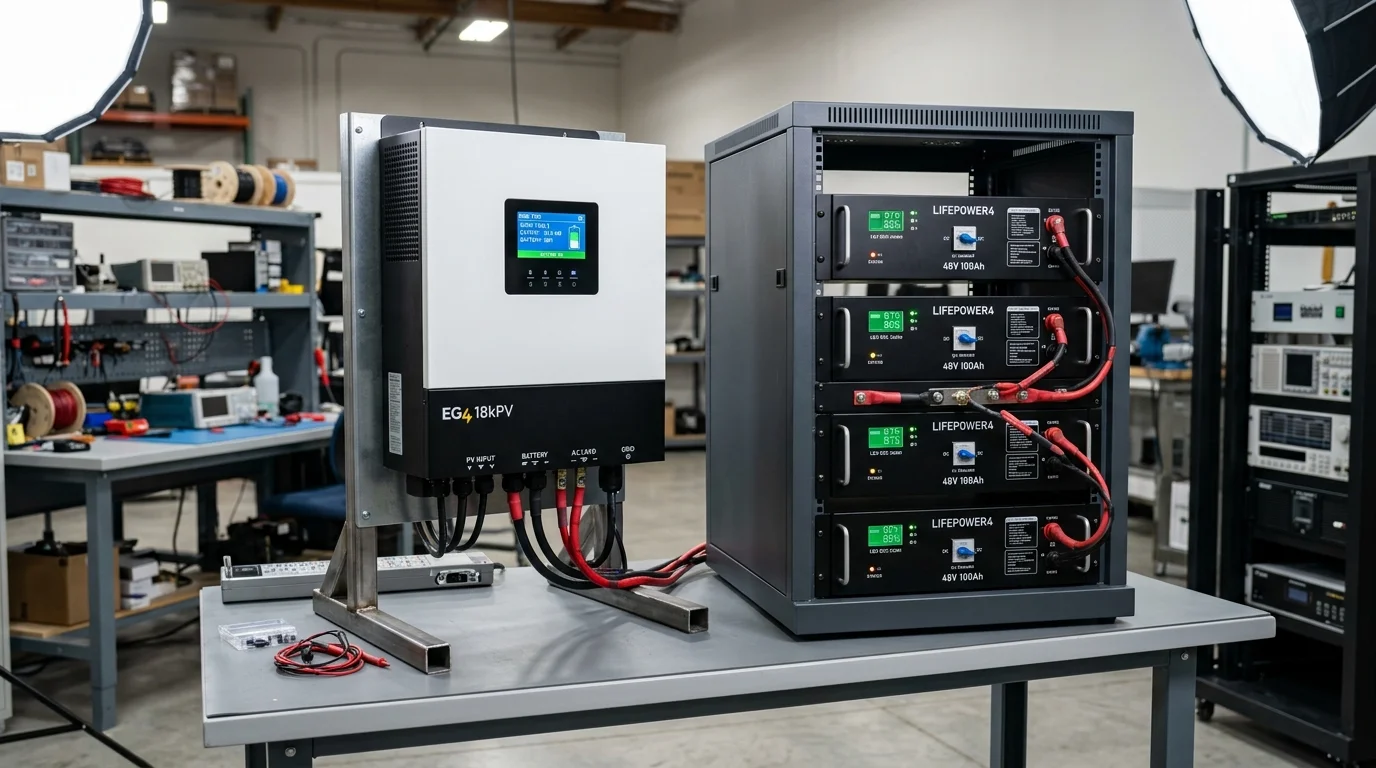
Signature Solar EG4 Complete Solar System
Combines an EG4 6000XP or 18kPV hybrid inverter, high-efficiency bifacial solar panels, an EG4 PowerPro 14.3kWh wallmount LiFePO4 battery, and pre-wired breakers. 100% of equipment cost qualifies for the 30% tax credit.
Explore Tax-Credit Eligible Solar Kits →
2. Anker SOLIX F3800 + Expansion Battery Bundle (7.68kWh Standalone Battery Storage)
If you need whole-home emergency power with zero roof mounting, the Anker SOLIX F3800 base station (3,840Wh) clears the 3kWh standalone battery threshold on its own. Pairing it with an expansion battery creates a 7.68kWh residential storage powerhouse.

Anker SOLIX F3800 Home Energy System
Armed with native 120V/240V split-phase output and a NEMA 14-50 plug that links directly to a home transfer switch. Qualifies for the 30% credit as standalone residential battery storage without requiring permanent solar panels.
Check Current Anker SOLIX Promotions →
3. EcoFlow DELTA Pro 3 + Smart Extra Battery Bundle (8.19kWh Home ESS)
The EcoFlow DELTA Pro 3 features 4,096Wh of base LiFePO4 storage. Adding one Smart Extra Battery doubles capacity to 8,192Wh (8.19kWh), delivering multi-day whole-home resilience that fully qualifies for Section 25D write-offs.

EcoFlow DELTA Pro 3 Home ESS Bundle
Delivers 4,000W of continuous dual-voltage 120V/240V power with whisper-quiet cooling and 2,600W solar charging. Connects to the EcoFlow Smart Home Panel 2 or manual transfer switch for seamless sub-20ms emergency failover.
View EcoFlow DELTA Pro 3 Bundles →
Step-by-Step Guide to Filing IRS Form 5695
Claiming the 30% solar and battery credit is straightforward and does not require complex tax preparation software. Here is how to claim it on your annual tax return:
- Retain Itemized Receipts: Keep all itemized equipment receipts, invoices, and spec sheets showing the model number and battery capacity (in Wh or kWh).
- Download IRS Form 5695: Form 5695 is titled Residential Energy Credits. Part I covers the Section 25D clean energy property credits.
- Report Qualified Expenditures:
- Line 1: Enter total qualified solar electric property costs (panels, inverters, racking, balance-of-systems).
- Line 5b: Enter qualified battery storage technology property costs (batteries with 3kWh or greater capacity).
- Calculate 30% Credit: Sum your eligible expenses on Line 6a and multiply by 30% () on Line 6b.
- Transfer to Form 1040: Transfer your final calculated credit to Schedule 3 (Form 1040), Line 5, which reduces your total federal tax balance due dollar-for-dollar.
Critical Solar Tax Mistakes to Avoid
Claiming Under-3kWh Camping Batteries
A small 1,000Wh (1kWh) or 2,000Wh (2kWh) portable power station does not qualify as standalone battery storage under Section 25D(a)(6). Attempting to write off a standalone 1kWh battery without meeting the statutory 3kWh threshold triggers IRS audit disallowances.
Signing Leases or Power Purchase Agreements (PPAs)
If you lease solar panels or sign a third-party PPA from a door-to-door solar installer, you do not own the system. Under IRS rules, the third-party leasing corporation claims the 30% tax credit, not you. You only qualify for the credit if you purchase the system with cash or a direct loan.
Deducting Your Personal DIY Labor
While you can claim 100% of the cost of contractor labor if you hire a licensed electrician, the IRS strictly prohibits imputing a dollar value to your own sweat equity. You can only claim the physical equipment, hardware, wiring, and permitting fees.
Failing to Carry Over Excess Credits
Many taxpayers mistakenly believe that if their calculated 30% credit exceeds their tax liability for the filing year, the remaining amount is lost. Section 25D includes an explicit carry-forward provision: unapplied credits roll into future tax years indefinitely until fully redeemed.
Frequently Asked Questions (FAQ)
Does the solar tax credit apply to off-grid cabins and second homes?
Yes! Section 25D applies to equipment installed in connection with any dwelling unit used as a residence by the taxpayer. This includes your primary home, a vacation cabin, or a second home. However, it cannot be claimed on rental properties that you do not personally reside in (rental units must be claimed under commercial Section 48 rules).
Can I claim the credit if I install solar panels on an RV or camper van?
Under IRS guidelines, an RV, camper van, or boat can qualify as a second home if it contains basic sleeping, cooking, and toilet facilities. If you use the vehicle as a personal residence, solar and battery systems installed on it generally qualify for Section 25D.
Is there a maximum dollar cap on the 30% residential clean energy credit?
No! Unlike energy efficiency improvements (like windows or insulation under Section 25C, which have annual caps), the Section 25D Residential Clean Energy Credit has zero dollar limit. Whether your qualified solar and battery system costs $5,000 or $50,000, you receive a full 30% credit ($1,500 to $15,000).
What documentation should I keep in case of an IRS audit?
Keep itemized merchant receipts showing purchase dates, product serial numbers, manufacturer spec sheets proving battery capacity (), and receipts for all balance-of-systems hardware (wire, fuses, breakers, mounting racks). You do not need to attach these receipts to Form 5695, but you must retain them with your tax records.