When extreme weather downs utility lines, a transformer blows, or a regional grid failure occurs, modern households face an abrupt reality: our water supply, food preservation, communication, and medical equipment are 100% dependent on continuous electrical current.
For decades, traditional gas generators were the default emergency backup choice. But anyone who has lived through a prolonged hurricane, ice storm, or wildfire knows their severe logistical bottlenecks:
- Carbon Monoxide Hazard: Gas generators cannot be run indoors, in garages, or near open windows, causing hundreds of fatal poisonings during disasters every year.
- Fuel Supply Collapse: During major regional blackouts, gas station fuel pumps have no electricity to operate, and long lines rapidly exhaust remaining reserves.
- Fuel Spoilage: Gasoline degrades into varnish within 3 to 6 months without stabilizers, clogging carburetors exactly when you need power most.
- Acoustic Signature: Roaring at 70 to 85 decibels, gas generators advertise your power reserves across the neighborhood.
Modern solar emergency backup systems eliminate these failure points entirely. Built around safe Lithium Iron Phosphate (LiFePO4) chemistry and high-efficiency MPPT solar charging, they operate silently inside your living room and replenish daily energy for free directly from the sun.
In this guide, we simplify emergency solar prep into an actionable, step-by-step engineering framework designed for everyday homeowners and disaster preparedness planners.
Hour 0 – 12 Baseline
Non-negotiable electrical circuits required for personal safety, emergency communications, and life support.
- CPAP / Medical monitors (30W–60W)
- Smartphones & satellite radios (15W–30W)
- LED emergency lighting (10W–20W)
Hour 12 – 48 Defense
Preventing thousands of dollars in spoiled food and defending home foundations from basement flooding.
- Full-size refrigerator (1,000Wh–1,400Wh/day)
- Deep chest freezer (600Wh–900Wh/day)
- Basement sump pump (500Wh–1,000Wh/day)
Extended Day 3+ Outages
Circuits operated strictly when solar input is actively generating surplus daytime harvesting.
- Countertop microwave (1,400W pulse)
- Single-burner induction stove (800W–1,200W)
- Box fans or 12V diesel heaters (40W–80W)
Performing an Emergency Energy Audit
Before spending a dollar on solar equipment, calculate exactly how many watt-hours of electrical energy your household consumes each day under emergency rationing conditions.
The formula for daily energy demand is:
Where:
- = Continuous running wattage of appliance (Watts).
- = Total operating hours per 24-hour cycle (Hours).
Typical Disaster Scenario Power Budget
| Appliance | Running Draw (Watts) | Daily Hours (Hours) | Daily Consumption (Wh) | Power Rationing Strategy |
|---|---|---|---|---|
| ResMed CPAP (Humidifier Off) | 35W | 8 hrs | 280 Wh | Turn off heated tube to cut power by 65% |
| Energy Star Refrigerator | 120W (35% duty cycle) | 24 hrs | 1,008 Wh | Keep door sealed; cycle 45 min on / 90 min off |
| Smartphones (2 devices) | 20W | 3 hrs | 60 Wh | Charge directly via DC USB-C ports |
| Wi-Fi Router / Starlink Mini | 25W | 10 hrs | 250 Wh | Power off overnight during sleep |
| LED Room Lighting (2 lamps) | 16W total | 5 hrs | 80 Wh | Use low-lumen warm LED bulbs |
| Inverter Standby Tare Loss | 25W continuous | 24 hrs | 600 Wh | Power off AC circuit when not running loads |
| Total Daily Demand () | — | — | 2,278 Wh (2.28 kWh) | — |
[!IMPORTANT] The CPAP Pro-Tip: Running a medical CPAP machine through the 120V AC wall plug with heated tubing and humidification consumes 90W to 120W, draining a 1,000Wh battery in a single night. Switching to a direct 12V or 24V DC cigarette cable and disabling heated humidification slashes power draw to 25W–35W, tripling your survival runtime.
Calculating Battery Runtime and Autonomy
Once your daily emergency budget is established, calculate the minimum battery storage capacity required to bridge days when heavy rain, clouds, or winter storms prevent solar generation.
The formula for emergency battery runtime is:
Where:
- = Rated nominal battery capacity in Watt-Hours (Wh).
- = Usable Depth of Discharge ( to for LiFePO4 vs for legacy AGM lead-acid).
- = Inverter conversion efficiency ( to ).
- = Average continuous power draw (Watts).
Battery Sizing by Outage Duration
To survive without running a noisy backup generator:
- 24-Hour Emergency Buffer: (One 2kWh to 3kWh power station).
- 48-Hour Extended Outage (2 Days of Autonomy): Requires 5,600 Wh to 6,000 Wh of total storage (e.g., an expandable base station plus one expansion battery).
Review our comprehensive guide on Sizing Battery Capacity for Your Solar Power System for full calculations.
Sizing the Solar Replenishment Array
A battery without solar charging is simply a countdown timer. To make your emergency power truly sustainable across weeks of grid failure, your solar panels must harvest enough power during daytime sun hours to replenish the previous 24 hours of electrical consumption.
The master equation for required solar array wattage is:
Where:
- = Daily energy demand (e.g., 2,278 Wh).
- = Available full-sun equivalent hours (typically 3.0 to 4.5 hours in summer, dropping to 2.0 to 3.0 hours in winter).
- = Real-world system efficiency derate factor (typically to to account for panel heat, dust, and wire resistance).
Real-World Calculation
Assuming an emergency daily draw of 2,278 Wh and a winter storm recovery scenario with 3.0 Peak Sun Hours:
To achieve daily energy equilibrium, you would need approximately one 1,000W array (e.g., five 200W portable panels or three 400W rigid ground-mount panels).
Top-Tier Emergency Solar Power Hardware
Based on real-world engineering teardowns and laboratory discharge stress tests, here are three proven emergency solar solutions tailored for disaster preparedness:
1. EcoFlow DELTA 2 Max + 400W Solar Kit (Essential Family Backup)
The EcoFlow DELTA 2 Max is the premier plug-and-play solution for suburban homes and apartments preparing for sudden 24- to 72-hour grid disruptions.
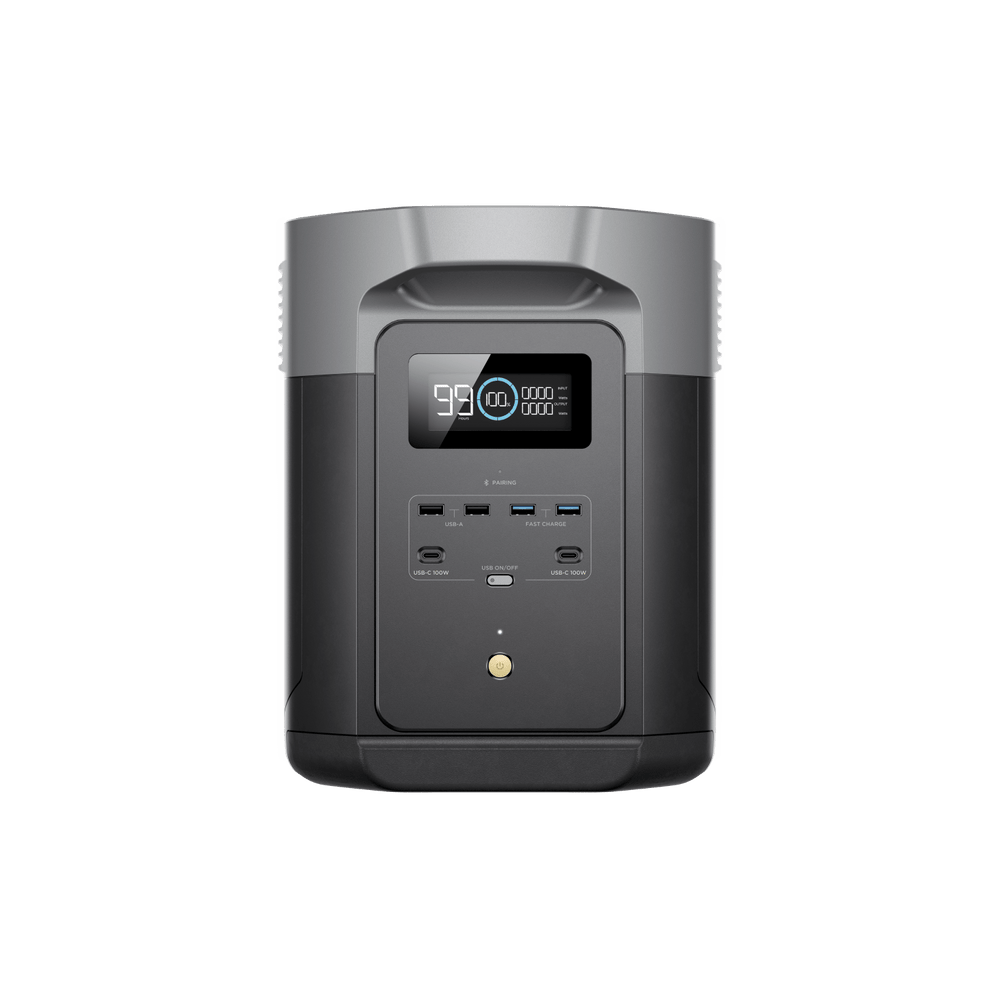
EcoFlow DELTA 2 Max Solar Bundle
Features a 2,400W pure sine wave inverter (4,800W surge) capable of starting stubborn refrigerator compressors. Boasts dual independent 500W MPPT solar inputs (1,000W total) that fully recharge the unit in under 2.5 hours of sunlight.
Check Current DELTA 2 Max Bundles →
2. Anker SOLIX F3800 + Home Backup Kit (Whole-Home 240V Powerhouse)
For homeowners who must keep 240V well pumps, central mini-split heat pumps, and electric water heaters operational during multi-day disaster declarations, the Anker SOLIX F3800 is an industrial-grade mobile plant.

Anker SOLIX F3800 Emergency System
Native 120V/240V split-phase output with a standard NEMA 14-50R outlet that connects directly into your home’s manual generator transfer switch. Supports up to 2,400W of direct solar PV input and direct EV vehicle charging.
View Anker SOLIX F3800 Deals →
3. Bluetti AC200L Emergency Solar Bundle (Best Value 2kWh)
If your goal is achieving 2,000Wh of reliable LiFePO4 emergency backup without paying premium brand markups, the Bluetti AC200L delivers best-in-class solar charging specifications per dollar.
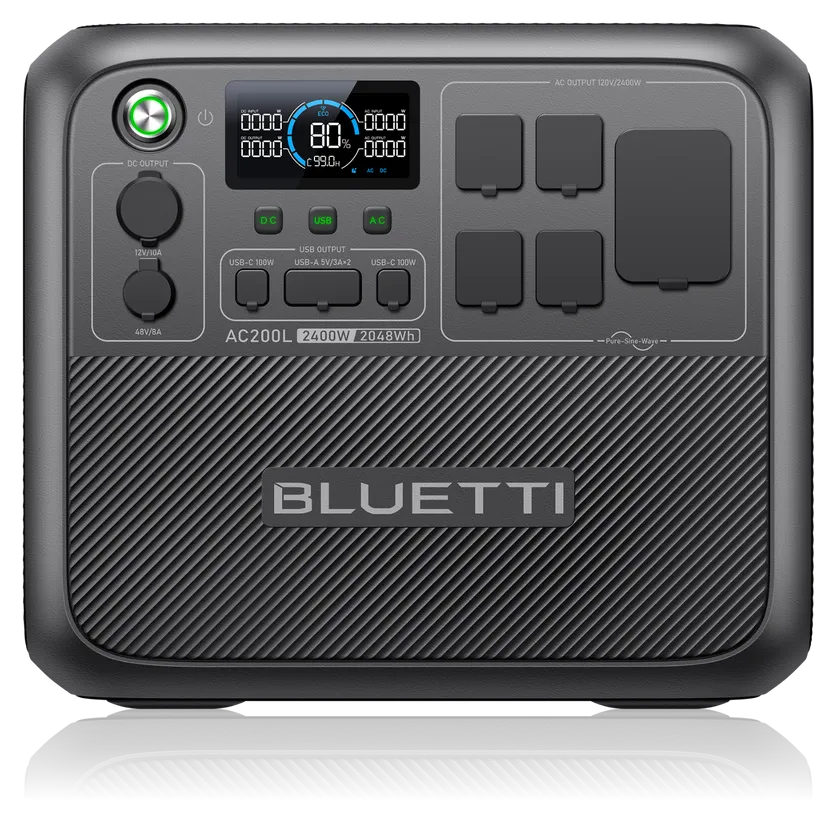
Bluetti AC200L Solar Generator
Armed with a high-voltage 12V–145V single MPPT solar controller capable of accepting up to 1,200W of solar input. Seamlessly powers refrigerators, medical equipment, and microwave pulses through its 2,400W pure sine wave inverter.
Check Bluetti AC200L Pricing →
Critical Emergency Prep Mistakes to Avoid
Assuming Rooftop Solar Works in Blackouts
Over 85% of residential grid-tied rooftop solar installations have no battery storage. Under IEEE 1547 and UL 1741 safety standards, grid-tied string inverters immediately shut down when utility power drops to protect linemen working on downed wires (anti-islanding). Without batteries, a 10kW roof generates zero emergency electricity.
Storing Batteries at 0% or 100% in Freezing Garages
Lithium batteries stored flat at 0% experience copper dendrite short-circuits that permanently brick internal cells. Conversely, storing cells at 100% in sub-zero winter garages accelerates electrolyte oxidation. Store emergency batteries between 50% and 70% State of Charge at room temperature, topping them up to 100% 24 hours prior to forecast storms.
Leaving the AC Inverter Switched On 24/7
Every power station’s AC inverter consumes 20W to 45W in constant standby tare loss simply keeping internal switching transistors energized. Leaving the AC power button on overnight without running appliances burns 250Wh to 500Wh of emergency energy. Always shut off AC circuits and power mobile devices via DC USB-C.
Neglecting Locked Rotor Amps (LRA) Surge
Inductive motor loads like 1/2 HP basement sump pumps or refrigerator compressors demand 3x to 5x their rated wattage during the first 100 milliseconds of startup. An inverter rated for 1,200W continuous will instantly trip into overload fault when an 800W sump pump attempts to start. Always select units with 2x to 3x surge headroom.
Frequently Asked Questions (FAQ)
Can I connect a portable power station directly to my home’s breaker panel?
Yes, but you must use a properly installed manual transfer switch or mechanical interlock kit. Never attempt a dangerous “suicide cord” (male-to-male plug) backfed into a standard wall receptacle; doing so backfeeds high voltage onto external utility lines, endangering electrical utility linemen and creating extreme fire risk.
Will portable solar panels charge a power station in cloudy weather?
Yes, but output drops significantly. On dense overcast or rainy days, solar panels produce only 10% to 25% of their rated wattage via diffuse sunlight. If your battery draws 2,000Wh daily, you must either expand panel surface area or rely on stored autonomy reserves until weather clears.
How often should I cycle my emergency backup battery in storage?
For modern LiFePO4 power stations, discharge the battery to 20% and recharge to 80% once every 6 months. This recalibrates the internal coulomb-counting battery management system (BMS) and guarantees that individual cell voltages remain balanced and ready for unexpected disaster deployment.
Can a solar generator run a central home air conditioner?
Standard central AC units (3 to 5 tons) draw 3,500W to 5,000W running and require massive 60A to 90A startup surges, making them impractical for standard 2kWh portable stations. However, large 240V split-phase systems (like the Anker SOLIX F3800 or EG4 18kPV) paired with a Micro-Air EasyStart soft-starter can easily start and run 3-ton to 4-ton central air conditioners during emergency outages.