Knowing that your home or cabin requires 4,000 Watts of solar power is only the first step in photovoltaic system design. The real engineering challenge lies in sizing and configuring the array itself: deciding how many panels to connect in series, how many strings to wire in parallel, and how to safely interface that power with your Maximum Power Point Tracking (MPPT) charge controller.
A solar array is not a passive appliance; it is an active power-generating DC circuit.
If you connect too many panels in series, an icy winter morning will send voltage skyrocketing past your inverter’s maximum input rating, permanently destroying its internal semiconductor switching transistors. If you wire too many panels in parallel, excessive amperage will overheat cabling, trigger charge controller current clipping, and demand expensive, heavy-gauge copper wiring.
Proper array sizing requires balancing four interlocking constraints: cold-temperature open-circuit voltage (), high-temperature operating voltage (), maximum MPPT short-circuit current (), and National Electrical Code (NEC) conductor protection standards.
In this advanced engineering guide, we walk through the exact formulas, circuit topologies, and hardware specifications needed to configure an ultra-efficient, code-compliant solar array.
Always calculate maximum string length using your location’s record-low winter temperature. For a standard 150V MPPT charge controller, maximum series string length is typically two to three 400W–455W panels. For modern 500V high-voltage hybrid inverters (e.g. EG4 18kPV, Sol-Ark 15K), string length expands to 8 to 10 panels in series, dramatically reducing cable thickness and line losses.
Open Cold-Temperature Voc Calculator →
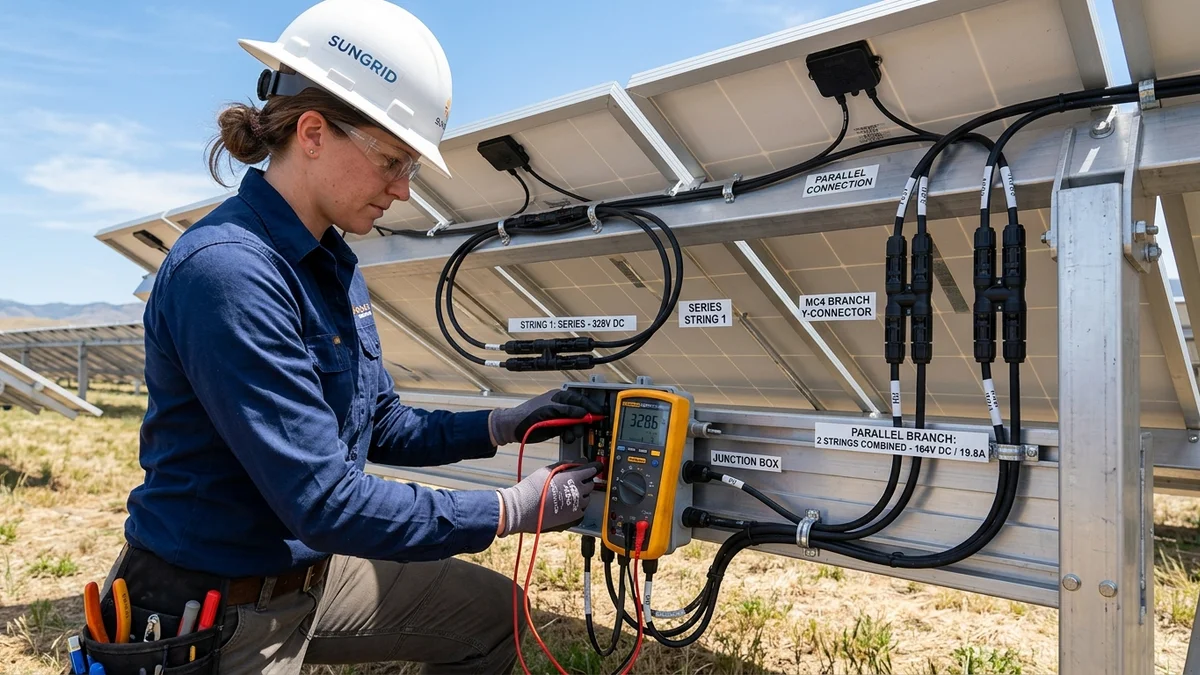
Series vs. Parallel String Topology: The Trade-Offs
When arranging individual solar modules into an array, you have three circuit topologies: pure series, pure parallel, or series-parallel combinations.
Pure Series Strings
Positive connects to negative. Voltages add together (), while current remains constant ().
- Slashes resistive cable losses () by up to 90%
- Uses thin, inexpensive 10 AWG copper wire
- Vulnerable to partial shading throttling entire string
Best For: Modern High-Voltage MPPT Inverters
Pure Parallel Strings
All positives combine; all negatives combine. Voltage remains constant (), while currents add together ().
- Keeps system voltage below 60V DC (touch-safe)
- Superior shade tolerance: shaded panel doesn’t pull down others
- High amperage demands thick, expensive 2 AWG / 4 AWG cable
Best For: 12V/24V Mobile Vans & Tiny Boats
Series-Parallel (2S2P, 3S2P)
Panels are wired into multiple series strings, which are then combined in parallel at a combiner box or dual MPPT inputs.
- Balances voltage headroom with current capacity
- Ideal for medium-voltage 150V–250V charge controllers
- Requires inline fusing if 3 or more strings are paralleled
Best For: Mid-Sized Off-Grid Cabins & RV Roofs
The Cold-Temperature Voc Sizing Formula (NEC 690.7)
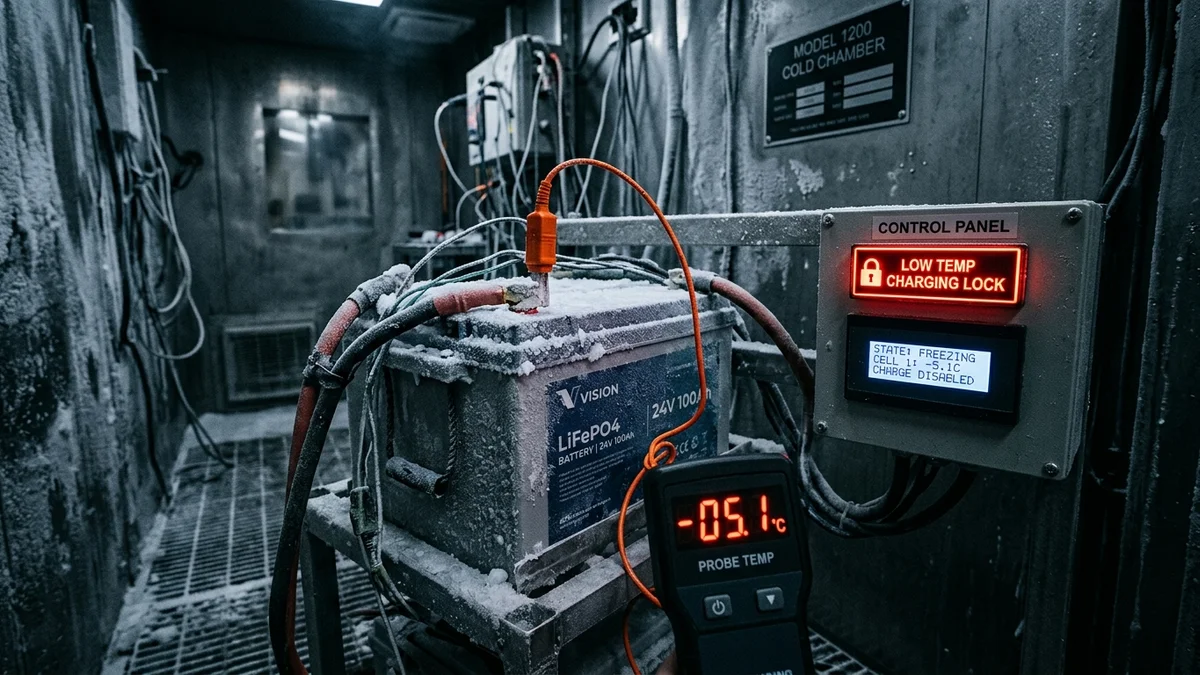
Silicon photovoltaic cells exhibit a negative temperature coefficient of voltage. When sunlight hits a solar panel on a bitter, sub-zero winter morning, the cold crystalline lattice allows electrons to flow with less thermal lattice scattering, causing open-circuit voltage () to spike dramatically.
If you size your series string based strictly on the panel’s Standard Test Conditions (STC) datasheet rating, your array will exceed your charge controller’s maximum voltage limit and permanently destroy its input capacitors.
The National Electrical Code (NEC Article 690.7) mandates calculating the maximum possible open-circuit voltage using your geographic location’s lowest recorded ambient temperature ():
Where:
- is the open-circuit voltage from the module datasheet.
- is the Temperature Coefficient of (expressed as a negative percentage, e.g. or ).
- is the lowest expected historical ambient temperature in Celsius.
Silicon Voc Temperature Inversion Curve
Practical Sizing Calculation Example
Let’s calculate maximum string length for a popular 450W N-type TOPCon panel installed in an area with a historical winter low of ():
- Module Nameplate
- Temperature Coefficient
- Temperature Delta:
Calculate the cold open-circuit voltage for a single panel:
Each panel produces 46.70 Volts on a freezing morning—an 11.2% voltage spike!
Case A: Sizing for a 150V MPPT Charge Controller (Victron, Renogy, Rich Solar)
To find maximum series panels ():
- With 3 panels: (Safe, under the 150V limit).
- If you mistakenly wired 4 panels: (Fatal: Instantly fries the 150V controller).
Case B: Sizing for a 500V High-Voltage MPPT Inverter (EG4 18kPV, Sol-Ark 15K)
A single 10-panel series string generates of clean solar power on a single pair of 10 AWG wires!
Verifying High-Temperature Minimum Voltage ()
While winter cold threatens charge controllers with overvoltage, scorching summer heat threatens charge controllers with undervoltage.
An MPPT charge controller requires a minimum operating voltage threshold (typically 15V to 20V above battery resting voltage) to remain awake and actively charge:
- In hot summer weather, rooftop solar cell temperatures routinely reach ().
- As silicon heats up, operating voltage () collapses according to the temperature coefficient.
If your series string voltage drops below your charge controller’s minimum operating floor during a sweltering July afternoon, the MPPT controller will shut down entirely, dropping your solar harvest to zero precisely when your air conditioner needs it most.
The Golden Rule: Always verify that your minimum hot string voltage () stays at least 15% above your battery bank’s maximum bulk charging voltage (e.g. 58.4V for a 48V LiFePO4 bank).
The 3-String Rule: When Is Inline Fusing Required?
When wiring multiple strings in parallel, National Electrical Code (NEC Article 690.9) enforces a strict fire-safety standard:
- 1 or 2 Strings in Parallel: No string fusing required. If one string shorts out, the maximum current the second string can backfeed into the fault cannot exceed the module’s Maximum Series Fuse Rating ().
- 3 or More Strings in Parallel: Fuses are strictly mandatory on every string! If String 1 suffers an internal short circuit, Strings 2 and 3 will combine their full current and backfeed into String 1 (), exceeding the conductor rating and causing an electrical fire.
Sizing the String Fuse: The 1.56x Multiplier
To prevent nuisance fuse blowing on sunny, high-irradiance days, the NEC mandates a double 1.25x safety multiplier ():
For a module with a short-circuit current () of 13.5 Amps:
Top Hardware for Sized Solar Arrays & String Balancing
To configure an optimized array with zero clipping and bulletproof circuit safety, these four hardware components deliver industry-leading reliability:

1. Canadian Solar BiHiKu7 660W Dual-Glass Bifacial
The ideal module for large off-grid arrays and 500V MPPT trackers. Its high 45.0V operating voltage () and 132 half-cut n-type TOPCon cells allow you to build massive 5,000W strings with just eight panels, minimizing combiner boxes and trenching costs.
Explore Canadian Solar Pallets on ShopSolar →

2. Aiko Neostar 2S+ 455W All-Black TOPCon
Delivers an industry-leading 23.6% conversion efficiency. With a compact 54-cell footprint and -0.26%/°C temperature coefficient, it fits comfortably into residential roof planes while maintaining stable voltage through triple-digit summer heatwaves.
Check Aiko Neostar on Signature Solar →
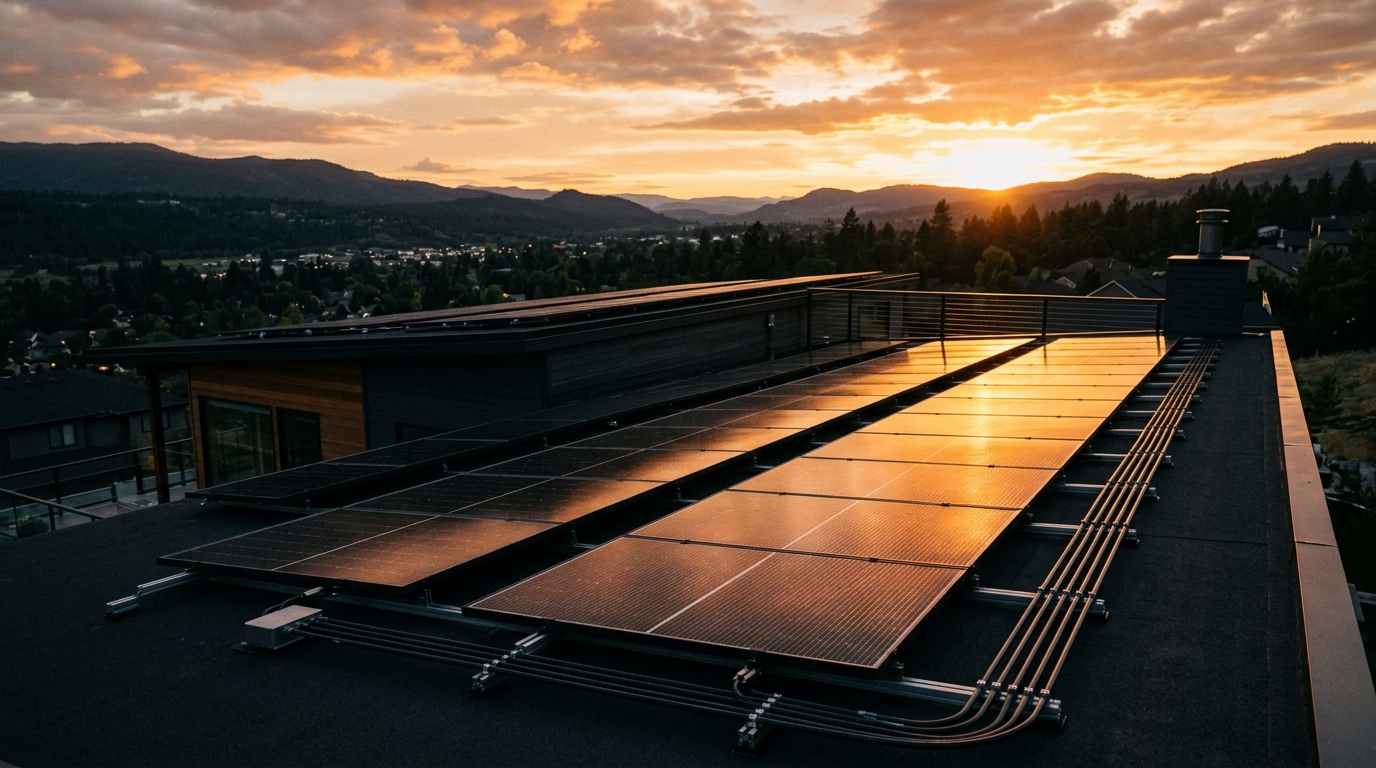
3. Rich Solar 200W Monocrystalline 12V/24V
The ultimate modular building block for camper vans, off-grid sheds, and 150V MPPT charge controllers. With an optimum operating voltage of 20.4V, you can wire panels in 2S2P or 3S2P arrays to achieve perfect voltage balance without special heavy equipment.
View Rich Solar 200W Pricing on ShopSolar →
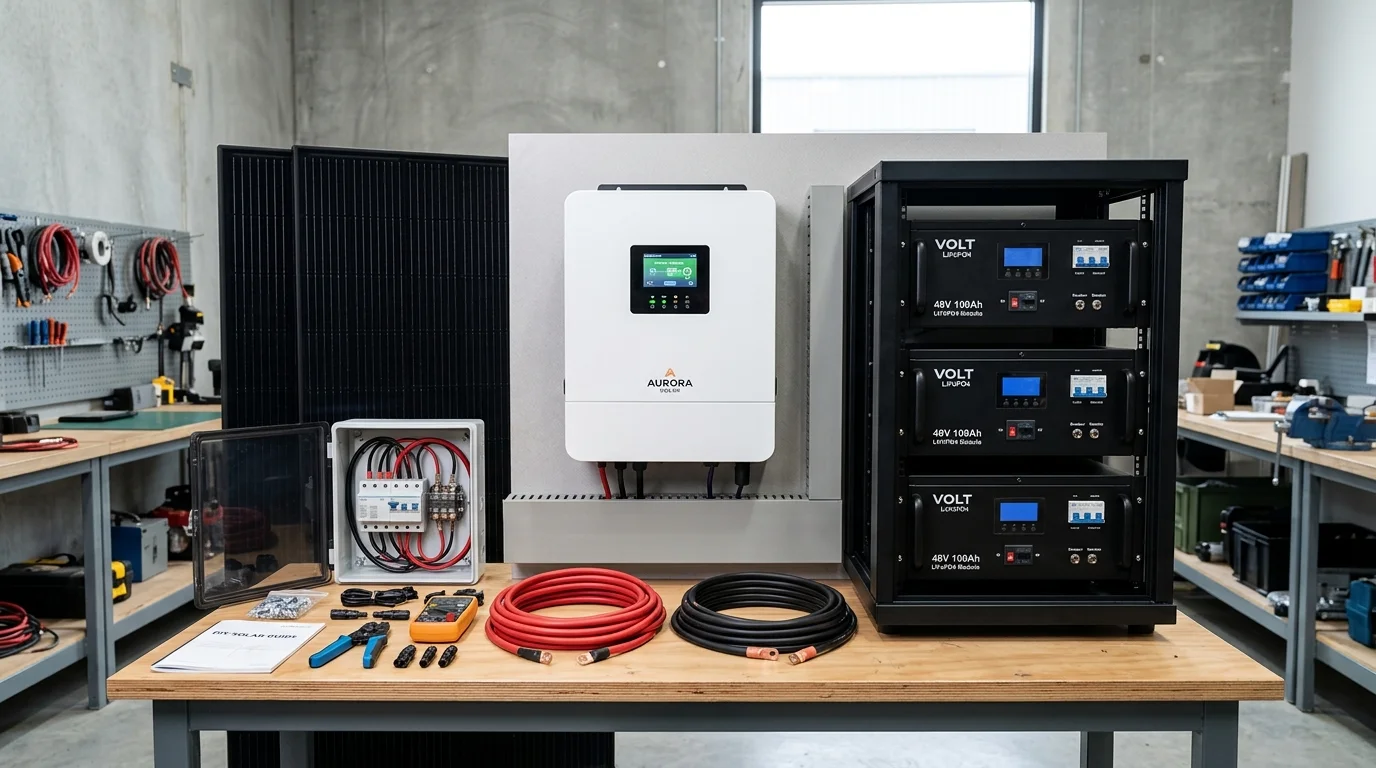
4. ShopSolar Complete Pre-Sized Solar Kit
Eliminate sizing math completely. ShopSolar engineers match pallet quantities of high-yield bifacial panels to hybrid split-phase inverters, dual MPPT charge controllers, string combiner breakers, and 48V server rack lithium batteries in an insured freight bundle.
Explore Complete Solar Packages →
4 Costly Array Sizing Mistakes to Avoid
- Calculating String Length Using STC Voltage: Never use the datasheet open-circuit voltage () to determine how many panels you can wire in series. On freezing sub-zero winter mornings, silicon voltage spikes by 10% to 15%. If that spike pushes string voltage past your charge controller’s limit, the controller will fry instantly.
- Paralleling Multiple Strings Without Fusing: The National Electrical Code allows combining up to two strings in parallel without fuses. As soon as you add a third string, each string must have an inline DC fuse. Without fuses, an internal short in one string allows the other two strings to dump 25+ Amps of fault current into the shorted panel, creating a catastrophic rooftop fire.
- Mismatched String Lengths on the Same MPPT: When wiring two parallel strings into a single MPPT tracker, both strings must have the exact same number of panels. If String 1 has four panels (160V) and String 2 has five panels (200V), the 40V differential forces high circulating backfeed currents from String 2 into String 1, drastically reducing overall generation and overheating bypass diodes.
- Exceeding MPPT Short-Circuit Current (): While MPPT charge controllers will safely clip excess operating current (), they have a hard physical limit for maximum short-circuit current (). Exceeding the controller’s rated can permanently damage its internal input relays and protection circuits.
Frequently Asked Questions (FAQ)
What happens if my solar array voltage is too high for my MPPT controller?
Excess voltage is catastrophic. MPPT charge controllers contain internal solid-state MOSFET transistors rated for a specific breakdown voltage (e.g. 150V, 250V, or 500V DC). If your solar string voltage exceeds that threshold by even 2 Volts on a cold morning, the dielectric barrier breaks down, frying the input circuitry with a pop and a puff of smoke. Excess voltage permanently destroys the controller and voids your warranty.
What happens if my solar array wattage is higher than my MPPT rating?
Unlike excess voltage, excess wattage or current is safely managed by the MPPT controller. If you connect a 2,000W solar array to a 1,500W MPPT charge controller, the controller simply limits its internal duty cycle to draw only its maximum rated amperage (a process known as current clipping). The excess 500W is simply left unharvested on the panels. Overpaneling by 20% to 30% is a standard engineering strategy to maximize energy generation during cloudy weather and morning/evening shoulder hours.
Can I connect different wattage solar panels in the same array?
You can, but you must respect circuit laws. If you connect panels in series, they must share the exact same operating current (), because the entire string is throttled down to the weakest panel. If you connect panels in parallel, they must share the exact same operating voltage (). If both voltage and current are mismatched, you must connect the dissimilar panels to separate, independent MPPT charge controller inputs.
What is the maximum distance solar panels can be from the inverter?
Solar panels can be located 100 to 300+ feet away from the inverter, provided you wire them in a high-voltage series configuration (e.g. 250V to 450V DC). Because high voltage keeps amperage low, you can run 10 AWG or 8 AWG pure-copper PV wire over 200 feet with under 2% voltage drop. Conversely, low-voltage 12V or 24V parallel arrays cannot run more than 20 to 30 feet without requiring massive, expensive 2/0 or 4/0 welding cables to prevent severe resistance losses.