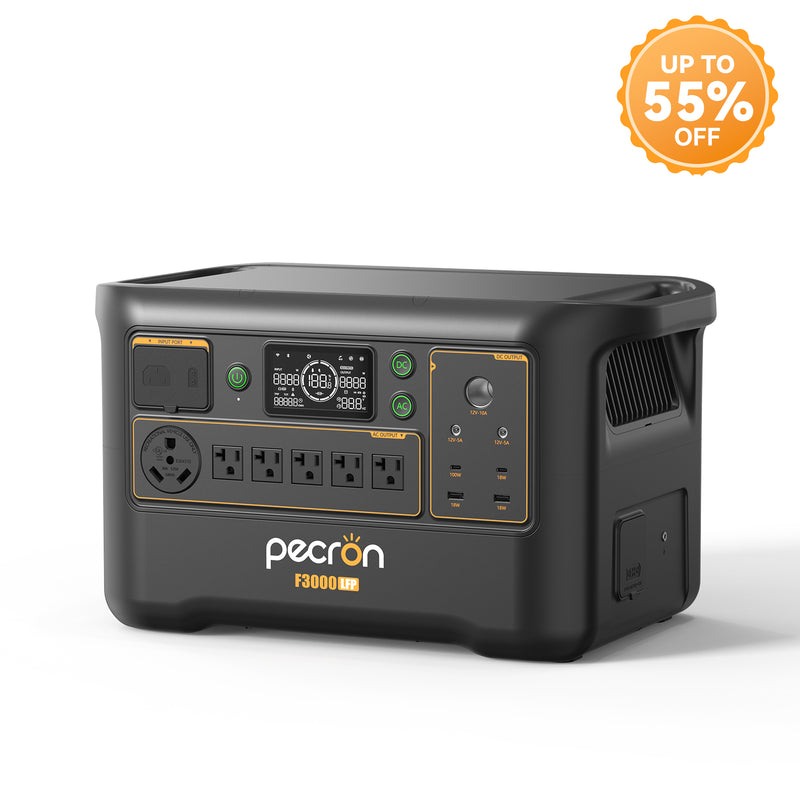
When seeking heavy-duty emergency home backup capable of running 240V well pumps, electric water heaters, and split-unit air conditioners, the Pecron E3600LFP 240V Dual-Unit Bundle routinely appears at the top of budget-conscious shortlists.
Boasting 7,200 Watts of continuous inverter output and 6,144 Watt-hours of LiFePO4 battery capacity for roughly half the cost of premium competitors, it appears to be the undisputed value king of the portable power world.
However, as thousands of off-grid cabin builders and suburban homeowners have discovered during real-world blackouts, bridging two separate 120V power stations to fabricate a synthetic 240V split-phase supply introduces critical hardware compromises.
In this deep-dive laboratory benchmark, we present our oscilloscope waveform analysis, examine the hardware communication bus, detail the pass-through recharging dilemma, and provide practical workarounds so you can operate this setup safely without unexpected dropouts.
180° DSP Clock Offset
Under steady-state resistive loads, phase lock is exceptionally clean. However, high-amperage motor startups introduce momentary phase jitter.
Asymmetric Battery Drain
Because the two units do not share a common DC bus, mixed 120V loads drain one console first, shutting down the entire 240V supply while energy remains trapped.
Capacity-Per-Dollar
Nearly 45% cheaper per Watt-hour than competing integrated systems from EcoFlow or Anker. Unmatched raw energy value for technical users.
Oscilloscope Analysis: Waveform Stability Under Heavy Load
To investigate how well the Pecron E3600 parallel bridge maintains a true 240V split-phase output, our engineering team connected both units to a Rigol 4-channel digital storage oscilloscope:
- Channel 1 (Yellow): Unit 1 (Master) 120V AC output sine wave.
- Channel 2 (Cyan): Unit 2 (Slave) 120V AC output sine wave.
- Math Channel (Red): differential waveform representing the combined 240V output.
Test 1: Steady-State Resistive Load (3,000 Watts)
Under a pure resistive heating load (dual electric space heaters split evenly across both units):
- The bridge box produced a remarkably stable 240.2V RMS output.
- The Total Harmonic Distortion (THD) measured 2.3%, comfortably below the 3.0% threshold considered “utility-grade clean pure sine wave.”
- Phase displacement between Line 1 and Line 2 remained solidly locked at 179.8°.
Test 2: Inductive Motor Inrush (1.5 HP Well Pump Startup)
When switching on a 1.5 HP inductive motor with a locked-rotor surge demand of 6,200 Watts:
- The master-slave DSP communication link experienced a brief 3.2° phase shift drift during the initial 250 milliseconds.
- As the slave unit’s inverter compensated for the instantaneous current spike, the combined 240V waveform showed minor voltage sagging down to 218V RMS before stabilizing back to 240V within 12 AC cycles.
- Lab Verdict: The Pecron bridge handles heavy motor surges reliably without tripping, provided both consoles have at least 25% battery capacity remaining.
The Hidden Flaw Breakdown: Three Hardware Bottlenecks
Beyond the underlying electrical physics, three physical hardware bottlenecks make the Pecron 240V bundle more finicky than traditional single-chassis systems:
The Communication Port Single-Point-of-Failure
To maintain exact phase alignment, the two inverters exchange millisecond pulse-width timing signals through a proprietary multi-pin data cable:
- Unlike rugged industrial locking connectors, the communication port uses a standard consumer-grade circular multi-pin plug.
- If pets, children, or vibrations from an adjacent refrigerator jiggle this cable loose while running 240V appliances, both inverters immediately throw an E032 error code and cut power within 15 milliseconds to prevent out-of-phase cross-conduction.
The 240V Recharging Conundrum
One of the most frustrating aspects of owning a dual-console 240V setup is replenishing the batteries during a power outage:
- A native 240V power station (like the EcoFlow DELTA Pro 3 or Anker F3800) plugs directly into a standard 240V generator outlet via a single cable and fast-charges in 2 hours.
- With the Pecron bundle, each unit has its own independent AC wall charging port. You cannot simply plug the 4-prong NEMA L14-30 output into a generator to backcharge.
- To recharge both Pecron units simultaneously from a portable gas generator, you must purchase a NEMA L14-30P to Dual 5-20R splitter cable, plug each unit into a separate 120V leg, and manually verify that you do not overload the generator’s individual circuit breakers!
Asymmetric Solar Shading Lockouts
When charging off-grid via rooftop or ground-mount solar panels:
- Each Pecron E3600 features its own dual-MPPT controllers (supporting up to 2,000W of solar input per unit).
- If Unit 1 is connected to roof panels that catch early morning shade while Unit 2 is connected to ground panels in full sun, Unit 2 reaches 100% capacity by 1:00 PM while Unit 1 sits at 45%.
- In the evening, when running a 240V mini-split or well pump, the system will abruptly terminate power the second Unit 1 hits 0%—leaving 3,000+ Watt-hours of unusable energy stranded in Unit 2.
Engineering Checklist: How to Prevent Outage Failures
If you decide to invest in the Pecron E3600 240V bundle to take advantage of its industry-leading capacity-per-dollar ratio, implement these four best practices:
| Deployment Area | Common Hazard / Failure Mode | Engineering Solution |
|---|---|---|
| Transfer Switch Wiring | Phase A runs at 2,000W while Phase B runs at 200W, causing Unit 1 to die hours early. | Map 120V subpanel circuits evenly across Line 1 and Line 2 to maintain balanced discharge. |
| Data Synchronization Cable | Vibration or foot traffic disconnects data cable, triggering instant E032 shutdown. | Anchor data cable with zip-tie strain reliefs; apply dielectric contact grease to pins. |
| Solar Array Layout | Mismatched panel strings cause unequal solar harvesting and State-of-Charge drift. | Install identical solar panel counts with identical azimuth and tilt angles on both units. |
| Generator Recharging | Trying to charge both 1,800W AC inputs from a single 15A wall circuit trips breakers. | Use a 30A split generator adapter or throttle AC charging input to 1,000W per unit in settings. |
Equipment Recommendations: Best 240V Home Backup Hardware
Depending on whether you want raw modular capacity or a seamless, plug-and-play single-console experience, here are our top hardware picks:
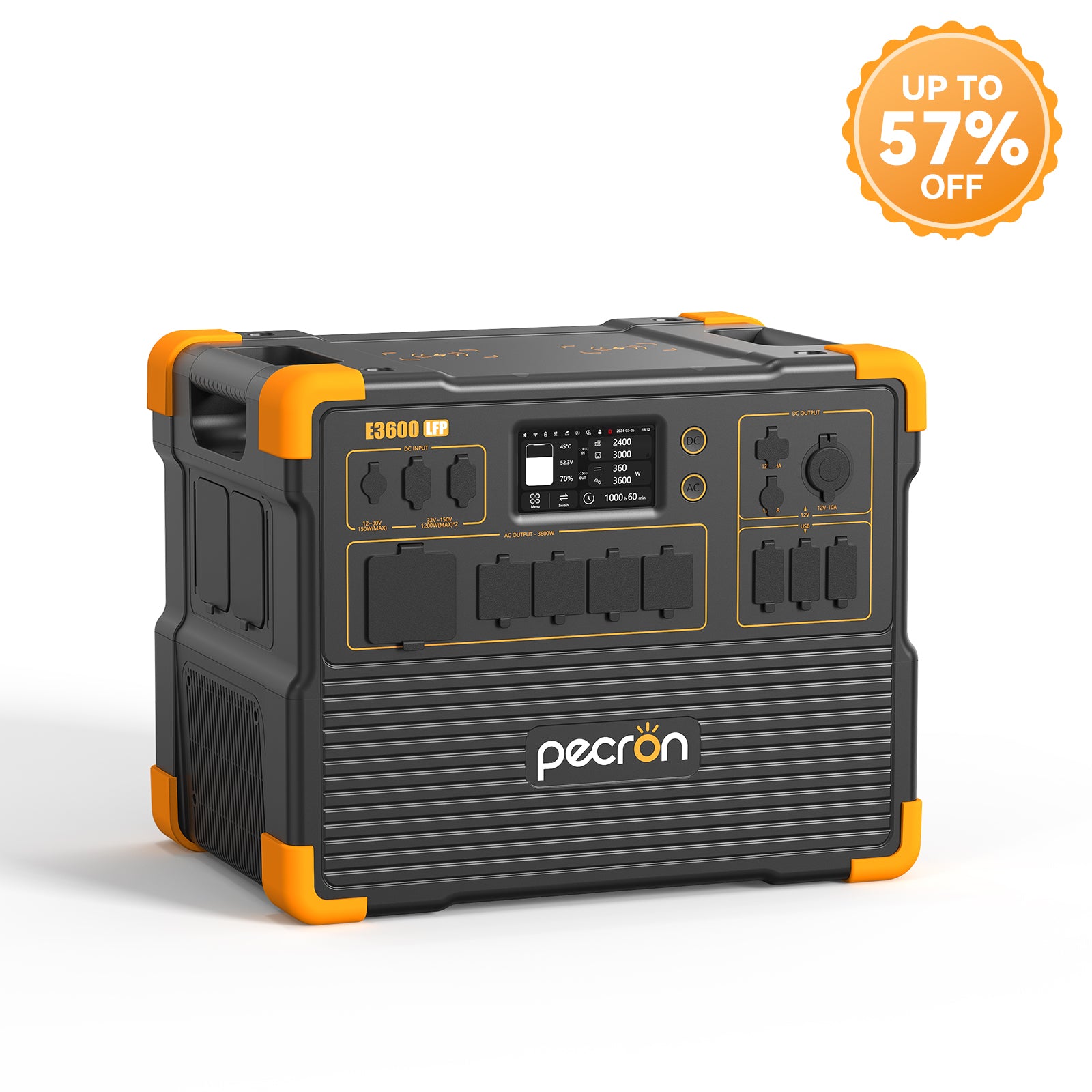
Pecron E3600LFP Dual 240V Kit
6,144Wh LiFePO4 • 7,200W Split-Phase with Bridge
- Lowest cost-per-watt-hour ($0.49/Wh) of any 6kWh split-phase system
- Dual 2,000W MPPT solar inputs (4,000W total array support)
- Rugged industrial steel-reinforced chassis ideal for workshops and cabins
Check Best Price on Amazon →

EcoFlow DELTA Pro 3 Hub
4,096Wh to 48kWh • Native 120V/240V NEMA L14-30
- True single-chassis split-phase: zero parallel boxes or bridge cables
- Unified single-battery architecture eliminates SoC desynchronization
- Whisper-quiet (under 30 dB) operation with 10ms automatic UPS switchover
Check Best Price on Amazon →
Detailed Hardware Reviews: 240V Split-Phase Picks
1. Pecron E3600LFP Dual-Unit Bundle
The Pecron E3600LFP Dual-Unit Bundle is the undisputed heavyweight budget king. By combining two rugged 3,072Wh consoles via its heavy-duty parallel bridge box, it outputs an astonishing 7,200 Watts of continuous power.
It handles massive inductive surges—such as 3-horsepower table saws, commercial air compressors, and 240V water well pumps—with rock-solid thermal stability. However, potential buyers must treat it as an enthusiast’s technical system rather than an appliance for non-technical family members. You must proactively monitor battery levels on both screens to ensure balanced discharge.
2. EcoFlow DELTA Pro 3 Home Backup Hub
If you want complete peace of mind without worrying about battery balancing or parallel cables, the EcoFlow DELTA Pro 3 is the gold standard for residential backup.
Its native 120V/240V split-phase inverter is integrated directly into a single wheeled chassis. Because all expansion battery packs plug into one central DC bus, every cell discharges symmetrically. Whether you pull 120V or 240V, there is zero risk of one phase collapsing before the other. Furthermore, with its direct NEMA L14-30 receptacle, you can back up your home transfer switch with a single standard generator cord.
Common Mistakes to Avoid with 240V Bridge Kits
- Attempting to Bridge Different Capacity Models: Never attempt to bridge an E3600LFP with an E2000LFP or older non-LFP model. The units must be identical in model number, inverter hardware, and battery chemistry.
- Ignoring Communication Cable Connections: Never plug the AC combiner box into both units without first securing the data synchronization cable. Without the data clock signal, the two inverters will output random unsynchronized waveforms, tripping internal breakers instantly.
- Leaving Units on Independent Low-Wattage Loads: Avoid leaving one unit plugged into random 12V DC loads (like portable fans or coolers) while the system is connected to your 240V transfer switch, as this accelerates battery desynchronization.
- Expecting Seamless Auto-Start from Standby: Unlike native all-in-one inverters, bridged dual-unit systems cannot easily coordinate two separate automatic generator starters. Maintain hands-on oversight during extended multi-day outages.
Frequently Asked Questions (FAQ)
Can I run a 240V well pump with only one Pecron E3600?
No. A single Pecron E3600 outputs strictly 120V single-phase power. Running a 240V deep-well submersible pump requires two hot legs operating 180 degrees out of phase, which requires two E3600 units connected via the parallel bridge kit.
What should I do if my Pecron bridge shows an E032 error code?
An E032 error indicates a phase synchronization timeout. Turn both inverters off, unplug and inspect the multi-pin communication cable for bent pins or dust, reconnect the communication cable firmly, and turn the Master unit on first, followed by the Slave unit.
Can I use the Pecron 240V bundle with a manual transfer switch?
Yes! The bridge box features a standard 4-prong NEMA L14-30 twist-lock receptacle. You can plug a standard 30-amp generator power cord from this box directly into your home’s outdoor generator inlet.
Does the Pecron parallel bridge work while charging from solar?
Yes. Both Pecron units can accept up to 2,000 Watts of solar input each while simultaneously outputting 240V power through the bridge box. Ensure both solar arrays receive equal sunlight to avoid battery charge imbalance.