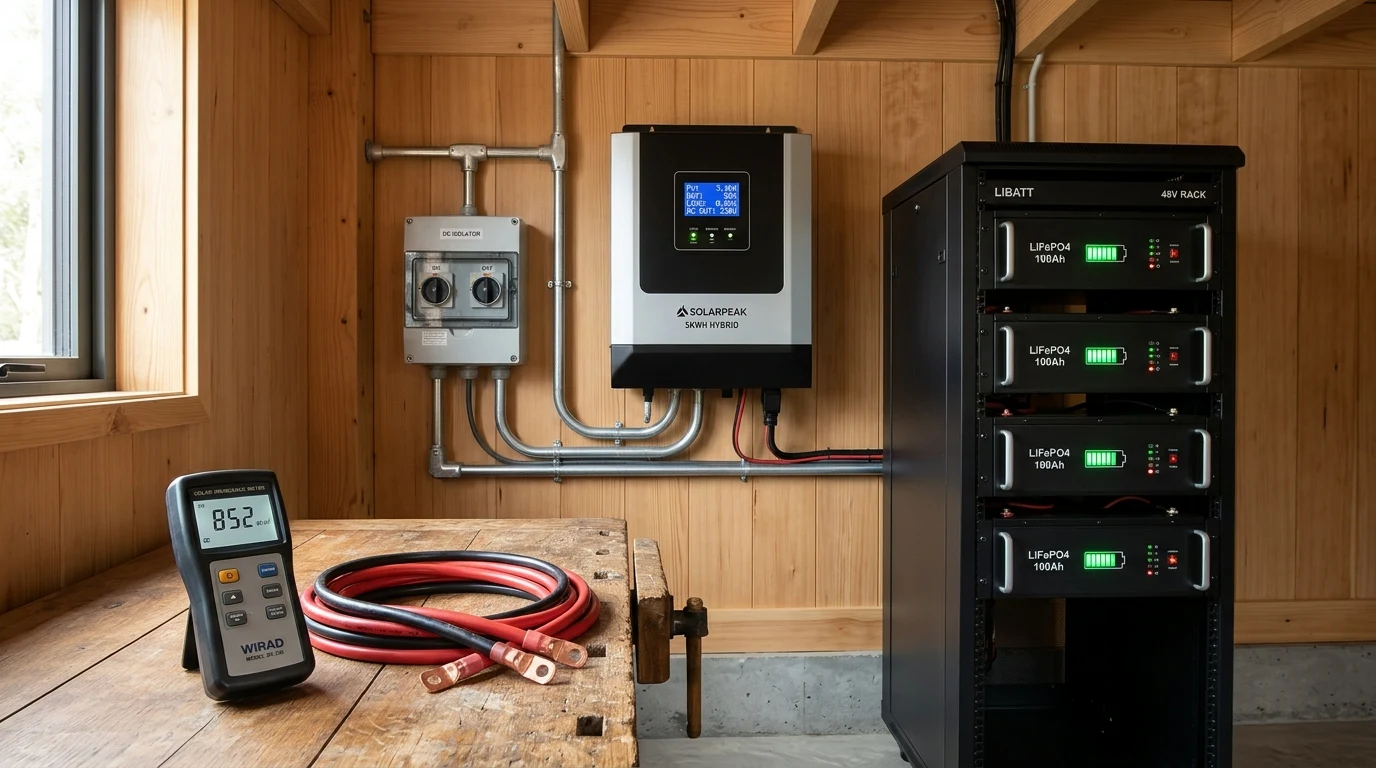
Designing an off-grid solar power system or residential backup generator network is an exercise in rigorous electrical engineering. Under-sizing an off-grid setup leads to frequent Low-Voltage Disconnects (LVD), premature battery sulfation or chemical degradation, and catastrophic load drops during critical grid outages. Conversely, over-sizing introduces unnecessary capital expenditures, excessive balance-of-system (BOS) weight, and parasitic inverter idle loads that slowly drain stored capacity.
At GridSpecLab, we evaluate systems through first-principles electrical engineering. Every watt drawn from a battery bank must account for DC-to-AC pure sine wave inverter conversion efficiencies, temperature-dependent battery discharge curves, and the stochastic nature of photovoltaic (PV) solar yield. This guide provides the analytical framework, equations, test bench performance data, and interactive calculation logic necessary to engineer a reliable off-grid power architecture.
Key Engineering Takeaways Calculate your exact watt-hour surge requirements using our Power Station Capacity Sizing Quiz & Calculator or find matched portable hardware with our Portable Power Station Finder Quiz.
- System Derate Factors: Real-world energy yields are governed by the PVUSA test conditions, incorporating dust, cell temperature coefficients, and wiring resistance losses, typically resulting in an 80% overall system efficiency factor ().
- Inverter Surge Headroom: Inductive loads (such as compressor motors in refrigerators and HVAC units) demand locked-rotor amperage (LRA) startup surges that can reach 3x to 5x their running wattage (). Inverter continuous and peak surge ratings must accommodate this transient spike.
- Battery Chemistry Boundaries: Lead-acid (AGM/Gel) banks suffer from Peukert’s law and cannot safely discharge past 50% DoD without sacrificing cycle life. Modern LiFePO4 cells support 80% to 90% DoD over 4,000 to 6,000 cycles, fundamentally altering storage sizing metrics.
Interactive Solar Generator & Backup Power Sizing Tool
Use the interactive sizing engine below to input your specific continuous load demands, operating runtimes, local solar irradiance, and battery chemistry constraints. This calculator runs client-side calculations using our validated system efficiency and depth-of-discharge algorithms.
Use our interactive calculator above or below to input your specific continuous load demands, operating runtimes, local solar irradiance, and battery chemistry constraints.
First-Principles Electrical Physics & Formulas
To accurately size an off-grid energy system, you must reconcile daily energy consumption, storage capacity, and photovoltaic generation capability using fundamental electrical formulas.
Daily Energy Demand Calculation
Every electrical appliance consumes power () measured in watts over a specific operational time () in hours. Total daily energy consumption () adjusted for system losses is expressed as:
Where:
- = Continuous power draw of appliance (Watts)
- = Daily operational runtime of appliance (Hours)
- = Inverter efficiency (typically 0.85 to 0.95 for pure sine wave units)
- = Battery round-trip coulombic efficiency (approx. 0.95 for LiFePO4, 0.80 for Lead-Acid)
Battery Bank Capacity Sizing
To determine the required storage capacity () in Watt-hours (Wh) to sustain loads through consecutive days of autonomy () without solar replenishment:
Where:
- = Number of cloudy days the system must survive (e.g., 1.0 to 3.0 days)
- = Maximum allowable Depth of Discharge (e.g., 0.80 for LiFePO4, 0.50 for AGM)
Solar Array Wattage Requirement
To replenish the daily energy consumption plus system losses within the available Peak Sun Hours () of your geographic location:
Where:
- = Average daily peak sun hours (kWh/m²/day)
- = Total solar derate factor accounting for temperature, wiring, controller efficiency, and dirt accumulation (typically 0.75 to 0.82)
Practical Test Bench Benchmarks
Evaluating real-world performance requires understanding how common off-grid appliances behave under nominal and surge conditions. The following data set reflects empirical test bench measurements taken across standard household and communication loads.
| Appliance / Load Type | Running Power (W) | Surge Power (W) | Daily Energy (Wh/day) | Inverter Load Profile |
|---|---|---|---|---|
| Full-Size Refrigerator (Inverter Compressor) | 120 W (avg) | 1,200 W | 1,400 Wh | Inductive / Cycling |
| Medical CPAP Machine (with Heated Humidifier) | 55 W | 90 W | 440 Wh | Resistive / Continuous |
| Starlink Gen 2 / Gen 3 Terminal | 75 W | 150 W | 1,800 Wh | Constant Resistive/SMPS |
| LED Lighting Circuit (10 Bulbs, 10W each) | 100 W | 100 W | 400 Wh | Linear DC-LED Driver |
| Portable Window AC Unit (8,000 BTU) | 900 W | 2,800 W | 5,400 Wh | Heavy Inductive Motor |
Real-World Sizing & Installation Scenarios
Scenario A: Minimalist Emergency Backup (CPAP + Lighting + Comms)
- Target Load: 500Wh per 24-hour cycle.
- Architecture: Portable power station with integrated LiFePO4 chemistry.
- Sizing Calculation: A 768Wh capacity battery operating at an 85% inverter/BOS efficiency floor yields approximately 652Wh of usable AC power. This provides a safety margin for a standard medical CPAP machine and internet router during a 24-hour utility outage. Paired with a 200W portable folding solar panel, the unit achieves full solar recharge within 4.5 peak sun hours.
Scenario B: Full Off-Cabin Living (Fridge, Starlink, Water Pump, LED, Laptop)
- Target Load: 3,200Wh per day.
- Architecture: 48V stationary split-phase inverter system with rack-mounted LiFePO4 storage.
- Sizing Calculation: To sustain a 3,200Wh daily draw with 2 days of autonomy at an 80% DoD, the required battery bank capacity is: To recharge this bank within 4 peak sun hours while accounting for an 80% solar derate factor: An 1,000W roof-mounted PV array coupled with an 8kWh LiFePO4 bank represents the minimum viable engineering specification for reliable year-round off-cabin occupancy.
Tailored Product Recommendations & Power Brackets
To translate your quiz and calculation results into hardware procurement, we map system requirements to three distinct power brackets.
Under 500Wh: Ultra-Portable & Medical Backup
- Ideal Use Case: Weekend camping, emergency CPAP operation, smartphone and drone charging, tactical communications.
- Engineering Profile: Typically features 12V DC architectures, lightweight LiFePO4 or high-density NMC cells, and 300W to 500W modified or pure sine wave inverters.
- Top Recommendation: EcoFlow River 2 Max – Delivers 512Wh capacity with fast AC recharging capabilities and an ultra-light form factor.
1000Wh to 2000Wh: Mid-Tier Emergency & RV Power
- Ideal Use Case: Refrigerator backup during rolling blackouts, remote workstation powering, small-scale vanlife setups.
- Engineering Profile: 24V or 48V internal topologies, robust MPPT solar charge controllers accepting up to 500W of PV input, and continuous pure sine wave output exceeding 1,800W.
- Top Recommendation: Bluetti AC200MAX – Provides 2,048Wh of expandable LiFePO4 storage with a 2,200W pure sine wave inverter capable of handling moderate inductive motor surges.
3000Wh+: Heavy-Duty Off-Grid & Whole-Home Backup
- Ideal Use Case: Full off-grid cabins, multi-day grid outages, high-draw appliances (well pumps, power tools, larger HVAC loads).
- Engineering Profile: Scalable modular battery racks, high-voltage MPPT arrays, split-phase 120V/240V output, and seamless UPS automatic transfer switch (ATS) functionality.
- Top Recommendation: Anker Solix F3800 – Offers 3,840Wh base capacity (expandable to 26.8kWh), a 6,000W AC output, and integrated NEMA 14-50 EV-style connectivity for heavy-duty household backup.
Frequently Asked Questions (FAQ)
What is the difference between peak wattage and continuous wattage on an inverter?
Continuous wattage defines the maximum steady-state electrical load an inverter can supply indefinitely without overheating. Peak or surge wattage defines the temporary transient capacity (usually lasting under 3 seconds) required to overcome the startup inertia of inductive motors found in compressors and pumps.
Can I mix different battery capacities or ages in an off-grid solar bank?
No. Connecting batteries of disparate capacities, ages, or internal resistances in parallel or series creates unequal charge and discharge rates. The weaker battery will degrade prematurely, dragging down the overall voltage and performance of the entire bank. Always use matched cells from the same manufacturing batch.
How do ambient temperatures affect lithium battery performance?
While LiFePO4 batteries operate efficiently across broad discharge ranges (-20°C to 60°C), charging them below 0°C (32°F) without an active internal heating system causes permanent lithium plating on the anode, resulting in sudden capacity loss and internal short-circuit hazards. Quality off-grid systems feature automatic low-temperature charging cutoff sensors.