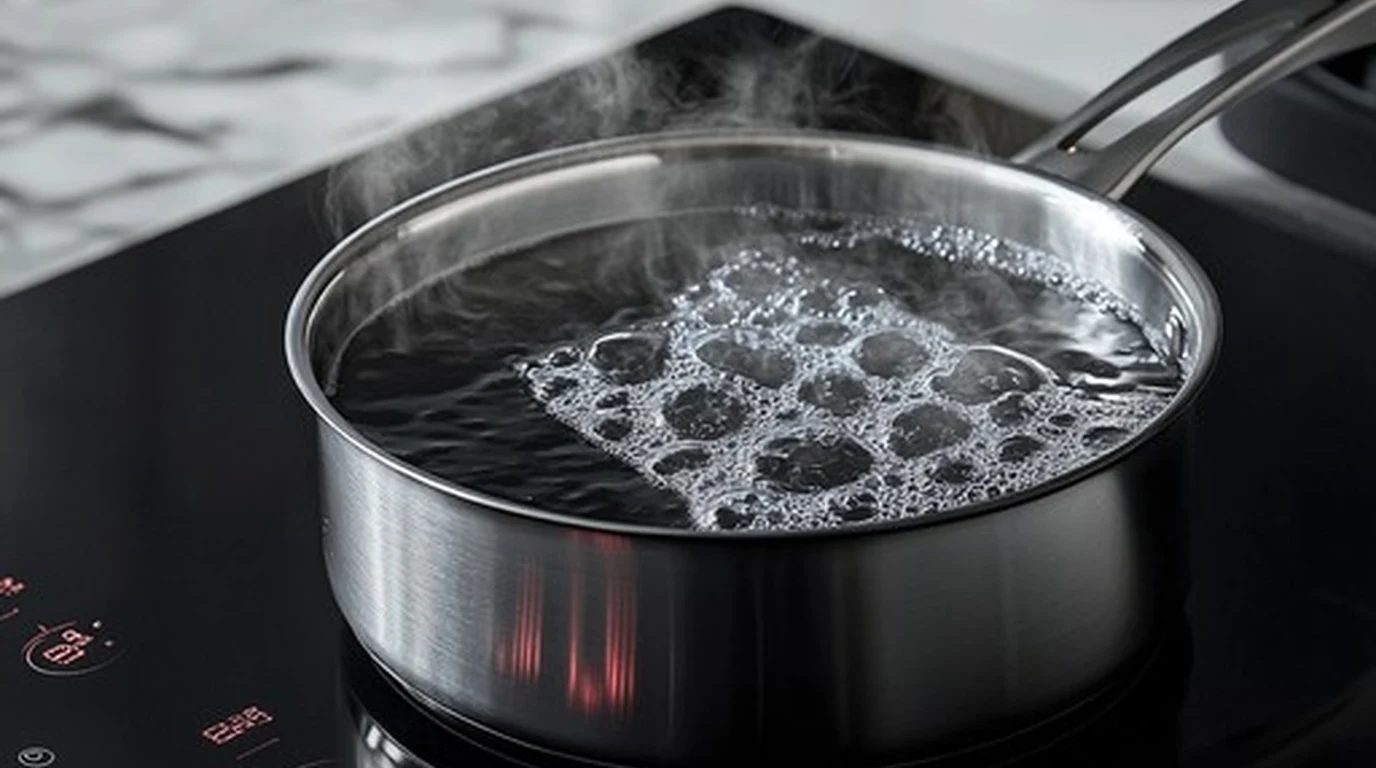
For decades, the standard playbook for designing an off-grid cabin or rural homestead was simple: use solar power for lights, refrigeration, and light electronics, while relying strictly on bottled propane gas for space heating, domestic water heating, and the kitchen cooking range.
Propane was viewed as an indispensable thermodynamic crutch. Because electric heating elements historically required thousands of watts of brute resistance power, powering an electric stove was considered an easy way to destroy an expensive lead-acid battery bank.
However, the rapid maturation of high-capacity Lithium Iron Phosphate (LiFePO4) storage, falling photovoltaic module costs, and modern electromagnetic induction technology have completely upended this equation.
Homesteaders are increasingly questioning the wisdom of paying three to five dollars per gallon for propane, hauling heavy 20-pound and 100-pound steel cylinders over unplowed winter access roads, and tolerating indoor combustion byproducts when free, rooftop solar energy is readily available.
This engineering guide examines the thermodynamic physics, daily kilowatt-hour electrical consumption, inverter sizing, and winter energy economics of switching from a propane kitchen range to an all-electric induction cooking setup on an off-grid solar system.
Executive Summary: The Off-Grid Kitchen Paradigm Shift
Can an off-grid solar system comfortably handle daily cooking on an induction cooktop? Yes, and it is far more efficient than most homeowners realize:
+-----------------------------------------------------------------------------------+
|               INDUCTION VS PROPANE COOKING COMPARISON AT A GLANCE                 |
+-----------------------------------------------------------------------------------+
| Metric                   | Propane Gas Range           | Induction Cooktop        |
+--------------------------+-----------------------------+--------------------------+
| Heat Transfer Mechanism  | Open Gas Combustion Flame   | High-Frequency Magnetic  |
| Thermal Efficiency       | 32% to 38% (65% Heat Lost)  | 84% to 90% (Direct Heat) |
| Energy to Boil 1L Water  | ~910 BTUs (0.27 kWh equiv.) | ~0.11 kWh (375 BTUs)     |
| Daily Energy for 4 People| 0.15 to 0.22 Gallons Propane| 1.6 to 2.2 kWh Electric  |
| 48V Battery Bank Drain   | 0 Amp-Hours                 | 35 to 45 Amp-Hours / Day |
| Required Solar PV Offset | 0 Watts                     | 600 to 800 Watts of PV   |
| Indoor Moisture / NO2    | High (Requires Active Vent) | Zero Combustion Emissions|
| Inverter Requirement     | None (120V pilot/igniter)   | 3kW (Portable) / 8kW (4B)|
+--------------------------+-----------------------------+--------------------------+
The key insight is that cooking is an intermittent, high-efficiency task. Unlike a water heater or baseboard heater that runs for hours at a time, searing steaks, simmering stew, or boiling pasta takes between five and thirty minutes of active heating.
Thermodynamic Physics: Why Induction Demolishes Gas Efficiency
The fundamental advantage of induction cooking lies in how thermal energy is generated and transferred into food.
The Thermal Losses of Open Gas Flames
When propane burns at the burner head:
Only a fraction of the thermal energy enters the cookware:
- The flaming gases expand outward and rise along the sides of the metal pot into the kitchen atmosphere.
- Because air is a poor conductor of heat, 62% to 68% of the heat content in every cubic foot of propane escapes directly into the room without heating the food.
- The true heat transfer efficiency of standard residential propane ranges is documented by the U.S. Department of Energy (DOE) at between 32% and 38%.
Electromagnetic Eddy Currents and Joulean Heating
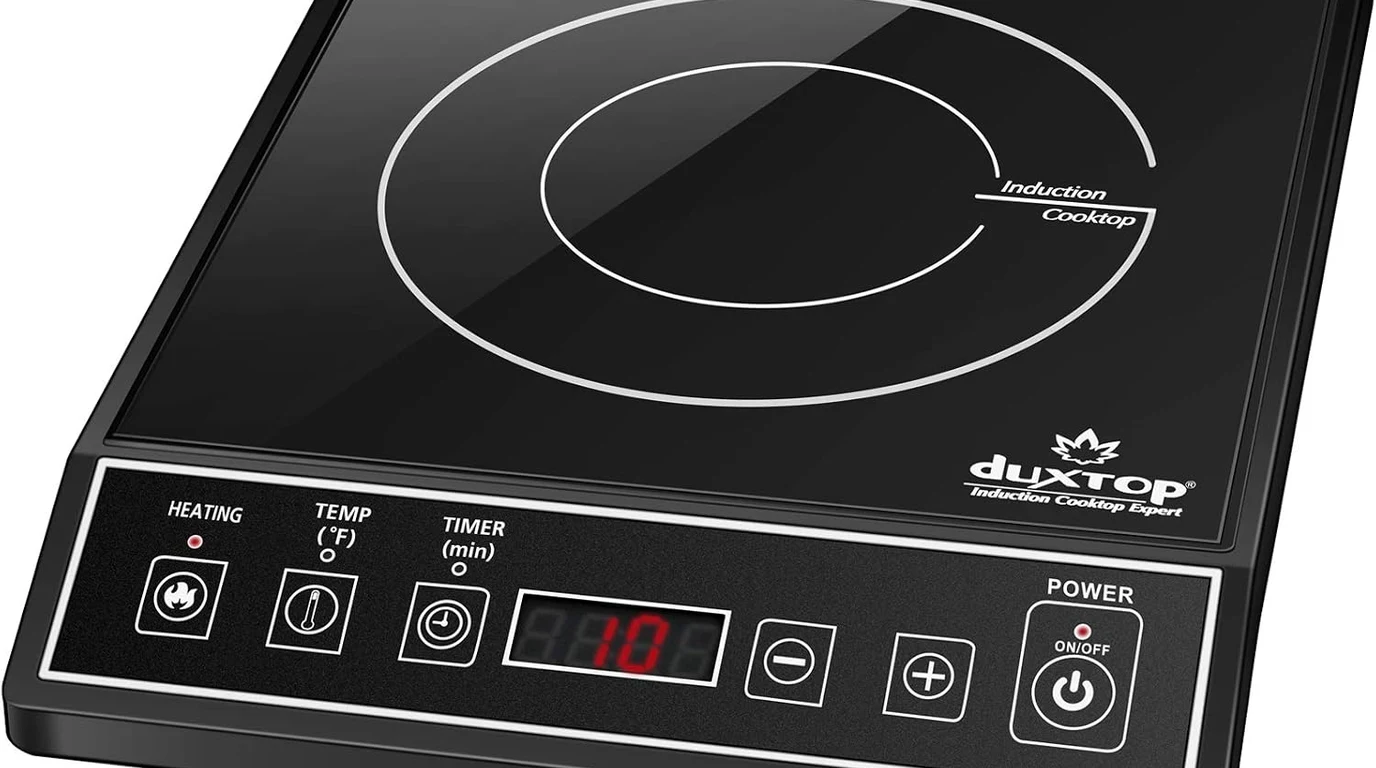
An induction cooktop does not contain a heating element. Beneath its smooth ceramic-glass surface sits a tightly wound planar copper coil:
- The cooktop supplies high-frequency alternating current (typically 20,000 Hz to 45,000 Hz) to the copper coil.
- This creates an oscillating high-speed magnetic field that penetrates through the ceramic surface.
- When ferromagnetic cookware (cast iron, carbon steel, or magnetic stainless steel) is placed on the burner, the alternating magnetic flux induces circulating electric currents known as Foucault currents (eddy currents) directly inside the base of the metal pan.
- Because the metal pan possesses electrical resistance, the eddy currents generate instantaneous Joulean thermal energy () directly inside the pan itself.
- The ceramic glass surface does not generate heat; it only absorbs residual warmth conducted back from the hot pan base.
- The resulting thermal transfer efficiency is 84% to 90%, meaning nearly every watt drawn from the solar battery bank goes directly into heating the food.
+-----------------------------------------------------------------------------------+
|                     HEAT TRANSFER ARCHITECTURE COMPARISON                         |
+-----------------------------------------------------------------------------------+
|  PROPANE OPEN FLAME:                                                              |
|       [ Pan Base ] <--- Only 35% Heat Absorbed                                    |
|      ( Flame Base )                                                               |
|     /      |      \                                                               |
|    v       v       v                                                              |
|   65% Waste Heat Radiates into Room (Heats up Kitchen, Wastes Fuel)               |
|                                                                                   |
|  ELECTROMAGNETIC INDUCTION:                                                       |
|       [ Pan Base ] <=== 88% Direct Internal Resistance Eddy Current Heating       |
|    - - - - - - - - - - - (Cold Ceramic Glass Surface)                             |
|       [ Copper Coil ] (25kHz Oscillating Magnetic Flux)                           |
|       Zero Waste Thermal Radiation into Ambient Air                               |
+-----------------------------------------------------------------------------------+
Energy Math: Sizing Daily Kilowatt-Hours for Off-Grid Living
To design an off-grid power plant capable of supporting an induction cooktop, we must calculate exact daily electrical consumption across typical household cooking routines.
Thermodynamic Benchmark: Boiling One Liter of Water
Calculating the theoretical sensible heat needed to raise one liter (1.0 kg) of water from room temperature (20°C / 68°F) to boiling point (100°C / 212°F):
Where , , and :
Converting kilojoules to kilowatt-hours ():
Factoring in real-world conversion efficiencies:
- Induction Cooktop (86% efficiency): At 1,800 Watts output, boiling one liter takes 3 minutes and 36 seconds.
- Propane Cooktop (35% efficiency): At a typical 9,000 BTU/hr burner rating, boiling takes 6 minutes and 3 seconds.
Daily Household Cooking Load Modeling
For a typical homestead family of four preparing three home-cooked meals:
+-----------------------------------------------------------------------------------+
|               DAILY OFF-GRID INDUCTION COOKING CONSUMPTION MODEL                  |
+-----------------------------------------------------------------------------------+
| Meal & Appliances Used        | Operating Power | Duration | Energy Consumed      |
+-------------------------------+-----------------+----------+----------------------+
| Breakfast:                    |                 |          |                      |
| • 2-Burner Eggs & Pancakes    | 1,200 Watts     | 18 mins  | 0.36 kWh             |
| • Electric Kettle / French Pr.| 1,500 Watts     | 6 mins   | 0.15 kWh             |
|                               |                 |          |                      |
| Lunch:                        |                 |          |                      |
| • Reheating Soup / Grilled Ch.| 1,000 Watts     | 15 mins  | 0.25 kWh             |
|                               |                 |          |                      |
| Dinner:                       |                 |          |                      |
| • Burner 1: Boiling Pasta     | 1,600 Watts     | 20 mins  | 0.53 kWh             |
| • Burner 2: Searing Meat      | 1,400 Watts     | 15 mins  | 0.35 kWh             |
| • Burner 3: Simmering Sauce   | 400 Watts       | 25 mins  | 0.17 kWh             |
+-------------------------------+-----------------+----------+----------------------+
| Total Daily Electrical Energy |                 |          | 1.81 Kilowatt-hours  |
+-------------------------------+-----------------+----------+----------------------+
A daily energy demand of 1.81 kWh represents just 12% of a standard 15.3kWh (300Ah / 48V) lithium server rack battery bank.
In terms of battery amp-hours:
An off-grid battery bank barely notices a 35Ah daily drain.
Inverter Sizing: Portable 120V Burners vs 240V Built-in Ranges
While daily kilowatt-hour consumption is modest, the instantaneous peak wattage dictates inverter selection.
Tier 1: Portable Countertop 120V Induction Burners
For smaller off-grid cabins, tiny homes, camper vans, or systems operating on 3kW to 5kW inverters:
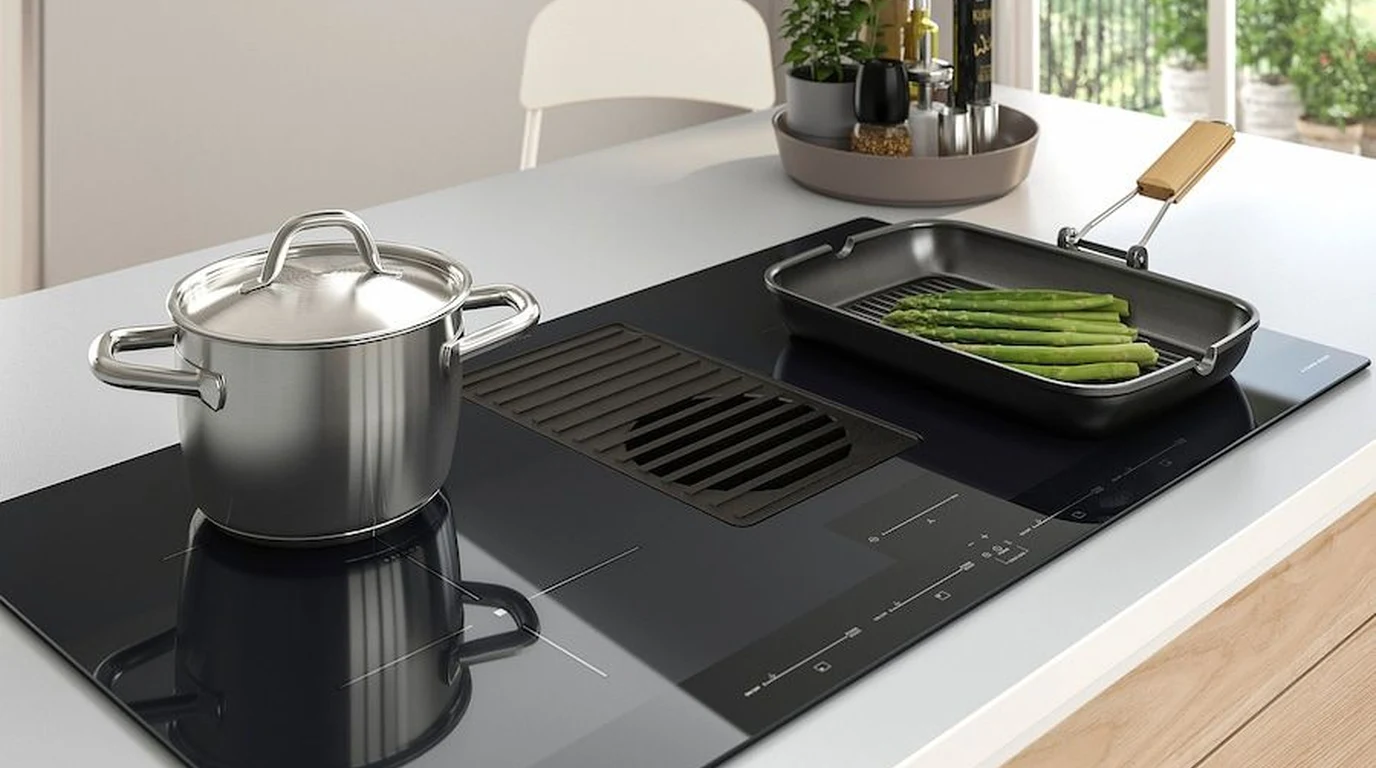
- Hardware: Units like the Duxtop 9600LS or NuWave Gold plug into a standard 120V 15A/20A wall outlet.
- Peak Power: Maximum draw is capped at 1,800 Watts (15 Amps at 120V).
- Inverter Sizing: Any high-quality 2,000W to 3,000W pure sine wave inverter (such as an EG4 3000EHV or Victron MultiPlus-II 12/3000) can run one portable induction burner effortlessly while powering the refrigerator and lights.
- Strategy: Many off-grid builders keep two single portable burners on the counter, using one for everyday cooking and engaging the second only when solar panels are producing peak midday output.
Tier 2: Built-in 240V 4-Burner Kitchen Ranges
For permanent off-grid residences seeking a traditional full-sized kitchen experience (e.g., Empava 30-inch, Frigidaire Gallery, or Bosch 500 series):
- Circuit Requirement: Built-in induction cooktops require a dedicated 240V split-phase 30A to 50A breaker circuit.
- Power Share Management: Full-size cooktops feature four to five induction zones:
- Zone 1 (Small): 1,400W
- Zone 2 (Medium): 1,800W
- Zone 3 (Large): 2,400W
- Zone 4 (Boost): Up to 3,700W
- Total Nameplate Rating: The theoretical connected load can reach 7,200W to 9,600W if all four burners were turned to maximum power simultaneously.
- Realistic Cooking Concurrency: In practice, family cooking rarely runs more than two burners at high heat simultaneously (typically drawing 3,200W to 4,600W combined).
- Inverter Sizing: Requires a split-phase hybrid inverter rated for at least 8,000W to 12,000W continuous output (such as a Sol-Ark 12K/15K, EG4 18kPV, or Schneider Conext XW Pro 6848). At 12kW capacity, turning on a 3,500W induction element leaves over 8,000W of headroom for well pumps and air conditioning.
+-----------------------------------------------------------------------------------+
|               INVERTER SIZING RECOMMENDATIONS FOR INDUCTION COOKING               |
+-----------------------------------------------------------------------------------+
| Cooking Hardware Setup        | Peak Continuous Draw | Recommended Inverter Model |
+-------------------------------+----------------------+----------------------------+
| Single 120V Portable Burner   | 1,800 Watts          | Victron MultiPlus-II 3kVA  |
| Dual 120V Portable Burners    | 3,600 Watts          | EG4 6000XP (6kW Split-Phase)|
| 30-inch 240V 4-Burner Cooktop | 4,500W to 7,200W     | Sol-Ark 15K or EG4 18kPV   |
+-------------------------------+----------------------+----------------------------+
Power Quality Requirements: Pure Sine Wave vs Modified Waveform Hazards
Induction cooktops are sophisticated solid-state power electronic devices. They do not operate like traditional resistive heating coils.
High-Speed IGBT Switching and Inverter THD
Inside an induction cooktop:
- Incoming AC power is filtered and rectified into a high-voltage internal DC rail.
- High-speed Insulated Gate Bipolar Transistors (IGBTs) chop this DC voltage into high-frequency pulses to drive the magnetic induction coil.
- Microprocessor control circuits continuously measure cookware resonance, pot presence, and pan temperature.
Critical Electrical Requirement: Induction cooktops mandate a Pure Sine Wave inverter with Total Harmonic Distortion (THD) under 3%:
- The Modified Sine Wave Hazard: Attempting to power an induction cooktop from a cheap modified sine wave (“square wave”) inverter will immediately destroy the cooktop’s internal input filter capacitors and burn out the control board.
- Dirty Generator Power: If your off-grid inverter is running in generator bypass mode while connected to an unconditioned, open-frame construction generator with high harmonic distortion (THD > 10%), the induction cooktop’s electronic touch sensors may glitch, refuse to detect pots, or throw flashing error codes.
Indoor Air Quality and the Winter Heating Penalty
An often-overlooked factor in off-grid cabin design is how cooking affects indoor air quality and seasonal heating efficiency.
Propane Combustion Moisture and Toxic Byproducts
Burning one gallon of propane gas releases approximately 0.8 gallons of vaporized water directly into your indoor living environment:
- In tight, well-insulated off-grid cabins, this excess humidity condenses on cold exterior walls, timber framing, and double-pane windows, promoting toxic black mold growth.
- Gas burners emit significant quantities of nitrogen dioxide (), carbon monoxide (), and ultrafine particulate matter ().
- To prevent headaches and respiratory illness, off-grid homeowners must run powerful mechanical range hoods (typically exhausting 200 to 400 CFM) while cooking with gas.
The Winter Ventilation Energy Penalty
In sub-zero winter conditions, running a 300 CFM range hood to evacuate propane exhaust creates an enormous heating penalty:
- Evacuating 300 cubic feet per minute of warm cabin air forces 300 CFM of freezing sub-zero air to infiltrate through doors and wall penetrations.
- Your wood stove or heat pump must burn extra energy simply to reheat that makeup air.
- The Induction Advantage: Because induction produces zero combustion emissions and zero off-gassing, cooking requires minimal ventilation, preserving warm indoor air and keeping cabin humidity completely controlled.
Off-Grid Solar Kitchen Design Checklist
Before disconnecting your propane cooking lines and transitioning to all-electric induction, verify that your homestead power system fulfills this checklist:
+-----------------------------------------------------------------------------------+
|                     OFF-GRID INDUCTION TRANSITION AUDIT                           |
+-----------------------------------------------------------------------------------+
| [X] Battery Bank Capacity: Minimum 10kWh to 15kWh (200Ah-300Ah at 48V) LiFePO4   |
|     to easily absorb 1.8kWh daily cooking without exceeding 20% total depth.      |
|                                                                                   |
| [X] Solar PV Allocation: Minimum 600W to 800W of dedicated solar array capacity   |
|     to fully replenish daily cooking energy even during cloudy shoulder months.   |
|                                                                                   |
| [X] Inverter Waveform: Pure sine wave inverter with verified Total Harmonic       |
|     Distortion (THD) under 3% to safeguard sensitive internal IGBT driver boards. |
|                                                                                   |
| [X] Continuous Inverter Headroom: Minimum 6kW split-phase capacity for dual 120V   |
|     burners; minimum 12kW split-phase capacity for 240V 4-burner kitchen ranges.  |
|                                                                                   |
| [X] Cookware Compatibility: High-quality magnetic stainless steel, enameled iron, |
|     or cast-iron cookware (cookware must firmly attract a refrigerator magnet).   |
|                                                                                   |
| [X] Winter Emergency Redundancy: Maintain a single portable butane/propane stove  |
|     in storage for multi-week winter blizzards or system maintenance.             |
+-----------------------------------------------------------------------------------+
By leveraging the ninety percent thermodynamic efficiency of magnetic induction, off-grid homeowners can eliminate recurring propane refill logistics, clean up their indoor living air, and prepare gourmet meals entirely powered by clean, self-replenishing solar energy.