When homeowners and off-grid homesteaders invest thousands of dollars in high-efficiency monocrystalline solar panels, they expect peak kilowatt-hour production day after day. Yet after a few dry months, many notice their system output slowly declining by 10%, 15%, or even 25%, despite crystal-clear blue skies.
The culprit is almost always photovoltaic soiling—the gradual buildup of airborne dust, pollen, bird droppings (guano), vehicle exhaust soot, and agricultural particulate on the front glass.
According to research from the National Renewable Energy Laboratory (NREL), uncleaned solar arrays lose an average of 5% to 7% of their annual energy yield in moderate climates, and over 25% in dry, dusty, or agricultural regions. On a 10kW residential system, that translates to hundreds of wasted kilowatt-hours and real financial losses every single year.
However, cleaning solar panels is not as simple as blasting them with a garden hose or scrubbing them like a kitchen floor. Modern solar glass is treated with an ultra-thin, microscopic Anti-Reflective Coating (ARC). Using hard tap water, harsh chemicals, abrasive brushes, or high-pressure washers can permanently destroy this coating, fracture tempered glass, or void your 25-year manufacturer warranty.
In this engineering guide, we break down the physics of soiling losses, examine the chemistry of solar glass maintenance, and outline the exact step-by-step protocol for cleaning your panels safely and efficiently.
Clean your solar panels twice a year (early spring after pollen season and late autumn after harvest/fire season). Always clean in the early morning or late evening when panel glass is cool to eliminate thermal shock glass breakage. Use only deionized (DI) or reverse-osmosis water (under 10 ppm TDS) paired with a soft flagged-bristle telescopic brush. Never use high-pressure washers, abrasive sponges, or chemical detergents.
Calculate Efficiency Payback →
The Physics of Soiling: Why Dust Steals Huge Wattage
Photovoltaic soiling affects power generation in two fundamentally distinct ways: uniform optical attenuation and localized cell reverse-bias hot-spotting.
Uniform Fine Dust & Pollen
A thin, even film of mineral dust scatters incoming photons before they reach the silicon p-n junction, causing a linear, symmetrical reduction in string current ().
Electrical Effect: Linear Current Drop
Bird Droppings & Leaf Debris
Completely blocks a single cell. The blocked cell turns into a resistive load, forcing string current around it via bypass diodes and sacrificing 33% of the entire module’s voltage.
Electrical Effect: Hot Spot & Bypass Trigger
Lower Frame “Mud Dams”
Rain washes dirt downward where surface tension pools it against the bottom aluminum frame. On low-tilt panels (under 15°), this creates a persistent sludge strip across the bottom cell row.
Electrical Effect: Bottom String Throttling
Why Rain Doesn’t Clean Your Panels Effectively
Many solar owners assume that periodic rainfall acts as a free, automatic cleaning service. While heavy, driving torrential downpours can wash away loose surface dust, light rain and morning dew frequently make soiling worse:
- The Cementing Effect: Light rain dissolves airborne dust and atmospheric smog, spreading a muddy slurry across the glass.
- Rapid Evaporation: As soon as the morning sun strikes the array, the water evaporates in minutes, leaving baked-on mineral sludge that sticks tenaciously to the glass.
- Pollen Resin: Tree and weed pollen contains organic resins that are water-insoluble. Rain simply smears the pollen into a yellowish, sticky film that water alone cannot dissolve.
If your panels are installed at a shallow tilt angle (under ), rainwater cannot overcome surface tension at the lower aluminum lip, leaving an opaque strip of dirt that shades the entire bottom series string.
The Chemistry of Solar Glass: Why Tap Water Is Dangerous
Modern solar panels do not use ordinary window glass. They utilize low-iron, high-transmission tempered glass coated with a microscopic 70nm to 100nm Anti-Reflective Coating (ARC) made of porous silicon dioxide (). This coating reduces surface reflection from 4% down to under 1%, allowing more photons to penetrate into the silicon.
Cleaning with the wrong materials destroys this delicate layer:
Electroluminescence Imaging of Cleaning & Mechanical Damage
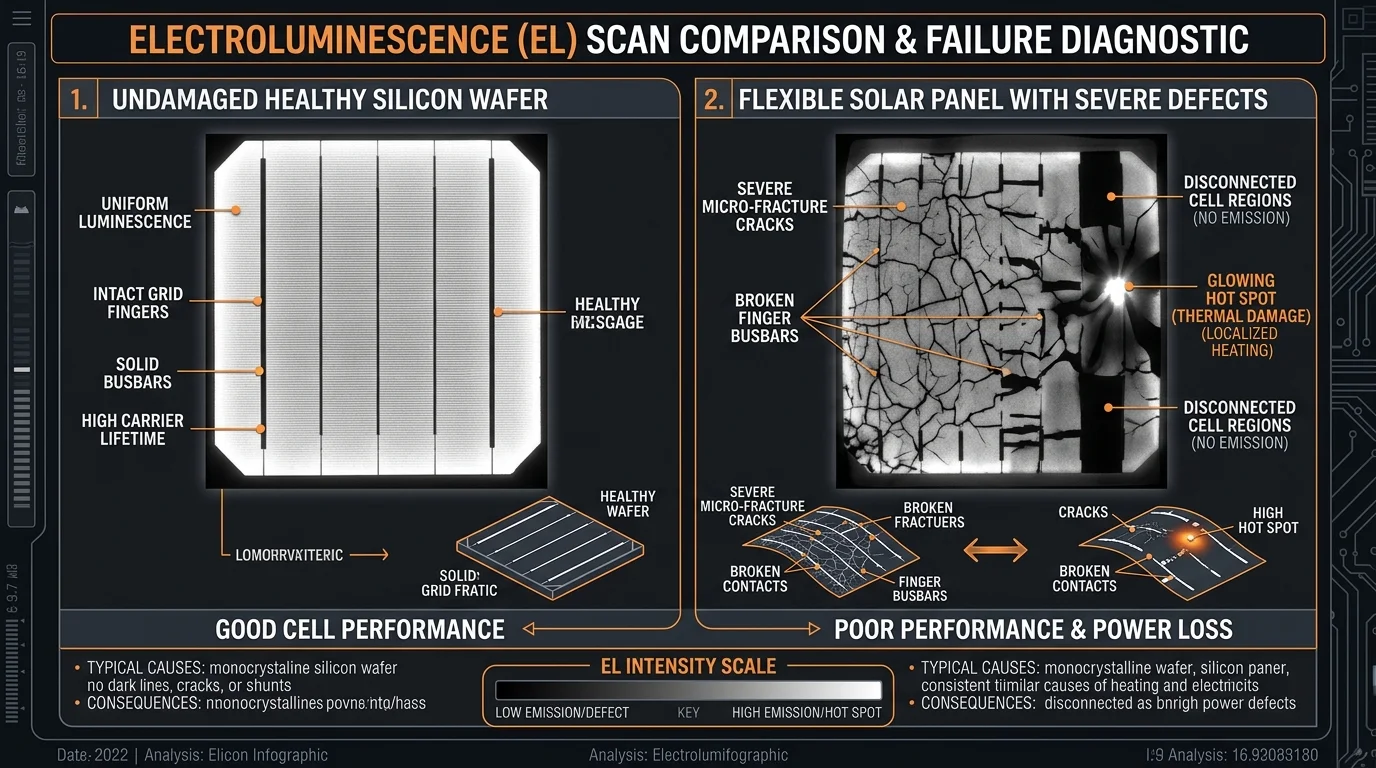
The Threat of Hard Water (Total Dissolved Solids)
Municipal tap water and well water are heavily saturated with dissolved minerals—principally calcium () and magnesium (). In most regions, tap water measures between 150 ppm and 450 ppm Total Dissolved Solids (TDS).
When you spray panels with a garden hose under warm weather:
- The water droplets evaporate rapidly.
- The dissolved calcium and magnesium precipitate out of solution, leaving behind microscopic crusts of calcium carbonate ()—commonly known as limescale.
- Under intense solar ultraviolet radiation and glass heat, this mineral crust chemically bonds with the porous anti-reflective coating.
- Within months, your panels develop permanent, milky white water spots that cannot be scrubbed off without etching the glass with acid—ruining panel transmission forever.
The Golden Rule: Always clean solar panels using pure deionized (DI) or reverse-osmosis (RO) water with a TDS rating under 10 ppm. Pure DI water evaporates completely spot-free, leaving zero mineral residue.
When and How Often to Clean Solar Panels
Cleaning frequency depends on your geographic location, surrounding land use, and array tilt angle:
| Operating Environment | Primary Soiling Source | Recommended Cleaning Frequency | Expected Energy Restoration |
|---|---|---|---|
| Arid / Desert Regions (AZ, NV, CA) | Fine silica dust, sandstorms, zero rain | Every 6 to 8 weeks during dry season | +15% to +28% |
| Agricultural / Farming Areas | Tractor tilling dust, pesticide mist, pollen | 3 to 4 times per year (post-harvest) | +12% to +20% |
| Highways / Industrial Corridors | Diesel particulate, tire rubber, carbon soot | Every 3 to 4 months | +8% to +14% |
| Standard Suburban Residential | Tree pollen, bird droppings, urban dust | Twice a year (Spring & Autumn) | +5% to +10% |
| High Rainfall Coastal Areas | Salt spray, light atmospheric dust | Once a year (inspect periodically) | +3% to +6% |
The Critical Timing Rule: Early Morning Only
Never clean solar panels in the middle of a sunny day.
By 1:00 PM on a clear summer day, solar glass reaches temperatures between and ( to ). Spraying unheated tap water () onto boiling-hot tempered glass creates a massive temperature differential:
When exceeds , the localized thermal contraction induces extreme tensile stress across the glass plate. The tempered glass will shatter instantaneously with a loud pop, resembling a spiderweb fracture.
Schedule your cleaning sessions:
- In the early morning before 8:30 AM, when the glass is cool and night dew has already softened caked-on dirt.
- In the late evening after sunset, once the panels have cooled down to ambient air temperature.
- On fully overcast, cool cloudy days.
The 5-Step Professional Cleaning Protocol
Follow this field-tested procedure to clean your solar panels with zero risk of glass etching or electrical shock:
Electrical Isolation (Shutdown Array)
Turn off your solar inverter and switch the DC disconnect isolator to the OFF position. While solar panels have insulated wiring, washing high-voltage DC arrays (up to 450V DC) with water carries a shock risk if any cable insulation or MC4 connector seal is damaged.
Dry Surface Pre-Sweep
Before applying any water, use a soft, dry telescopic microfiber duster or flagged-bristle brush to sweep away loose leaves, pine needles, cobwebs, and heavy dry dust. Removing dry particulate first prevents creating a gritty slurry that can scratch the glass when scrubbed.
Low-Pressure DI Water Rinse
Using a water-fed telescopic pole connected to a pure deionizer tank, wet the panel surface thoroughly under low pressure (under 40 PSI). Allow the pure water to soak for 60 seconds to soften baked bird droppings and sap deposits.
Gentle Agitation with Flagged Boar’s Hair Brush
Gently brush the wet glass in horizontal overlapping passes. Flagged bristles have microscopic split ends that trap and lift dirt without applying abrasive pressure. For stubborn bird droppings, use a specialty pH-neutral, biodegradable solar wash soap.
Spot-Free Rinse & Squeegee
Give the array a final rinse with pure deionized water. If using DI water (under 10 ppm TDS), you can let the panels air dry completely streak-free. For ground mounts, use a soft rubber window squeegee to remove excess water from the bottom aluminum frame lip.
Best Solar Cleaning Equipment & Hardware
To clean your solar array safely without climbing onto precarious roof pitches, invest in dedicated professional-grade cleaning tools:
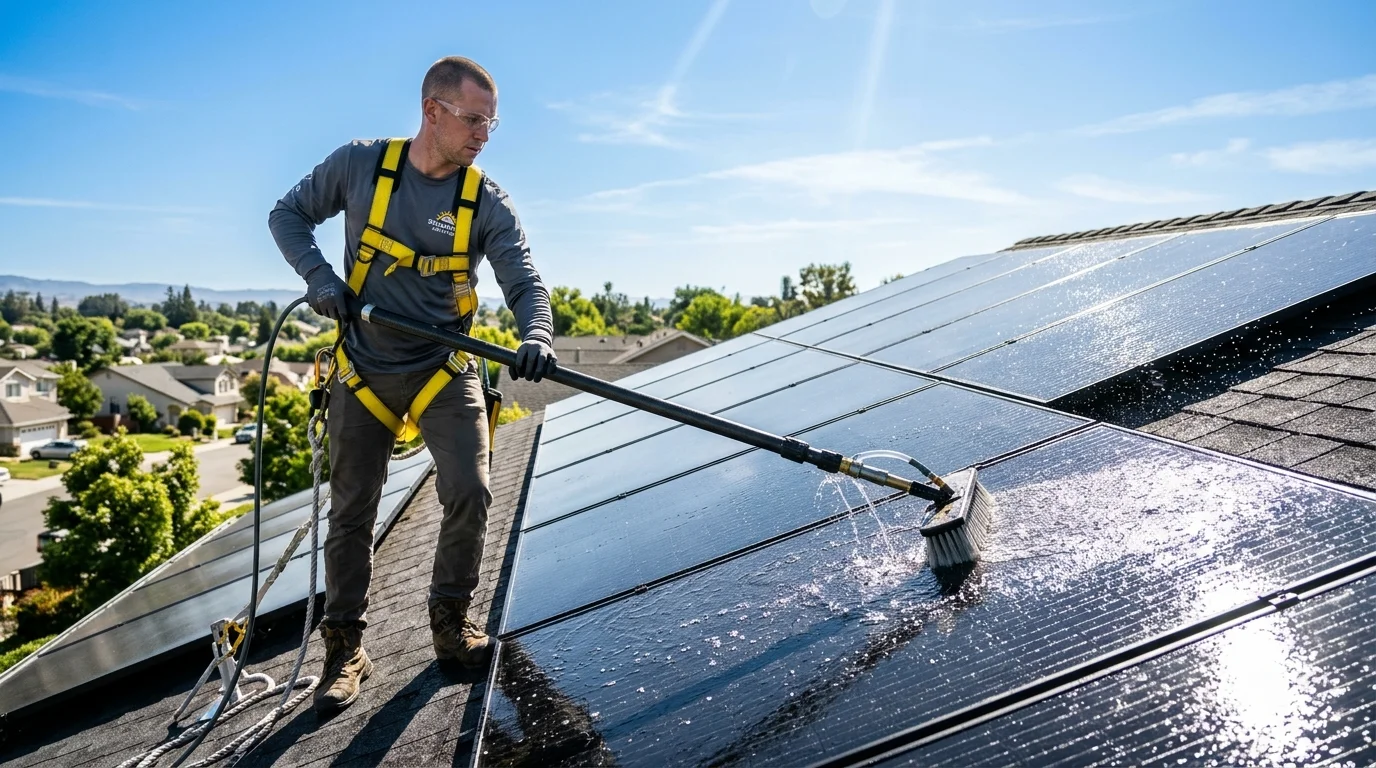
1. Telescopic Water-Fed Solar Cleaning Pole Kit (24ft – 30ft)
Allows you to clean single-story and two-story rooftop arrays safely from the ground or from a stable ladder. Crafted from lightweight aerospace carbon fiber with internal water hoses, adjustable angle gooseneck, and non-abrasive flagged nylon bristles.
Check Water-Fed Pole Pricing →
2. Pure DI Water Deionizer Resin Filter Tank
Connects directly between your outdoor garden spigot and water-fed pole. Nuclear-grade mixed-bed ion-exchange resin strips 100% of dissolved calcium, magnesium, and salts from tap water, producing laboratory-grade 0 PPM water for streak-free drying.
Explore Deionizer Filter Options →
3. Specialized pH-Neutral Solar Wash Concentrate
Formulated specifically to dissolve stubborn organic bird droppings, bee pollen resin, and tree sap without attacking aluminum frames or the anti-reflective silica coating. Biodegradable, non-toxic, and safe for roof runoff into landscape garden beds.
View Solar Cleaning Solutions →

4. Professional Non-Scratch Rubber Squeegee (18-Inch)
For ground-mounted solar arrays and RV roof panels, an 18-inch soft vulcanized rubber squeegee wipes away standing water in a single sweep, preventing lower frame lip sludge accumulation and speeding up return-to-service time.
Check Squeegee Accessories →
4 Costly Mistakes to Avoid When Cleaning Solar Panels
Avoid these four dangerous maintenance habits that cause permanent hardware failure and void equipment warranties:
- Walking or Kneeling on Solar Modules: Never step or kneel on a solar panel. While the tempered glass can support heavy distributed snow loads without shattering, localized point pressure from human feet causes microscopic silicon wafer fractures (micro-cracks). Over successive thermal expansion cycles, these micro-cracks sever internal silver grid fingers, creating permanent hot spots and slashing module output by 20% to 50%.
- Using High-Pressure Power Washers: High-pressure washer wands (exceeding 1,200 PSI) blast water past the protective silicone seals bordering the aluminum frame and penetrate the IP65/IP68 bypass diode junction box on the rear. Internal moisture causes immediate ground-fault inverter trips, electrolytic corrosion, and catastrophic electrical shorts.
- Using Household Detergents, Bleach, or Abrasives: Dishwashing soaps (like Dawn), laundry detergents, Windex, and bleach leave greasy chemical residues that attract airborne dust like a magnet. Abrasive scrub pads (like Scotch-Brite) gouge the anti-reflective coating, turning glossy clear glass into a cloudy, frosted surface that scatters photons.
- Scraping Ice or Frozen Snow with Metal Shovels: In winter, scraping ice off panels with metal or hard plastic blades will scratch the ARC coating and crack the glass. Use a soft automotive foam snow rake, or rely on steep array tilt angles and internal cell heating to slide snow off naturally.
Frequently Asked Questions (FAQ)
Will cleaning my solar panels void the manufacturer warranty?
Cleaning your panels according to manufacturer guidelines (using clean water, non-abrasive soft brushes, and pH-neutral soap) will not void your warranty. However, using high-pressure washers, chemical solvents (such as acetone, paint thinner, or bleach), abrasive scouring pads, or walking on the modules will instantly void both the workmanship and power output warranties.
How much extra electricity will I get after cleaning my panels?
In moderate suburban environments with regular rainfall, cleaning typically restores 5% to 10% of lost energy. In dry agricultural valleys, desert regions, or areas affected by wildfire smoke and heavy spring pollen, cleaning can restore 15% to 30% of total array output. You can verify your exact gains by checking your inverter’s live solar generation app before and after washing.
Can I clean rooftop solar panels from the ground?
Yes. With modern telescopic water-fed poles extending 24 to 30 feet, homeowners can safely clean single-story and most two-story rooftop arrays from ground level or a low, stable stepladder. We strongly discourage homeowners from walking on pitched roofs—the combination of wet sloped roof tiles, soapy water, and tripping hazards makes roof climbing extremely dangerous.
Can I use vinegar to clean stubborn water spots on solar panels?
While dilute white vinegar (a mild acetic acid) can dissolve light mineral scale, we do not recommend it as a routine cleaning solution. Acidic solutions can degrade the aluminum frame’s anodized protective layer and attack the silicone sealant bonding the glass to the frame. The best strategy is prevention: always rinse with deionized water (under 10 ppm TDS) so limescale never forms in the first place.
Do automated solar cleaning robots actually work?
Automated robotic cleaning systems work exceptionally well for large commercial rooftop installations and utility-scale ground mount solar farms, where labor costs are prohibitive. However, for residential systems with only 15 to 30 panels, the high capital cost of robotic cleaning hardware (4,000+) cannot be economically justified compared to a simple $150 water-fed pole used twice a year.