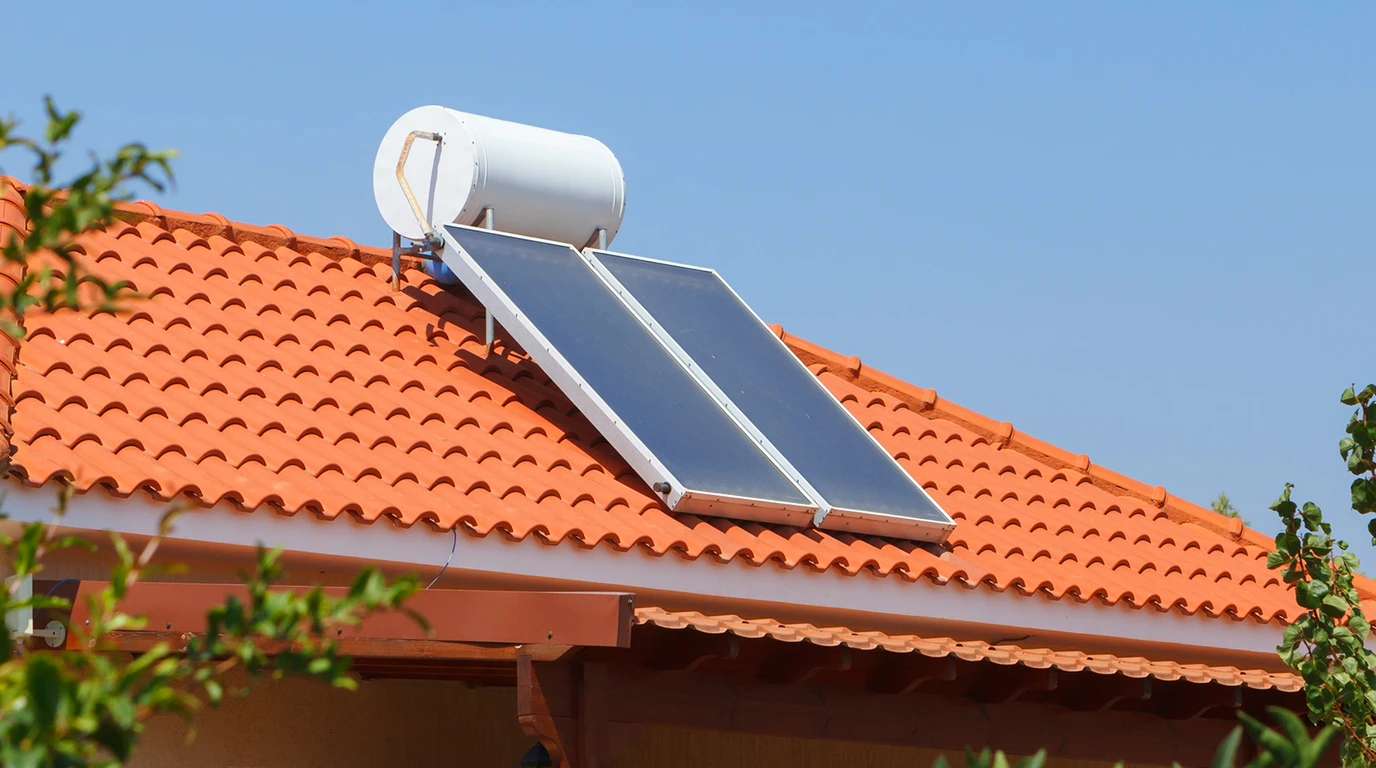
Domestic water heating is typically the second largest consumer of electrical energy in a residential home, accounting for 18% to 25% of total annual utility consumption. On remote homesteads, off-grid cabins, and rural farms, heating water with standard electric resistance elements places immense strain on inverters and rapidly drains expensive lithium or lead-acid battery banks.
Historically, solar builders turned to solar thermal plumbing systems: roof-mounted evacuated tubes or flat-plate collectors that circulated propylene glycol fluid through copper pipes down to an internal heat exchanger coil. While thermally efficient on paper, solar thermal plumbing is notorious for maintenance headaches: circulating pumps fail, glycol degrades and turns acidic under stagnation, roof penetration seals leak, and winter freeze-ups can burst copper pipe headers.
Over the past decade, a quiet revolution in photovoltaic manufacturing economics changed everything. With high-efficiency monocrystalline solar panels dropping below thirty cents per Watt, an elegant engineering alternative emerged: Direct Photovoltaic (PV) Water Heating.
By wiring standard solar panels directly to an electric water heater’s resistive element—bypassing central inverters, charge controllers, and battery banks entirely—you create an indestructible thermal storage system with zero moving parts, zero plumbing fluid leaks, and virtually 100% electrical-to-thermal conversion efficiency.
However, connecting direct current from solar panels to a water heater requires strict adherence to electrical engineering principles. If you fail to match element resistance to the panel array’s Maximum Power Point, or if you route high-voltage DC through a standard AC mechanical thermostat, you risk catastrophic power collapse or sustained electrical fires.
This comprehensive guide details the Ohm’s Law mathematics, DC arc suppression circuitry, and installation protocols required to build a bulletproof direct-PV solar water heating system.
A standard 50-gallon domestic water heater raised from 55°F to 140°F stores approximately 35,400 BTUs of thermal energy—the electrical equivalent of 10.4 kilowatt-hours of usable battery capacity. Storing this energy in a 48V lithium iron phosphate battery costs roughly $3,500 and degrades over 6,000 cycles. Storing that exact same energy as thermal heat inside a well-insulated $500 water tank costs pennies per kilowatt-hour, exhibits zero chemical degradation, and lasts thirty years.
Why Direct PV Water Heating Outperforms Solar Thermal Plumbing
Before analyzing the electrical circuitry, it is essential to understand why direct-PV heating has largely rendered glycol solar thermal collectors obsolete:
+-------------------------------------------------------------------------------+
|                 SOLAR THERMAL GLYCOL VS DIRECT PV WATER HEATING               |
+-------------------------------------------------------------------------------+
|                                                                               |
|  [ TRADITIONAL SOLAR THERMAL PLUMBING ]                                       |
|  Sunlight ---> [ Evacuated Tubes ] ===(Hot Glycol Pipes)===> [ Heat Exchanger]|
|                        |                                             |        |
|                        +--> High Risk: Glycol leaks, air locks,      +--> Tank|
|                             pump failures, stagnation boiling (300°F)         |
|                                                                               |
|  [ DIRECT PV TO RESISTIVE TANK ]                                              |
|  Sunlight ---> [ Standard PV String ] ===(Flexible 10 AWG Wire)===> [ Element]|
|                        |                                             |        |
|                        +--> Zero Maintenance: No fluid, no pumps,    +--> Tank|
|                             no roof leaks, 100% solid-state wires             |
|                                                                               |
+-------------------------------------------------------------------------------+
The Reliability Superiority of Solid-State Copper Wires
- Installation Simplicity: Pulling two flexible 10 AWG copper solar conductors through an attic or conduit is infinitely faster, cheaper, and less invasive than soldering insulated 3/4-inch copper tubing with expansion loops, air bleeders, and pressure relief drains.
- Freeze and Stagnation Resilience: During sub-zero winter blizzards, solar thermal glycol can gel, and if a circulating pump loses power during a sunny summer outage, collector temperatures spike past 350°F (177°C), boiling glycol into an acidic sludge that destroys seals. Photovoltaic panels, by contrast, operate with higher efficiency in freezing temperatures and simply enter open-circuit standby () when no current is drawn, suffering zero physical damage from stagnation.
- Lifecycle Cost per BTU: When factoring in annual glycol replacement, pump replacements, and specialized plumbing labor, direct-PV systems deliver a lower levelized cost of heat over a 25-year operational lifecycle.
Ohm’s Law and The Resistance Matching Equation
The single most common mistake made by DIY solar builders is connecting low-voltage solar panels to a standard off-the-shelf residential water heater. To understand why this fails, we must analyze the fundamental relationship between voltage, resistance, and dissipated power.
Calculating Element Internal Resistance
A standard American residential electric water heater element is rated at 4,500 Watts at 240 Volts AC. Using Joule’s Law:
Substituting the manufacturer’s rated specifications:
The internal resistance of that nichrome heating element is permanently fixed at 12.8 Ohms. It does not care whether the applied voltage is AC or DC; it obeys Ohm’s Law purely as a resistive load.
The Low-Voltage Trap: Why 48V Produces Almost Zero Heat
Suppose an off-grid homeowner connects a 48V battery bank or a 48V nominal solar array directly to that 4,500W element:
Connecting a 4,500W heating element to 48 Volts does not yield 900W or 1,000W—it yields a dismal 180 Watts! Because power scales with the square of the voltage (), cutting voltage by a factor of five reduces heat production by a factor of twenty-five. A 50-gallon tank receiving 180W will lose heat to ambient room air faster than the element can warm it.
Solving the Impedance Mismatch: Low-Voltage vs High-Voltage Strategies
To extract maximum power from solar photovoltaic panels, the resistive load () must equal the dynamic resistance of the solar array at its Maximum Power Point ():
Installers can achieve this optimal resistance match using one of two distinct engineering methodologies:
+-------------------------------------------------------------------------------+
|                       TWO PATHS TO IMPEDANCE MATCHING                         |
+-------------------------------------------------------------------------------+
|                                                                               |
|  PATH A: Custom Low-Voltage DC Element                                        |
|  [ 48V Solar Setup ] ---> High Current (25A) ---> [ 1.92-Ohm Custom DC Element]|
|  - Requires thick 6 AWG or 4 AWG copper wire over short distances             |
|                                                                               |
|  PATH B: High-Voltage PV Series String                                        |
|  [ 5x 400W Panels in Series ] ---> Low Current (10A) ---> [ Stock 12.8-Ohm AC ]|
|  - Uses standard 10 AWG wire over hundreds of feet with stock water heater    |
|                                                                               |
+-------------------------------------------------------------------------------+
Strategy A: Custom Low-Voltage DC Submersible Elements
If your solar array operates at a low DC voltage (e.g. 24V or 48V):
- You must unscrew the factory 240V AC heating element using a 1.5-inch element socket wrench and replace it with a custom low-voltage DC element wound with thick nichrome wire.
- For a 48V DC, 1,200W target power level:
- Tradeoff: While low voltage eliminates high-voltage shock hazards, pushing 1,200 Watts at 48 Volts requires 25 Amperes of continuous current (). High current demands heavy, expensive 6 AWG or 4 AWG copper wiring to avoid severe line-resistance voltage drop between the panels and the water heater.
Strategy B: High-Voltage PV Stringing with Stock 12.8-Ohm Elements
The far more elegant and economical engineering approach is to increase the solar array string voltage to match the factory 12.8-Ohm element:
- Suppose you connect five 400W commercial monocrystalline solar panels in series.
- Typical panel specifications:
- Rated Maximum Power Voltage ():
- Rated Maximum Power Current ():
- Open-Circuit Voltage ():
- Total array string characteristics:
- Connecting this 200V DC string to the factory 12.8-Ohm heating element:
- Operating at 200V DC and 15.6 Amperes, the solar array operates directly within its peak power band, delivering over 3,000 Watts of thermal energy directly into the tank using thin, inexpensive 10 AWG solar cable run over distances exceeding 150 feet.
Critical Electrical Safety: The DC Arc Phenomenon and Quenching
While high-voltage direct-PV water heating is mechanically simple, it introduces an extreme electrical hazard that every installer must respect: sustained DC electrical arcing.
+-------------------------------------------------------------------------------+
|                       AC ZERO-CROSSING VS CONTINUOUS DC ARC                   |
+-------------------------------------------------------------------------------+
|                                                                               |
|  AC Current Waveform (60Hz):                                                  |
|       +--+      +--+                                                          |
|  ----+----+----+----+----+----> Crosses ZERO Volts 120 times every second!   |
|            +--+      +--+       Arcs naturally extinguish as voltage crosses 0|
|                                                                               |
|  DC Current Waveform:                                                         |
|  ===============================> Continuous, uninterrupted voltage!          |
|                                 An open contact sustains a 2,000°F plasma arc |
|                                 that vaporizes copper and causes structural   |
|                                 fires unless magnetically or electronically   |
|                                 quenched!                                     |
|                                                                               |
+-------------------------------------------------------------------------------+
Why Standard Water Heater Thermostats Catch Fire on DC
Residential water heaters use bimetallic snap-action mechanical thermostats (such as Therm-O-Disc 59T/66T). When the water reaches its setpoint (e.g. 130°F), the bimetal disc flexes, pulling two small silver contacts apart by roughly 1/16 of an inch.
- On Alternating Current (AC), the electric arc formed across the opening contacts extinguishes within a fraction of a millisecond because AC voltage drops to zero volts 120 times per second.
- On Direct Current (DC) exceeding 30 Volts, there is no zero-crossing point. When contacts open under 150V to 200V DC, the ionizing air gap ignites a continuous plasma blowtorch reaching temperatures over 2,000°F (1,100°C). The silver contacts melt, plastic enclosures ignite, and the thermostat housing catches fire.
The Solid-State Relay (SSR) Solution
To control a high-voltage DC heating element safely, you must decouple the mechanical thermostat from the high-voltage load circuit:
+-------------------------------------------------------------------------------+
|                 SOLID-STATE RELAY (SSR) CONTROL SCHEMATIC                     |
+-------------------------------------------------------------------------------+
|                                                                               |
|  [ Solar Array DC (+) ] ---> [ DC Circuit Breaker ] ---> [ Solid-State Relay ]|
|                                                                  |            |
|                                                            (Load Terminal)    |
|                                                                  v            |
|                                                            [ Water Element ]  |
|                                                                  |            |
|  [ Solar Array DC (-) ] <----------------------------------------+            |
|                                                                               |
|  CONTROL LOOP (Safe Low-Voltage Circuit):                                     |
|  [ 12V DC Wall Transformer or Small Battery ]                                 |
|          |                                                                    |
|          +---> [ Stock Tank Thermostat Contact ] ---> [ SSR Control Inputs ]  |
|                                                                               |
+-------------------------------------------------------------------------------+- Use an Industrial DC-Rated Solid-State Relay: Install an industrial DC-DC SSR (such as a Crydom or Fotek rated for at least 300V DC and 40 Amperes) mounted to an aluminum heatsink. Solid-state relays use silicon semiconductor junctions (MOSFETs or IGBTs) with zero physical contacts, eliminating mechanical arcing entirely.
- Low-Voltage Thermostat Pilot Circuit: Route a safe 12V DC auxiliary signal through the factory water heater thermostat. When the water is cold, the thermostat contact closes, feeding 12V to the SSR control terminal, which switches on the high-voltage solar DC circuit. When the tank hits 130°F, the thermostat opens the 12V pilot line, commanding the SSR to seamlessly shut off the high-voltage solar loop.
- Emergency Mechanical Over-Temperature Cutoff (ECO): Never bypass the tank’s upper Emergency Cut-Off (ECO) button. The upper ECO must remain wired in series to trip an external DC-rated magnetic shunt breaker if water temperatures ever reach 180°F.
Mechanical Plumbing Safety and Temperature-Pressure Relief
Converting high solar wattage into domestic water storage requires redundant hydraulic over-temperature and over-pressure protection:
+-------------------------------------------------------------------------------+
|                      TANK PLUMBING AND OVERPRESSURE SAFETY                    |
+-------------------------------------------------------------------------------+
|                                                                               |
|                             [ Cold Water Inlet Line ]                         |
|                                       |                                       |
|                                       v                                       |
|  [ Hot Water Outlet Line ] <--- [ Insulated Tank ] ---> [ T&P Relief Valve ]  |
|             |                                                  |              |
|             v                                                  v              |
|  [ Anti-Scald Thermostatic                               [ Rigid Down-Pipe ]  |
|    Mixing Valve (120°F) ]                                (Drains to floor     |
|                                                           within 6 inches)    |
|                                                                               |
+-------------------------------------------------------------------------------+
The Temperature and Pressure (T&P) Relief Valve
Every pressurized domestic water tank must feature an ASME-certified Temperature and Pressure (T&P) Relief Valve rated for 150 PSI and 210°F (99°C).
- If electrical controls fail and the heating element continues boiling water uncontrollably, superheated water can flash into steam, expanding 1,600 times in volume and turning the water tank into a violent hydraulic rocket.
- The T&P valve features an internal thermal probe that opens mechanically when temperatures exceed 210°F or internal tank pressure exceeds 150 PSI, dumping boiling water safely through an air gap drain pipe.
- Never cap, plug, or reduce the pipe diameter of a T&P relief discharge line!
Anti-Scald Thermostatic Mixing Valve
On bright, sunny summer days, direct-PV arrays will easily push holding tank temperatures to 160°F to 175°F (maximizing thermal energy storage capacity).
- Water at 160°F causes third-degree skin burns in less than one second.
- Install an adjustable Thermostatic Anti-Scald Mixing Valve directly on the hot water outlet manifold. The valve automatically mixes cold supply water with the superheated tank water to deliver a safe, regulated 120°F (49°C) flow to household sinks and showers.
Financial Analysis: Cost per BTU vs Inverter-Coupled Solar
To evaluate the economic viability of direct-PV water heating, we benchmarked the hardware costs, conversion efficiency, and levelized cost of energy across three common off-grid water heating configurations:
+-------------------------------------------------------------------------------+
|               CAPEX & EFFICIENCY: THREE OFF-GRID HEATING PATHS                |
+-------------------------------------------------------------------------------+
|                                                                               |
|  Option 1: Inverter + Lithium Battery Architecture                            |
|  PV Array ---> Charge Controller ---> 48V Battery ---> Inverter ---> Element  |
|  - System Cost: $7,500 - $9,500                                               |
|  - Round-Trip Efficiency: ~76% (Conversion & electrochemical losses)          |
|                                                                               |
|  Option 2: Roof-Mounted Glycol Solar Thermal Plumbing                         |
|  Evacuated Tubes ---> Pump Station ---> Glycol Loop ---> Heat Exchanger Tank  |
|  - System Cost: $5,500 - $7,000                                               |
|  - Maintenance Overhead: High (Glycol testing, pump seals, freeze checks)     |
|                                                                               |
|  Option 3: Direct PV to Element with DC Solid-State Control                   |
|  PV Array (5x 400W) ---> DC Disconnect ---> SSR Switch ---> Stock Element     |
|  - System Cost: $1,600 - $2,100                                               |
|  - System Efficiency: ~98% Direct Electrical-to-Thermal Conversion            |
|                                                                               |
+-------------------------------------------------------------------------------+
Key Economic Takeaways
- Hardware Savings: Direct-PV eliminates the need to oversize your central off-grid inverter. Running a 3,000W water heater element through a whole-home inverter requires buying a 6kW or 8kW inverter and expanding your 48V battery bank by at least 15kWh. By offloading water heating to a dedicated direct-PV array, you can downsize your primary home power system significantly.
- Simplicity Wins: For cabins, workshops, off-grid homesteads, and small commercial farms, spending $1,800 on five solar panels, a solid-state relay, and a standard electric water heater delivers unlimited free domestic hot water with virtually zero annual maintenance.
By mastering Ohm’s Law resistance matching and respecting the physics of continuous DC arcing, you can transform ordinary solar panels into a virtually indestructible, high-capacity thermal energy battery for your homestead.