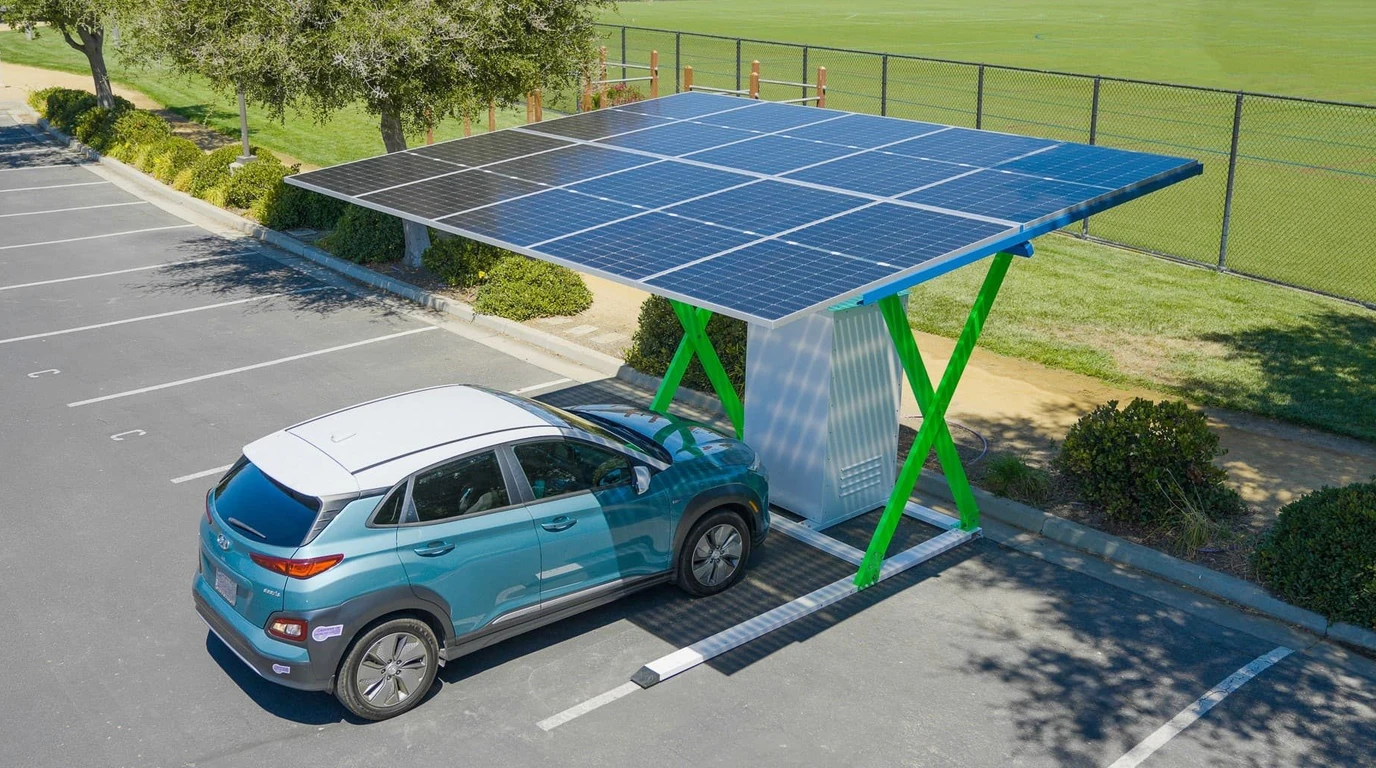
The widespread adoption of modern electric vehicles (EVs) has introduced a revolutionary mobile energy storage asset to off-grid homesteads and remote commercial facilities. A typical long-range electric vehicle houses between seventy-five and one hundred and thirty kilowatt-hours (75–130 kWh) of high-density lithium-ion battery capacity—an energy reservoir five to ten times larger than a typical residential stationary battery bank.
However, integrating an EV into an off-grid solar power system through conventional charging equipment introduces extreme electrical inefficiencies. Traditional residential EV charging relies on Level 2 Alternating Current (AC): direct-current solar power is stepped down to 48V DC, converted to 240V split-phase AC through a large central inverter, routed through an EVSE cable, and then converted back into 400V DC by the vehicle’s internal onboard charger.
Each conversion stage extracts a significant thermodynamic penalty in the form of wasted heat. On an off-grid solar homestead where every harvested Watt-hour is precious, squandering nearly a quarter of your solar generation in redundant power conversion is unacceptable.
The future of off-grid EV integration is Direct DC-to-DC Solar Fast Charging. By routing high-voltage photovoltaic strings directly into the vehicle’s traction battery via the Combined Charging System (CCS) or North American Charging Standard (NACS) ports, off-grid builders can achieve ultra-efficient charging, eliminate thermal stress on home inverters, and unlock massive bidirectional Vehicle-to-Home (V2H) microgrid storage.
This engineering guide examines the conversion losses of conventional AC charging, analyzes DC-to-DC buck-boost converter topologies, details digital communication protocols (ISO 15118), and maps out off-grid bidirectional V2H implementation.
Executive Summary: The Triple Conversion Loss Dilemma
In an off-grid solar system, photovoltaic modules generate direct-current (DC) electricity, stationary batteries store direct current, and an EV traction battery requires direct current.
Despite operating entirely within a DC native paradigm, conventional residential off-grid charging routes power through a needlessly convoluted AC detour:
+-----------------------------------------------------------------------------------+
|               CONVENTIONAL OFF-GRID LEVEL TWO AC CHARGING PIPELINE                |
+-----------------------------------------------------------------------------------+
|  [ Solar Array DC ] (400V DC)                                                     |
|         |                                                                         |
|         v (MPPT Step-Down Efficiency: ~ 96.5%)                                    |
|  [ Stationary Battery ] (48V DC Busbar)                                           |
|         |                                                                         |
|         v (Off-Grid DC-to-AC Inverter Efficiency: ~ 91.0%)                        |
|  [ 240V AC Split-Phase Power ] (Wall EVSE)                                        |
|         |                                                                         |
|         v (Vehicle Onboard AC-to-DC Charger Efficiency: ~ 87.5%)                  |
|  [ EV Traction Battery ] (400V DC Pack)                                           |
|                                                                                   |
|  NET SYSTEM END-TO-END EFFICIENCY:  0.965 x 0.910 x 0.875  =  76.8%               |
|  TOTAL ENERGY WASTED AS CONVERSION HEAT:                       23.2%              |
+-----------------------------------------------------------------------------------+
Nearly one out of every four kilowatt-hours generated by your solar panels is lost as heat before reaching your vehicle’s wheels. If an EV requires sixty kilowatt-hours to recharge, conventional Level 2 AC charging forces your solar array to produce seventy-eight kilowatt-hours total.
In contrast, a direct DC-to-DC Solar Fast Charger couples the high-voltage solar array directly to the vehicle’s DC charging pins through a single high-efficiency synchronous switching stage:
By eliminating the 48V intermediate step-down, the central inverter, and the vehicle’s onboard AC rectifier, energy losses drop from twenty-three percent down to under four percent, conserving fourteen kilowatt-hours of solar energy on every single recharge cycle.
The Inefficiency of Level Two Alternating Current Charging
To engineer a superior DC charging pipeline, we must first analyze the internal bottlenecks of conventional Level 2 AC charging.

The Cascading Stage Losses of Inverter-Based Charging
When charging at standard residential Level 2 rates (forty Amps at 240V AC, or 9,600 Watts), the off-grid power infrastructure experiences simultaneous stress across multiple components:
- Stationary Battery Discharge Overhead: In mixed solar conditions, sudden cloud cover forces the stationary 48V battery bank to output over two hundred Amps () to sustain the EVSE demand. This heavy C-rate discharge causes internal resistive heating inside stationary lithium cells, shortening their calendar life.
- Inverter Tare and Thermal Saturation: A 10kW or 12kW split-phase inverter operating near full capacity for five continuous hours runs its internal cooling fans at maximum speed, with core transformer and MOSFET temperatures exceeding one hundred and sixty degrees Fahrenheit.
- Vehicle Onboard Charger (OBC) Thermal Throttling: The vehicle’s onboard rectifier is confined within a cramped aluminum casing under the vehicle hood or trunk. Because it relies on single-phase AC rectification, it generates hundreds of watts of rejected heat, forcing the vehicle to run its internal coolant pump and radiator fans continuously throughout the charging session, consuming an extra two hundred to four hundred watts of parasitic power.
+-----------------------------------------------------------------------------------+
|               PARASITIC VEHICLE COOLING LOAD DURING AC CHARGING                   |
+-----------------------------------------------------------------------------------+
|  Gross AC Power Delivered by Inverter:                      9,600 Watts           |
|  Vehicle Onboard Charger Rectification Loss (12%):        - 1,152 Watts           |
|  Vehicle Thermal Management (Coolant Pump & Radiator):    -   350 Watts           |
|  Net Power Entering Lithium Cells:                          8,098 Watts           |
|  Actual Power Efficiency Reaching Battery:                   84.3%                |
+-----------------------------------------------------------------------------------+
Direct DC-to-DC Architecture: The Solid-State Solar Pipeline
Direct DC solar fast charging replaces the entire AC conversion apparatus with an intelligent, solid-state DC Charge Controller (such as the Enteligent e-Go or specialized commercial DC microgrid chargers).
High-Voltage Photovoltaic String Voltage Matching
Modern off-grid solar installations utilize high-voltage solar strings connected to hybrid inverters. Standard 400W to 550W commercial bifacial modules possess an open-circuit voltage () of approximately forty-eight to fifty volts and a maximum power point voltage () of roughly forty to forty-two volts.
By wiring eight to twelve modules in series, string voltages operate between three hundred and fifty and six hundred volts direct current (350V–600V DC):
+-----------------------------------------------------------------------------------+
|                   HIGH-VOLTAGE DC STRING TO EV TRACTION BATTERY                   |
+-----------------------------------------------------------------------------------+
|  Solar PV Array (10 Modules in Series):    ~ 420V DC Maximum Power Point (Vmp)    |
|  Tesla / Rivian / Hyundai EV Battery Pack: ~ 350V to 450V DC Operating Window     |
|                                                                                   |
|  VOLTAGE DELTA IS NEARLY IDENTICAL: High-Efficiency Direct DC Coupling Achievable |
+-----------------------------------------------------------------------------------+
Because modern 400V EV battery architectures (such as Tesla Model 3/Y, Ford F-150 Lightning, and Rivian R1T) operate across a nominal voltage window of 320V DC (zero percent state of charge) to 415V DC (one hundred percent state of charge), the solar array voltage closely mirrors the battery pack voltage.
Synchronous Buck-Boost DC Optimization
To regulate power delivery across varying solar irradiance levels, the DC solar EV charger employs a bidirectional four-switch synchronous buck-boost converter:
Where represents the high-frequency switching duty cycle of the Silicon Carbide (SiC) MOSFETs.
- SiC Wide-Bandgap Semiconductors: Operating at switching frequencies above one hundred kilohertz (100 kHz), Silicon Carbide power switches achieve efficiency ratings exceeding ninety-eight percent.
- Zero Inverter Load: The entire 10kW to 25kW charging stream travels directly from the roof down dedicated DC conductors, through the charger, and across the vehicle’s DC contactors. The home’s main split-phase inverter sees zero load, preserving its entire electrical capacity for domestic lights, well pumps, and refrigeration.
+-----------------------------------------------------------------------------------+
|                     DIRECT DC-TO-DC SOLAR EV FAST CHARGER                         |
+-----------------------------------------------------------------------------------+
|  [ High-Voltage Solar Array ] (450V DC)                                           |
|               |                                                                   |
|               v (Direct DC Photovoltaic Feed)                                     |
|  [ Synchronous SiC Buck-Boost Converter ] (98.2% Efficiency)                      |
|               |                                                                   |
|               v (Isolated DC Charging Cable)                                      |
|  [ CCS / NACS Port ] ===> Directly charges 400V Traction Battery                  |
|                                                                                   |
|  RESULT: Home Inverter Load = 0 Watts; End-to-End System Efficiency = 96.5%       |
+-----------------------------------------------------------------------------------+
Digital Handshaking and Safety Protocols: Combined Charging and NACS
DC fast charging cannot simply connect live high-voltage DC conductors to an electric vehicle. Because direct-current electricity produces severe, continuous plasma arcs if disconnected under load, strict international safety handshakes are governed by ISO 15118 and DIN 70121 standards.

Pilot Signal Negotiation and Isolation Resistance Checks
When the charging plug (CCS Combo 1 or NACS) is inserted into the vehicle:
+-----------------------------------------------------------------------------------+
|                      ISO 15118 DC FAST CHARGE HANDSHAKE                           |
+-----------------------------------------------------------------------------------+
|  Step 1: Mechanical Latch locks connector into vehicle port.                      |
|  Step 2: Proximity Pilot (PP) detects connection integrity.                       |
|  Step 3: Control Pilot (CP) initiates HomePlug Green PHY Power Line Comm (PLC).   |
|  Step 4: Charger performs 500V DC Isolation Resistance Test (Must exceed 100kΩ).  |
|  Step 5: Vehicle reports instantaneous Battery Pack Voltage (e.g. 382.4V DC).     |
|  Step 6: Charger adjusts internal output voltage to MATCH pack within 20 Volts.   |
|  Step 7: Vehicle closes main high-voltage DC contactors with ZERO arc strike.     |
|  Step 8: Current ramps dynamically based on available solar irradiance.           |
+-----------------------------------------------------------------------------------+
Pre-Charging Contactors and Arc-Flash Prevention
The most critical safety phase in direct DC charging is voltage pre-charging:
If a charger sitting at 450V were connected directly to a vehicle battery sitting at 360V, the ninety-volt differential across low-impedance battery cells would cause an instantaneous inrush current of thousands of Amperes, welding the vehicle’s internal contactors shut.
Under ISO 15118 protocols:
- The vehicle informs the DC charger of its exact internal terminal voltage via digital packets.
- The solar DC charger energizes internal capacitors and adjusts its SiC power stage until its output voltage matches the vehicle’s battery voltage to within less than twenty volts ().
- Only after voltage equilibrium is verified does the vehicle’s Battery Management System energize its internal mechanical contactors, guaranteeing spark-free closure.
Bidirectional Vehicle-to-Home Integration: The Mobile Homestead Microgrid
The ultimate realization of off-grid DC charging is Bidirectional Vehicle-to-Home (V2H) capability.
Transforming Electric Vehicles into Massive Off-Grid Storage
Consider the storage economics of a standard off-grid homestead:
- Standard Stationary Solar Battery: Six 48V 100Ah server rack batteries provide 30.7 kWh of storage at a cost of roughly nine to twelve thousand dollars.
- Modern Electric Pickup (Ford F-150 Lightning / Rivian R1T): Contains 131 kWh of automotive-grade liquid-cooled NMC or LFP storage.
+-----------------------------------------------------------------------------------+
|               OFF-GRID STORAGE COMPARISON: STATIONARY VS VEHICLE                  |
+-----------------------------------------------------------------------------------+
|  Stationary 48V Lithium Bank (6 Racks):      [=====] 30.7 kWh                     |
|  Long-Range Electric Vehicle (Rivian R1T):   [==============================] 131 kWh |
|                                                                                   |
|  STORAGE MULTIPLIER: 4.26x Greater Battery Capacity Already Sitting in Driveway   |
+-----------------------------------------------------------------------------------+
With a bidirectional DC-coupled charging station, power flows both directions:
- Sunny Afternoon: Solar strings feed directly into the vehicle at twelve kilowatts, fully saturating the 131 kWh battery pack.
- Prolonged Winter Blizzard (Three Sunless Days): The vehicle reverses power flow, delivering clean 400V direct current backward into the home’s microgrid. The vehicle effortlessly powers the entire homestead—including well pumps, heat pumps, and induction cooking—for seven to ten consecutive days without firing a fossil-fuel generator once.
High-Current Disconnects and Grounding Electrode Systems
To safely implement bidirectional DC microgrids:
- National Electrical Code (NEC) Article 625 & 705 Compliance: Requires a dedicated, lockable DC disconnect switch rated for 600V DC and continuous load breaking within sight of the charger.
- Galvanic Isolation: The DC charger must incorporate a high-frequency isolation transformer within its power stage to isolate the vehicle’s floating traction battery chassis ground from the homestead’s central grounding electrode system (NEC 250), preventing dangerous ground-fault loops.
Comprehensive Technical Comparison Matrix
To evaluate whether direct DC solar charging or traditional Level 2 AC charging fits your off-grid system, consult this technical matrix:
| Technical Specification | Traditional Level 2 AC Charging | Direct DC-to-DC Solar Fast Charging |
|---|---|---|
| End-to-End Solar Efficiency | 72% to 78% (Multi-stage losses) | 94% to 97% (Direct solid-state pipeline) |
| Load on Central Inverter | Extreme (9.6kW Continuous Load) | Zero (Completely bypasses home inverter) |
| Stationary Battery Wear | High (Heavy C-rate cycle cycling) | Zero (Charges straight from PV array) |
| Charging Power Limits | Capped by OBC (7.2kW to 11.5kW) | Scalable (10kW to 25kW+ Direct Solar) |
| Vehicle Thermal Management | Runs continuous radiator fans | Minimal (No onboard rectifier heating) |
| Communication Protocol | Basic PWM pilot duty cycle (J1772) | Digital PLC Handshake (ISO 15118 / NACS) |
| Bidirectional V2H Support | Rare / Complex AC synchronization | Native Native DC Bus Transfer |
| Equipment Cost | Low (800 for AC EVSE) | Moderate to High (4,500 for DC charger) |
+-----------------------------------------------------------------------------------+
|                        SELECTION DECISION FLOWCHART                               |
+-----------------------------------------------------------------------------------+
|  Do you drive daily and require maximum winter energy conservation?               |
|  ├── YES: Install Direct DC-to-DC Solar Fast Charger (Enteligent / NACS DC)       |
|  │        Benefits: Saves 14 kWh/charge, 0 inverter load, unlocks 100kWh V2H backup.|
|  │                                                                                |
|  └── NO (Occasional town driving, small commute, sunny climate):                   |
|           Level 2 AC Charger (Wired with Smart Solar Diversion / Charge Amps knob)|
|           Benefits: Inexpensive hardware, works with standard 240V generator plug.|
+-----------------------------------------------------------------------------------+
Final Engineering Verdict
Electric vehicles represent the single largest electrical load an off-grid homestead will ever encounter—but they also represent the single largest energy storage solution ever created.
Routing high-capacity charging through traditional Level 2 AC conversion chains is a thermodynamic compromise that off-grid systems cannot afford. By implementing Direct DC-to-DC Solar Fast Charging, homesteaders eliminate over twenty percent of wasted heat, completely liberate their home inverters from heavy continuous loads, and transform their daily commuter vehicle into an unstoppable, whole-home off-grid microgrid reservoir.