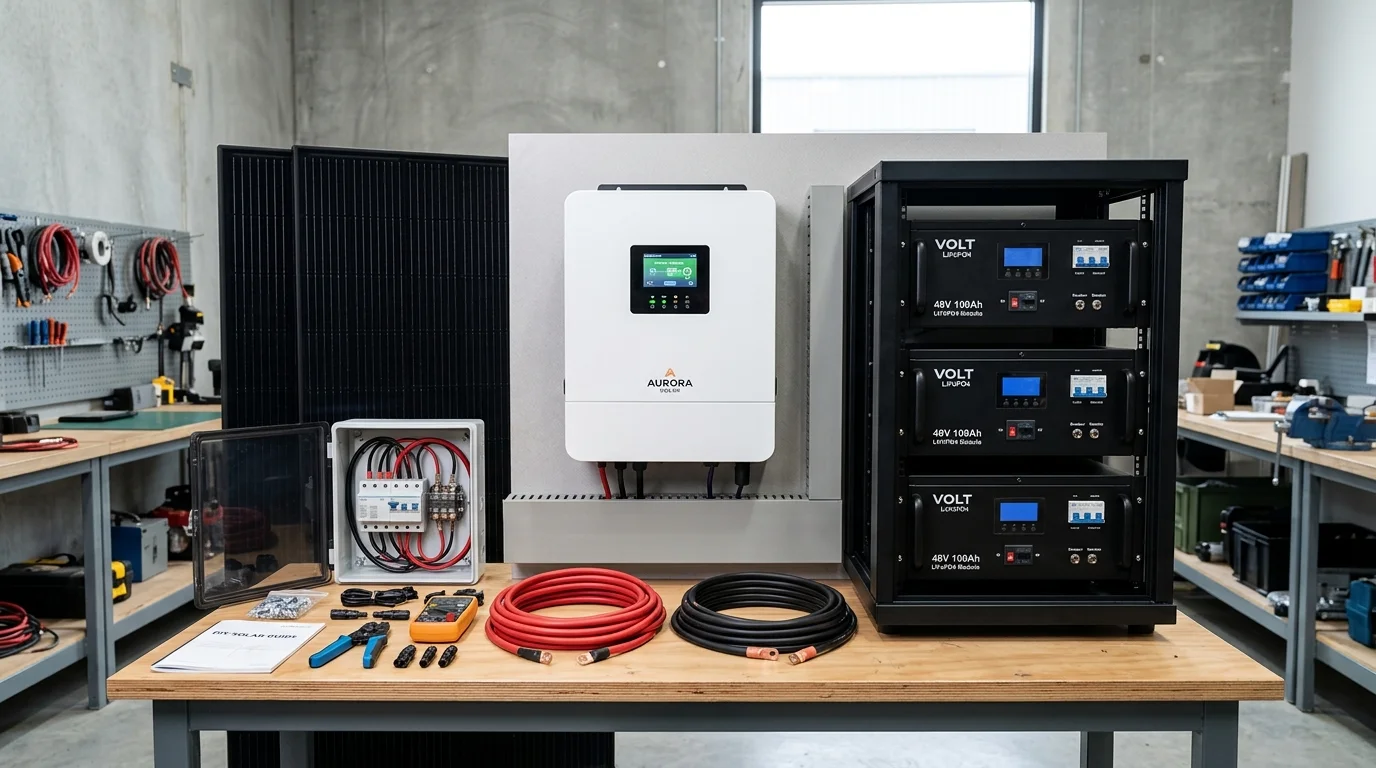
Procuring high-performance solar arrays, charge controllers, and battery banks through digital marketplaces requires rigorous electrical auditing. When acquiring hardware without direct distributor oversight, engineers and advanced DIYers must independently verify data sheet parameters, thermal coefficients, and certification listings to safeguard system reliability.
This technical guide establishes the evaluation frameworks required for sourcing photovoltaic hardware online. We analyze open-circuit voltage drift under thermal stress, inverter topology selection, and NEC compliance mandates to ensure your online procurement decisions meet professional utility and safety standards.
Key Engineering Takeaways
Sourcing solar equipment online shifts the burden of electrical design and compatibility verification entirely to the system integrator or installer. To prevent catastrophic hardware failures, thermal runaways, or code non-compliance, keep these foundational rules at the forefront of your procurement strategy:
- Thermal Voltage Expansion: Cold-weather voltage spikes can easily exceed inverter MPPT voltage ceilings if you calculate sizing using standard test conditions (STC) alone.
- Component Certification: Never purchase uncertified inverters or lithium battery modules lacking recognized safety listings like UL 1741, UL 1973, or IEEE 1547.
- System Topology Match: Ensure your DC bus voltage (, , or ) and maximum string current strictly match the charge controller’s operational limits.
First-Principles Electrical Physics and Sizing Formulas
Online equipment selection relies on accurate mathematical modeling. Failing to account for temperature coefficients or inverter idle consumption will result in premature hardware failure or underpowered system performance.
Voltage Temperature Correction
Photovoltaic modules exhibit a negative temperature coefficient for voltage (). As ambient temperatures drop below standard test conditions (), module voltage increases. Calculate the maximum open-circuit voltage () using the lowest expected ambient temperature ():
This absolute maximum voltage must remain below your charge controller or grid-tied inverter’s maximum DC input voltage rating under all operating conditions.
System Energy and Daily Yield
To size your battery bank and solar array correctly when buying components piece-by-piece, calculate daily watt-hour requirements and divide by overall system efficiency (, typically to for DC-coupled systems):
Practical Test Bench Benchmarks
When evaluating online equipment listings, compare your target specifications against standardized industrial benchmarks. The table below outlines key operational parameters for major solar hardware categories.
| Equipment Category | Key Specification | Acceptable Threshold | Critical Risk of Substandard Spec |
|---|---|---|---|
| Photovoltaic Panels | Bifacial Gain & Temp Coeff | >70% Bifaciality; <-0.35%/°C | Thermal output degradation and micro-cracking. |
| MPPT Controllers | Conversion Efficiency | >98% Peak, >95% CEC Weighted | Excessive heat generation and reduced harvest. |
| Lithium LiFePO4 Packs | BMS Continuous Discharge | >1C Rate with Low-Temp Cutoff | Lithium plating during sub-freezing charge cycles. |
| Inverter / Chargers | Total Harmonic Distortion | <3% THD (Pure Sine Wave) | Inductive motor overheating and logic noise. |
 Caption: Professional test bench setup verifying inverter waveform distortion and conversion efficiency under variable loads.
Real-World Sizing and Installation Scenarios
Sourcing modular components online means you must verify physical and electrical compatibility across different brands.
Scenario: Assembling a Hybrid 48V Off-Grid Power System
An online buyer intends to pair a high-voltage solar array with a server-rack lithium battery bank and an off-grid hybrid inverter.
- String Design: The user selects six panels with a rated of . In a series string, STC voltage totals .
- Thermal Check: Applying a regional minimum temperature of with a temperature coefficient of , the adjusted open-circuit voltage reaches approximately .
- Inverter Match: The chosen inverter specifies an MPPT operating range of to with a maximum input voltage of . The configuration is safe and avoids over-voltage lockouts.
Common Mistakes to Avoid
- Ignoring Shipping Logistics & Freight Damage: Solar panels shipped via standard parcel services suffer high rates of transit damage. Always inspect glass frames and terminal junction boxes immediately upon delivery before signing the bill of lading.
- Mixing Battery Chemistries and Ages: Connecting parallel lithium battery banks with different state-of-charge profiles or aged internal resistance values causes massive circulating currents across BMS units.
- Overlooking Firmware Compatibility: Online discount equipment may feature outdated firmware that lacks support for closed-loop CAN/RS485 communications between the inverter and battery management system.
Frequently Asked Questions (FAQ)
What certifications should I look for when buying solar equipment online?
Ensure all electrical components carry recognized third-party safety listings such as UL 1741 (inverters and charge controllers), UL 1973 (stationary batteries), and IEEE 1547 (grid interconnection). Uncertified hardware often fails local electrical inspections and voids homeowner insurance policies.
How do I verify if an online solar vendor is authorized?
Check the manufacturer’s official website for an authorized dealer locator or distribution partner list. Purchasing from unauthorized gray-market sellers frequently voids manufacturer warranties and leaves you without technical support or firmware updates.
Can I mix solar panels from different manufacturers in the same array?
You can mix panels if they share identical electrical characteristics (specifically operating current, ). If you wire mismatched panels in series, the string current is throttled down to match the lowest-rated panel’s amperage.