Entering the world of solar energy can feel overwhelming. Manufacturer specification sheets are packed with dense acronyms like VOC, IMP, MPPT, LRA, Ah, and kWh.
Online forums are full of conflicting advice: some builders tell you that 12 Volts is easiest for beginners, while seasoned electrical engineers warn you that running high-power inverters on 12V will melt your cables.
Here is the truth: Solar power is simply applied physics.
You do not need an electrical engineering degree to build a reliable off-grid system, power an emergency backup generator, or size rooftop solar panels. You only need a firm grasp of four core electrical concepts: Volts, Amps, Watts, and Ohms, and how they interact when sunlight strikes a silicon photovoltaic wafer.
In this beginner-friendly engineering guide, we break down the foundational principles of electricity, explain the crucial difference between power and energy, and show you how to calculate solar panel and battery sizing with absolute confidence.
Remember the universal power equation: Watts = Volts × Amps (). If you need to generate 1,200 Watts of power: at 12 Volts, you need a blistering 100 Amps of current (requiring thick, expensive 2/0 AWG copper cable); but at 48 Volts, you only need 25 Amps of current (requiring slim, affordable 10 AWG wire). High voltage always minimizes heat, line loss, and equipment cost.
Launch Sizing Calculator →
The Four Fundamentals: Volts, Amps, Ohms & Watts
To visualize electricity, engineers frequently use the hydraulic water pipe analogy:
Voltage (Volts - V)
Electrical Pressure
Voltage is the electrical pressure pushing electrons through a conductor, analogous to water pressure (PSI) inside a garden hose. A 48V battery pushes electrons with four times more potential energy than a 12V battery.
Current (Amperes - A)
Volume Flow Rate
Amperage is the volume of electrons flowing past a specific point per second, analogous to gallons per minute (GPM). Heavy current generates physical heat due to friction as electrons squeeze through copper atoms.
Resistance (Ohms - Ω)
Pipe Restriction
Resistance is the physical opposition to electron flow, analogous to a constriction or nozzle in a hose. Thin wire has high resistance; thick wire has low resistance. Governed by Ohm’s Law: .
Power (Watts - W)
Rate of Work Performed
Watts represent instantaneous mechanical or electrical work done, analogous to spinning a water wheel. Calculated directly as the product of pressure and volume: ().
Power vs. Energy: Watts vs. Watt-Hours
The single most common misunderstanding in renewable energy is confusing Watts (W) with Watt-Hours (Wh).
- Watts (): Instantaneous rate of power delivery (like the speedometer in your car showing ).
- Watt-Hours (): Total volume of energy consumed or generated over time (like the odometer showing miles traveled).
Consider two drastically different household appliances:
| Appliance | Running Power (Watts) | Daily Run Time | Total Energy (Watt-Hours) | Key Takeaway |
|---|---|---|---|---|
| Microwave Oven | 1,200 Watts | 6 Minutes (0.1 Hours) | 120 Wh (0.12 kWh) | High power, but negligible total battery drain |
| Energy Star Refrigerator | 60 Watts (Avg.) | 24 Hours (Continuous) | 1,440 Wh (1.44 kWh) | Low power, but consumes 12x more energy than microwave! |
| Starlink Satellite Dish | 45 Watts | 24 Hours (Continuous) | 1,080 Wh (1.08 kWh) | Quiet vampire load draining 50% of a 2kWh battery daily |
[!IMPORTANT] When sizing a solar generator or battery bank, you size the Inverter continuous wattage for the highest instantaneous peak load (e.g., 1,800W for a microwave), but you size the Battery capacity (Wh) and Solar panel array (W) for the total 24-hour kilowatt-hour consumption.
Direct Current (DC) vs. Alternating Current (AC)
Electricity comes in two distinct electrical waveforms:
Direct Current (DC)
Electrons flow in a single, continuous direction from negative to positive terminals.
- • Sources: Solar panels, chemical battery cells, USB-C ports, car 12V sockets.
- • Characteristics: Constant voltage, zero frequency (), highly efficient for short-distance energy storage.
- • Arc Hazard: DC arcs do not cross a zero-voltage threshold, requiring specialized magnetic DC disconnects.
Alternating Current (AC)
Electrons rapidly reverse direction in a sinusoidal wave, alternating 60 times per second ( in the US).
- • Sources: Standard household wall outlets, utility power grids, inverter AC output sockets.
- • Characteristics: Easily stepped up or down in voltage via transformers for long-distance transmission.
- • Waveform Quality: Always insist on Pure Sine Wave (THD < 3%) to protect digital circuit boards.
Series vs. Parallel Circuits: How Solar Arrays Work
When combining multiple solar panels or battery blocks, how you wire them dictates total system voltage and current:
Series Wiring (Daisy-Chain)
Voltage AddsConnecting Positive (+) of Panel 1 to Negative (-) of Panel 2:
Engineering Advantage: Higher voltage allows thin, affordable 10 AWG wire over long distances with minimal voltage drop. Powers MPPT controllers earlier in the morning.
Parallel Wiring (Combiner)
Current AddsConnecting all Positives together and all Negatives together using Y-branch combiners:
Engineering Advantage: Partial shade on one panel does not choke the output of adjacent panels. Best for portable arrays with varying sun angles.
Recommended Starter Hardware for Beginners
For beginners seeking hands-on electrical confidence without dealing with dangerous high-voltage line terminations, modern all-in-one portable power stations bundle the battery, MPPT charge controller, BMS, and pure sine wave inverter into a certified plug-and-play enclosure.
1. Anker SOLIX C1000 Gen 2 (Best Complete Entry-Level System)
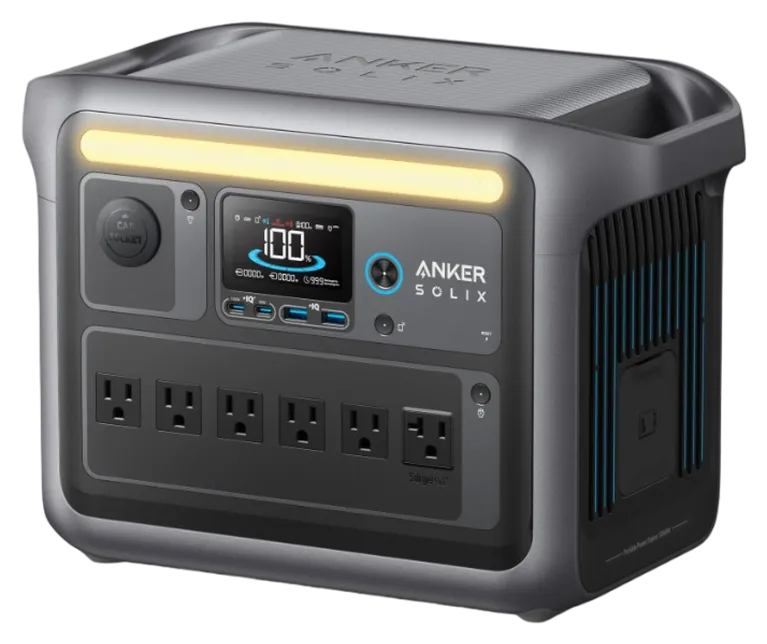
Anker SOLIX C1000 Gen 2 (1,056Wh LiFePO4)
The C1000 provides a crystal-clear digital LCD and companion smartphone app that visually displays real-time input Watts, output Watts, remaining runtime, and battery percentage. It accepts up to 600W of direct solar panel input (11V to 60V MPPT) and provides 1,800W continuous pure sine wave AC power, handling power tools, refrigerators, and electronics effortlessly.
Check Best Price on Anker SOLIX →
2. EcoFlow DELTA 2 Max (Best Intermediate Whole-House Backup)
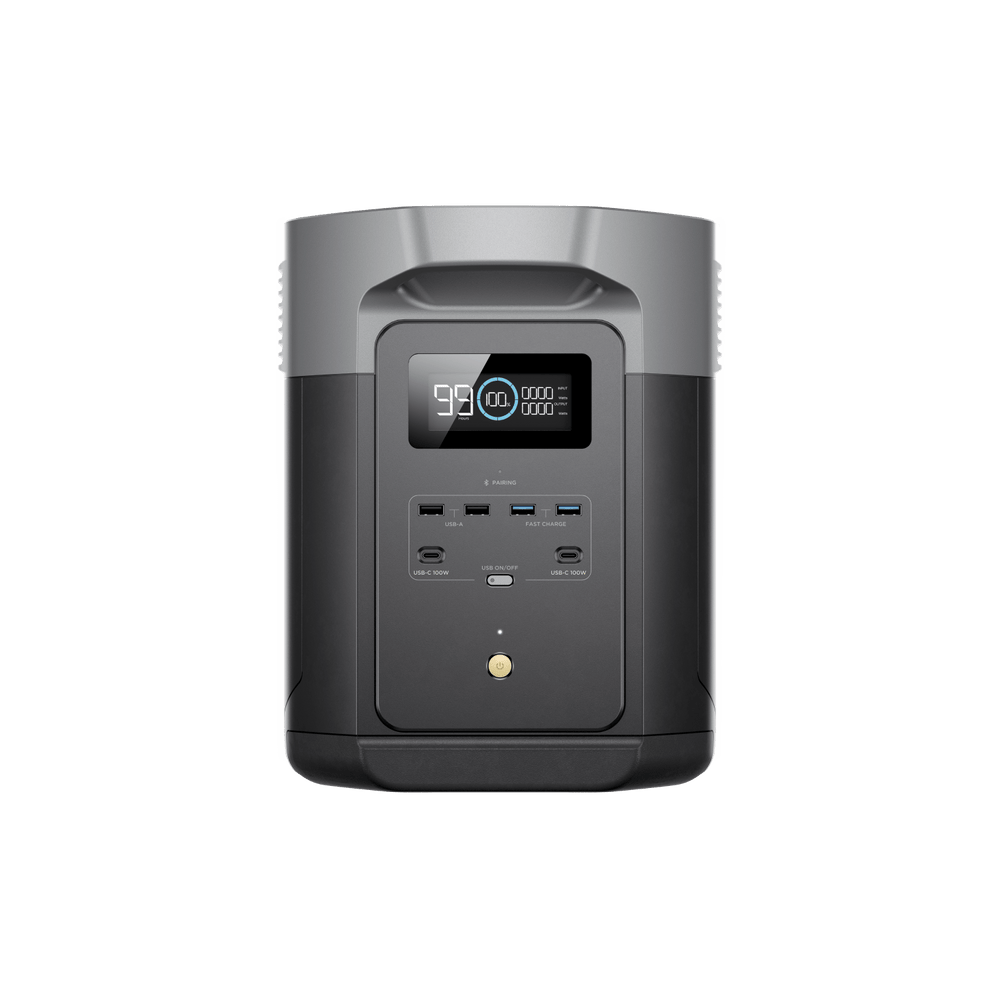
EcoFlow DELTA 2 Max (2,048Wh LiFePO4)
If you want to step up to a whole-home emergency power reserve, the 2,048Wh DELTA 2 Max is our top lab-tested benchmark. It includes dual independent 500W MPPT solar controllers (1,000W total input), handles 2,400W continuous output (4,800W surge), and expands up to 6,144Wh with plug-in expansion batteries.
Check Best Price on DELTA 2 Max →
Costly Electrical Mistakes Beginners Make
Ignoring Cold Temperature Open-Circuit Voltage Spikes ()
Solar panels are semiconductors: as temperature drops, voltage increases. A panel rated at at will surge past on a freezing winter morning. If your total string voltage exceeds your MPPT charge controller’s maximum voltage rating (e.g. 60V or 150V) by even 1 Volt, the input MOSFETs will instantly fry. Always calculate temperature-adjusted before wiring panels in series.
Sizing Inverters Without Checking Motor Surge (LRA)
Inductive motor loads (refrigerators, sump pumps, air conditioners, power tools) require an instantaneous startup inrush current of 5x to 8x their running wattage for 200 milliseconds to break mechanical inertia. A 600W sump pump can require a 3,000W surge to start. Sizing an inverter purely for running watts leads to chronic overload shutoffs.
Under-Gauging Low-Voltage DC Wiring
Drawing 1,500W at 120V AC requires only 12.5 Amps (handled easily by 14 AWG wire). But drawing 1,500W at 12V DC requires a massive 125 Amps! Forcing 125A through thin wire causes catastrophic resistance heating () and can ignite insulation within seconds. Always consult an ampacity table when sizing DC battery cables.
Assuming Nameplate Wattage Equals Real-World Solar Production
Standard Test Conditions (STC) test solar panels in a climate-controlled laboratory at (). On a real summer afternoon, dark panel cells heat up to (), losing ~0.35% power per degree. Combined with atmospheric haze and dust, a 400W solar panel typically produces 300W to 320W of real power. Always plan on 75% to 80% real-world yield.
Using Cheap Modified Sine Wave Inverters
Modified sine wave inverters produce a choppy stepped square wave with high total harmonic distortion (THD > 25%). This waveform causes electric motors to run 20% hotter, makes AC fans buzz loudly, and frequently burns out the delicate digital power supplies inside laptops, medical equipment, and modern appliances. Always buy Pure Sine Wave inverters.
Frequently Asked Questions (FAQ)
What is the difference between an Amp and an Amp-Hour?
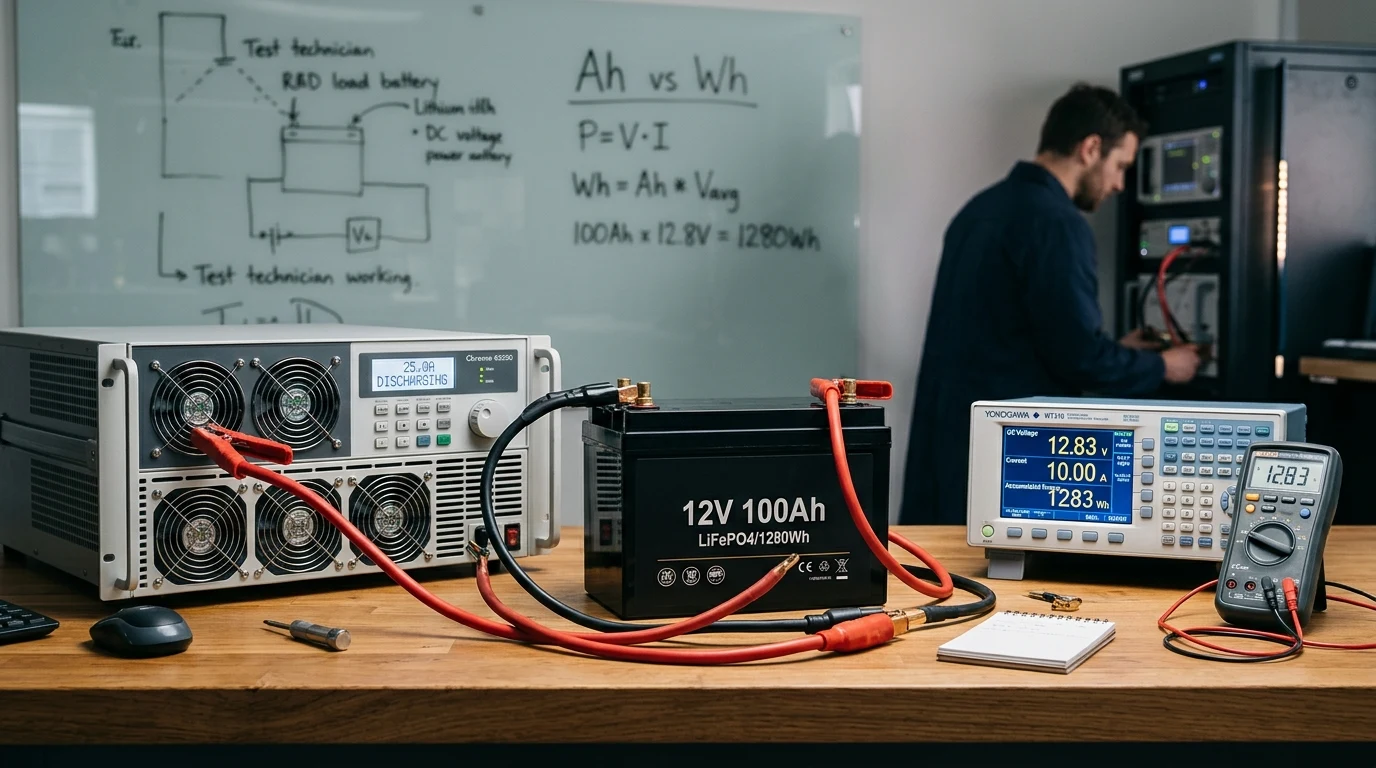
An Amp (A) is the instantaneous rate of electrical current flowing through a circuit at any given second. An Amp-Hour (Ah) measures total charge capacity over time: a 100Ah battery can deliver 1 Amp for 100 hours, or 10 Amps for 10 hours. To convert Amp-Hours to Watt-Hours, multiply by nominal voltage ().
How many solar panels do I need to run a TV and lights?
A modern 55-inch LED TV draws approximately 80W, and four LED light bulbs draw roughly 40W (120W total). Running them for 5 hours each evening requires of energy. Factoring in system inefficiencies, a single 200W solar panel paired with a 1,000Wh portable power station easily covers this daily demand with energy to spare.
Why do solar panels have two different voltage ratings ( and )?
- (Open-Circuit Voltage): The maximum voltage a panel produces when disconnected from any electrical load (zero current flowing). You use to ensure you never exceed your charge controller’s maximum voltage limit.
- (Maximum Power Voltage): The optimal voltage the panel delivers when connected to a load under peak sunlight. An MPPT charge controller actively searches for this exact voltage point to extract maximum wattage.
Can I connect a 12V solar panel to a 24V or 48V battery?
Yes, but only if you use an MPPT Solar Charge Controller with a boost-charging capability, or by wiring multiple 12V solar panels together in series so their combined voltage exceeds the battery’s charging threshold (typically >28.8V for a 24V battery, or >57.6V for a 48V battery).