Understanding the physics of electricity is the single most valuable skill you can possess when designing, purchasing, or troubleshooting a residential solar system, portable power station, or off-grid cabin.
Every single decision you make—from choosing between a 12V, 24V, or 48V battery bank, to determining how many solar panels you can string together without frying an MPPT charge controller—comes down to the fundamental relationship between three basic units: Volts (V), Amps (A), and Watts (W).
When newcomers misunderstand these units, costly disasters happen: undersized wires melt from excessive amperage, expensive hybrid inverters shut down from high voltage spikes on freezing mornings, and buyers overpay by thousands of dollars for batteries with deceptive Amp-Hour ratings.
This engineering guide demystifies electrical theory into intuitive, practical rules. Whether you are assembling your first vanlife solar kit or sizing a whole-home battery backup system, here is how electricity actually flows through your equipment.
The Golden Formula: Instantaneous electrical power is calculated as Watts = Volts × Amps. Always evaluate battery capacity in Watt-Hours (Wh) rather than Amp-Hours (Ah), because a 100Ah battery at 48V holds 4,800Wh of energy—four times more than a 100Ah battery at 12V (1,200Wh). When designing solar arrays, remember that wiring in series stacks Voltage, whereas wiring in parallel stacks Amperage.
Deconstructing the Electrical Trinity: Volts, Amps, and Watts
To make sense of solar specifications, we must first isolate what each unit measures at the physical and practical levels.
Voltage (Volts)
Electrical Potential / Pressure
The electromotive force pushing electrons through a conductor. High voltage pushes current across long distances with minimal resistance losses.
Current (Amperes)
Volume of Electron Flow
The actual count of electrons passing a given cross-section per second (1 Amp = 6.242 × 10¹⁸ electrons/sec). High amperage dictates heavy, thick copper cabling.
Power (Watts)
Real-Time Rate of Work
The total rate at which electrical energy is transformed into light, heat, or mechanical torque (1 Watt = 1 Joule/second). Calculated directly as Volts × Amps.
Voltage: The Driving Force Behind Current
Voltage () represents the electrical potential difference between two distinct points in a circuit. In a direct current (DC) solar system, voltage is generated by photovoltaic cells as sunlight knocks free electrons within silicon p-n junctions.
Without voltage, electrons have no direction or incentive to move. A common 12V lead-acid battery sitting on a shelf has 12 volts of chemical pressure ready to deliver, but zero current is flowing until you connect a closed conductive loop between the positive and negative terminals.
In residential solar installations, voltages typically range from:
- 12V to 48V DC: Low-voltage battery banks and vehicle systems.
- 60V to 600V DC: High-voltage residential rooftop solar strings feeding string or hybrid inverters.
- 120V / 240V AC: Standard North American split-phase household alternating current.
Current (Amps): What Generates Thermal Heat in Wiring
Current (), measured in Amperes or Amps, is the physical volume of electrical charge moving through a conductor over time.
If you think of electrons as cars on a highway, voltage is the speed limit, and current is the total number of cars passing a toll booth every second.
Crucially, amperage is the factor that heats up wires. As electrons collide with copper atoms inside a wire, friction generates thermal energy. If you push 50 amps through a wire designed for only 15 amps, the insulation will soften, melt, and ignite a residential fire. That is why circuit breakers and catastrophic fuses are strictly rated in Amps, not in Watts or Volts.
Power (Watts): The Universal Currency of Appliances
Power (), measured in Watts, tells you exactly how much work an appliance consumes or a solar panel produces at any single instant.
A 100W incandescent light bulb uses 100 joules of electrical energy every second. A 1,800W induction cooktop consumes energy 18 times faster.
The universal equation uniting all three variables is Ohm’s Power Law:
Where:
- = Power in Watts (W)
- = Voltage in Volts (V)
- = Current in Amperes (A)
This equation proves that you can achieve the same wattage through infinitely different combinations of voltage and current:
- A 1,200W microwave running on standard 120V household AC draws 10 Amps ().
- A 1,200W inverter drawing power from a 12V battery bank must pull 100 Amps ().
- The same 1,200W load connected to a 48V battery bank draws only 25 Amps ().
The Water Pipe Analogy That Never Fails
To intuitively cement these concepts, engineers have long relied on the hydraulic plumbing analogy:
Electrical vs. Plumbing System Mapping
Imagine a water tower perched on a mountain. The height of the tower creates gravitational pressure. A 100-foot tower exerts more PSI at the base than a 10-foot tank. Voltage is that exact pressure pushing electrons down the line.
How many gallons of water pass through the hose per minute. To carry 100 gallons per minute without bursting, you need a heavy 4-inch firehose. To carry 2 gallons per minute, a thin garden hose suffices.
Place a waterwheel under the stream. The speed and torque with which it spins depends on both the pressure (PSI) and the volume (GPM). Water shooting at high pressure or massive flow both turn the wheel.
Friction inside the pipes restricts flow. Thin pipes or rough interior walls choke the gallons per minute and turn kinetic pressure into lost heat. In circuits, this is electrical resistance measured in Ohms (Ω).
Power vs. Energy: Demystifying Watts vs. Watt-Hours and Amp-Hours
One of the most persistent confusions among solar beginners is the distinction between Power and Energy.
- Power (Watts): The speed at which you are using electricity right now (like miles per hour on your car’s speedometer).
- Energy (Watt-Hours / kWh): The total volume of electricity accumulated or consumed over time (like the total distance in miles on your odometer).
If you turn on a 1,000W space heater for exactly one hour, you have consumed 1,000 Watt-hours (1 kWh) of energy. If you run that same 1,000W heater for 30 minutes (0.5 hours), you have consumed 500 Watt-hours (0.5 kWh):
The Trap of Amp-Hours (Ah)
Battery manufacturers frequently market batteries in Amp-Hours (Ah). For example, you will see “100Ah Lithium Battery” stamped prominently on retail packaging.
[!WARNING] An Amp-Hour rating without a voltage specification is completely meaningless.
Consider these three different batteries, each rated at “100Ah”:
- A small 3.7V smartphone power bank cell: 100Ah × 3.7V = 370 Wh
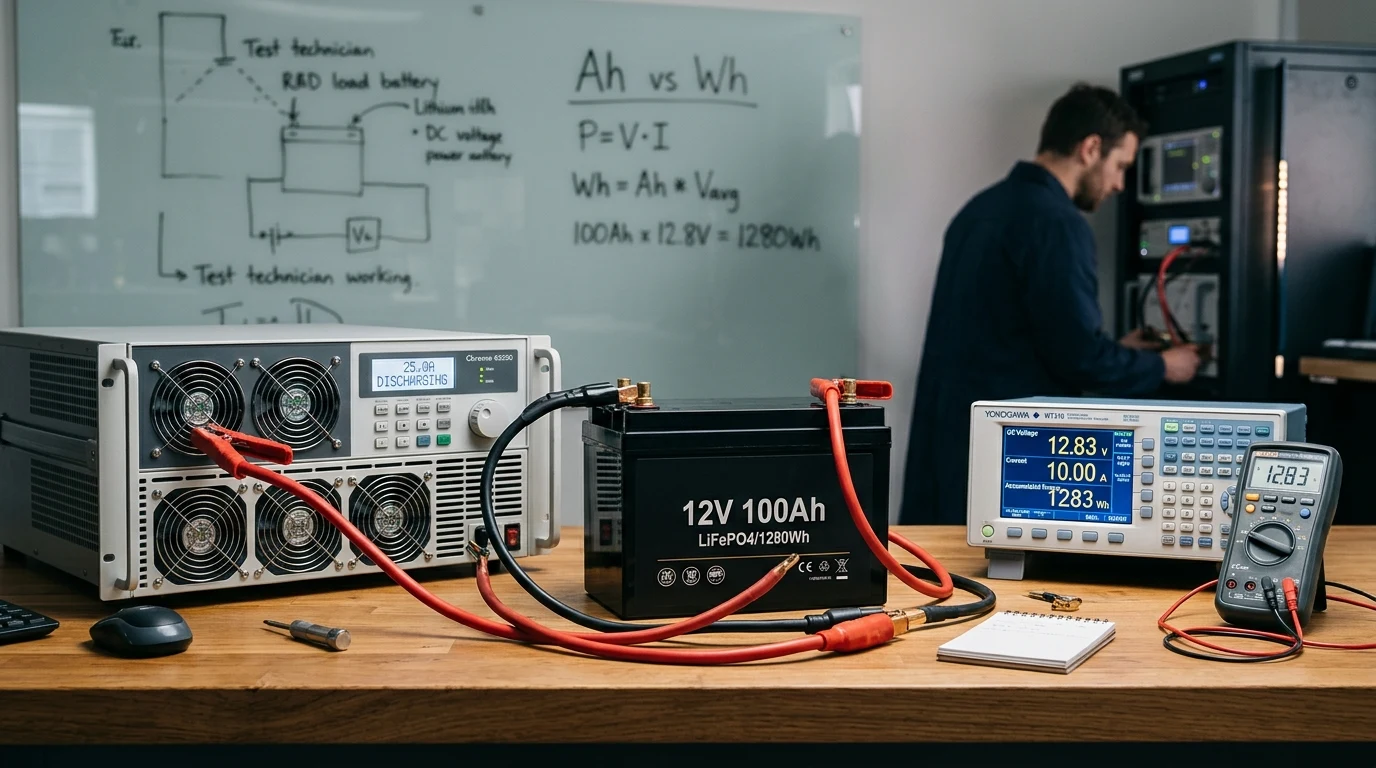
- A 12.8V marine LiFePO4 battery: 100Ah × 12.8V = 1,280 Wh
- A 51.2V server-rack solar battery: 100Ah × 51.2V = 5,120 Wh
All three carry the label “100Ah”, but the 51.2V server-rack unit stores fourteen times more usable energy than the phone bank, and four times more than the 12V marine battery.
When comparing portable power stations, backup batteries, or whole-home solar storage, always multiply nominal voltage by amp-hours to find total Watt-Hours (Wh).
Series vs. Parallel Circuits: The Rules of Solar Arrays & Batteries
When you connect multiple solar panels together on your roof or wire multiple batteries into an off-grid energy storage bank, you must choose between two foundational circuit architectures: Series or Parallel.
Wiring in Series (Positive to Negative)
Connecting the positive (+) lead of one panel or battery to the negative (−) lead of the next component.
Key Benefit: High voltage allows you to run thin, inexpensive 10 AWG wire over long distances with almost zero power loss.
Wiring in Parallel (Positive to Positive)
Connecting all positive (+) terminals together to a single busbar, and all negative (−) terminals together.
Key Benefit: Partial shade on one panel will not drag down the power production of the unshaded panels.
A Real-World Solar Array Example
Imagine you have four 400W solar panels. Each individual panel produces:
- Voltage at Maximum Power () = 40 Volts
- Current at Maximum Power () = 10 Amps
Here is what happens under each wiring setup:
| Wiring Method | Total Array Voltage | Total Array Amps | Total Array Power | Required Wire Gauge |
|---|---|---|---|---|
| All 4 in Series (4S) | 160 Volts (40V × 4) | 10 Amps | 1,600 Watts | Standard 10 AWG |
| All 4 in Parallel (4P) | 40 Volts | 40 Amps (10A × 4) | 1,600 Watts | Heavy 6 AWG or 4 AWG |
| Series-Parallel (2S2P) | 80 Volts (40V × 2) | 20 Amps (10A × 2) | 1,600 Watts | Standard 10 AWG |
Notice that in all three configurations, total wattage generated is identical: 1,600 Watts. However, the 4S series string operates at a safe, modest 10 Amps, allowing cheap wiring and tiny line loss, while the 4P parallel setup pushes a massive 40 Amps, requiring thick commercial copper wire and expensive combiner boxes.
The Law: Why Higher Voltage Saves Thousands on Copper Wire
Why do modern whole-home solar systems utilize 48V battery banks or 400V high-voltage storage instead of the traditional 12V batteries found in cars and RVs?
The answer lies in Joule’s First Law of Thermal Heating:
Where:
- = Power wasted as radiant heat along the wire (Watts)
- = Current running through the wire in Amperes
- = Electrical resistance of the copper wire in Ohms
Notice that amperage is squared (). If you double your amperage, your thermal losses multiply by four. If you quadruple your amperage, heat dissipation multiplies by sixteen!
Line Loss Comparison: Powering a 3,000W Inverter Load
Suppose an inverter is powering a 3,000-watt load through 10 feet of cabling with 0.002 Ohms of circuit resistance:
Line Loss: 250² × 0.002 = 125 Watts
Requires 4/0 AWG CableLine Loss: 125² × 0.002 = 31.2 Watts
Requires 1/0 AWG CableLine Loss: 62.5² × 0.002 = 7.8 Watts
Requires 4 AWG CableBy stepping up from 12V to 48V:
- Current drops by 75% (from 250A down to 62.5A).
- Power wasted as heat drops by 93.75% (from 125W wasted to under 8W).
- Copper wire costs drop from $15/foot for massive 4/0 welding cable down to $2/foot for flexible 4 AWG wire.
Essential Equipment to Measure & Monitor Solar Electricity
To verify your systems, troubleshoot faulty strings, and monitor charging efficiency, you need reliable electrical test gear:
1. Digital AC/DC Clamp Multimeter: Klein Tools CL800

Klein Tools CL800 Auto-Ranging Digital Clamp Meter
Standard multimeters require cutting into the wire to measure current. A True RMS clamp meter measures DC and AC amperage simply by clamping around a single conductor—vital for checking solar string output and battery draw safely.
Check Current Multimeter Pricing →
2. High-Efficiency 2,000Wh Portable Generator: Bluetti AC200L
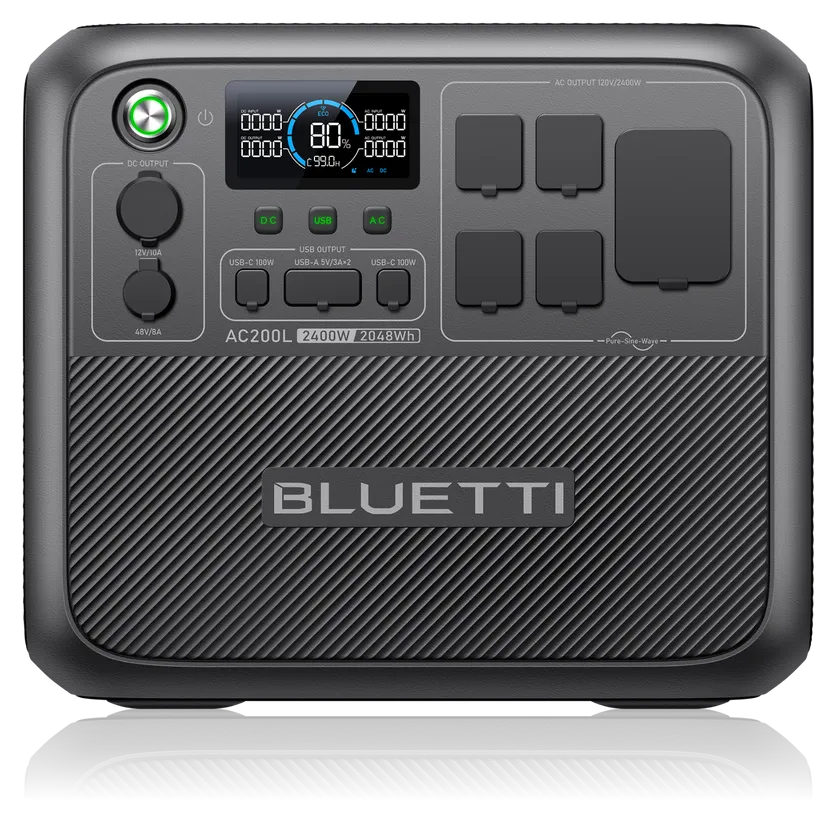
Bluetti AC200L (2,048Wh / 2,400W Pure Sine Inverter)
Features an advanced real-time LCD and mobile app displaying incoming solar Volts and Watts, alongside outgoing AC and DC amperage draw. Accommodates up to 1,200W of solar input across a wide 12V–145V MPPT voltage window.
View Bluetti AC200L Deals →
Critical Electrical Mistakes Beginners Make in Solar DIY
When designing your first electrical system, avoid these four common pitfalls:
Comparing Amp-Hours Without Normalizing to Voltage
As detailed earlier, buying a “300Ah” 12V battery (3,840Wh) for $800 might seem cheaper than a “100Ah” 48V battery (5,120Wh) for $1,100. But on a cost-per-Watt-hour basis, the 48V system is actually significantly cheaper ($0.21/Wh vs. $0.28/Wh). Always convert to Watt-Hours or kilowatt-hours before comparing prices.
Clamping Around Both Positive and Negative Wires Simultaneously
When using a clamp multimeter, beginners often clamp the jaw around an entire jacketed two-conductor cable (like Romex or extension cords). Because the current going out on the positive wire equals the current returning on the negative wire, their opposing magnetic fields cancel each other out, reading 0.00 Amps on your meter. You must clamp around only one conductor at a time.
Mixing Panels with Different Amperage Ratings in Series
If you connect a 400W panel (10A ) in series with a 100W panel (5A ), the entire string will be choked down to the lowest common denominator: 5 Amps. Your 400W panel will be forced to operate at half its capacity. Always match amperage ratings within a series string, or use microinverters / separate MPPT controllers.
Forgetting Catastrophic Fusing at the Battery Terminal
Chemical storage batteries can discharge thousands of amps during an accidental dead short. An unfused cable contacting metal chassis or ground will glow red-hot and vaporize copper in seconds. Always install a catastrophic Class-T or MRBF fuse directly on the positive battery terminal post sized to protect the wire gauge.
Interactive Sizing and Runtime Calculators
Test your understanding of electrical equations using our interactive diagnostic calculators:
- Solar Generator Runtime Calculator: Input appliance running watts and battery watt-hours to predict true off-grid runtime after inverter conversion losses.
- Solar Cold Temperature Voltage Calculator: Calculate open-circuit voltage expansion during winter mornings to protect your MPPT charge controller.
- Inverter Tare Loss Calculator: Measure the idle wattage vampire draw of pure sine wave inverters running 24/7.
Frequently Asked Questions (FAQ)
What is the difference between AC and DC electricity?
Direct Current (DC) flows in a single constant direction. Solar panels and chemical batteries produce and store DC power. Alternating Current (AC) rapidly alternates its directional flow back and forth (60 times per second in North America, or 60 Hz). Household wall outlets supply AC because high-voltage AC can be stepped up or down easily using transformers for grid transmission.
Can high voltage damage an MPPT solar charge controller?
Yes. Exceeding the Maximum Input Voltage rating of an MPPT controller—even by a single volt for a fraction of a second—will blow internal MOSFET transistors and permanently destroy the unit. You must always calculate the panel string’s open-circuit voltage () adjusted for freezing winter temperatures.
Why do appliances have both surge watts and running watts?
Appliances with electric induction motors or compressors (refrigerators, well pumps, air conditioners, and power tools) require an immense burst of current to overcome physical inertia and magnetize motor windings during startup. This startup inrush surge often draws 3x to 5x their steady-state running wattage for the first 100 to 500 milliseconds.
Is a 48V solar system dangerous to touch?
In general, voltages under 60V DC are considered “Safety Extra Low Voltage” (SELV) and do not possess enough electrical pressure to penetrate human dry skin under normal conditions. However, high-voltage rooftop series strings (which can reach 300V to 600V DC) are lethal and require strict NEC code compliance, rapid shutdown devices, and insulated safety tools.