To the untrained eye, a solar power setup can look like an intimidating maze of thick black cables, copper busbars, blinking electronic boxes, and flashing digital displays.
However, whether you are examining a compact 600W portable camping power station, an off-grid tiny house system, or a massive 15kW whole-home hybrid installation, every photovoltaic system on earth relies on the exact same four fundamental building blocks, supported by essential circuit protection hardware:
- The Energy Harvester: Solar Photovoltaic (PV) Panels
- The Voltage Governor: Maximum Power Point Tracking (MPPT) Charge Controller
- The Energy Reservoir: Battery Storage Bank (LiFePO4 Chemistry)
- The Power Converter: Pure Sine Wave DC-to-AC Inverter
- The Safety Guardrails: Fuses, Circuit Breakers, Disconnects & Shunts
Below, we explain how each component functions, how they communicate across the power pipeline, and what happens when any single link in the chain fails.
Photons hit the silicon solar cells → creating direct-current (DC) electricity at variable voltage (18V–150V+) → The MPPT controller steps down voltage and amplifies charging current → The Battery Bank chemically stores kilowatt-hours via LiFePO4 cells → The Inverter converts 48V DC into pure 120V/240V 60Hz AC electricity for household appliances.
The 4 Core Solar Components Explained
[ Solar PV Panels ]  ---> (High-Voltage DC) ---> [ MPPT Charge Controller ]
                                                           |
                                                  (Regulated DC Charging)
                                                           v
[ AC Household Loads ] <--- (120V/240V AC) <--- [ Inverter ] <--- [ LiFePO4 Battery Bank ]
1. Solar Photovoltaic (PV) Panels: The Energy Harvesters
Solar panels consist of monocrystalline or polycrystalline silicon semiconductor cells wired in series. When sunlight strikes the silicon wafer, photons knock electrons free from silicon atoms—a physical phenomenon known as the photovoltaic effect.
- Output Type: Raw Direct Current (DC).
- Key Electrical Metrics: Open-Circuit Voltage (), Maximum Power Voltage (), and Short-Circuit Current ().
- Real-World Reality: A solar panel’s rated wattage (e.g., 400W) is measured in a laboratory under Standard Test Conditions (STC: 1,000 W/m² irradiance at 25°C). In the real world, panels typically deliver 75% to 85% of rated power due to ambient heat and atmospheric haze. Read our engineering analysis on Why Solar Panels Produce Less Than Rated.
2. MPPT Charge Controller: The Intelligent Voltage Governor
You cannot connect a 40V or 100V solar panel string directly to a 12V or 48V battery. Doing so will over-voltage the battery cells, trigger BMS safety lockouts, or destroy the battery pack.
The Maximum Power Point Tracking (MPPT) Controller acts as an electronic transmission:
- It continuously monitors the solar panel’s IV curve (hundreds of times per second) to locate the exact voltage and current combination that produces maximum wattage.
- It efficiently converts excess voltage into additional charging current. For instance, it can take () from the solar array and step it down to a safe battery charging profile of () with up to 98% conversion efficiency.
To understand why older PWM controllers waste up to 35% of your solar potential, see our technical comparison on MPPT vs. PWM Solar Charge Controllers.
3. Battery Storage Bank: The Chemical Reservoir
Solar panels only generate electricity when the sun shines, but homes consume power continuously, especially during peak evening hours. The battery bank stores generated kilowatt-hours for use at night or during blackouts.
- Chemistry Benchmark: Modern residential and off-grid systems use Lithium Iron Phosphate (LiFePO4). Unlike legacy lead-acid or AGM batteries that suffer rapid capacity loss when discharged past 50%, LiFePO4 batteries deliver 3,000 to 5,000 cycles at 80% to 90% Depth of Discharge.
- The BMS Guardian: Every lithium battery contains an internal Battery Management System (BMS). The BMS balances individual cell voltages, cuts off power if temperatures drop below freezing (preventing dangerous lithium plating), and protects against short circuits. Learn more in our guide to Battery Management Systems (BMS) & Cell Balancing.
4. DC-to-AC Inverter: The Grid Replicator
Batteries store direct current (DC), but modern household appliances (refrigerators, microwaves, computers, televisions) are engineered to operate on alternating current (AC) oscillating at 60Hz (120V/240V).
The pure sine wave inverter uses high-speed semiconductor transistors (MOSFETs or IGBTs) and pulse-width modulation (PWM) to invert DC battery voltage into a smooth, clean mathematical sine wave.
- Why Pure Sine Wave is Critical: Modified sine wave inverters produce harsh, stepped square waveforms with up to 45% Total Harmonic Distortion (THD), causing motors to overheat and digital displays to flicker. Read our breakdown on Pure Sine Wave vs Modified Sine Wave Inverters.
- Sizing Considerations: To size your inverter’s continuous wattage and motor surge capacity correctly, check our guide on How to Size a Solar Inverter.
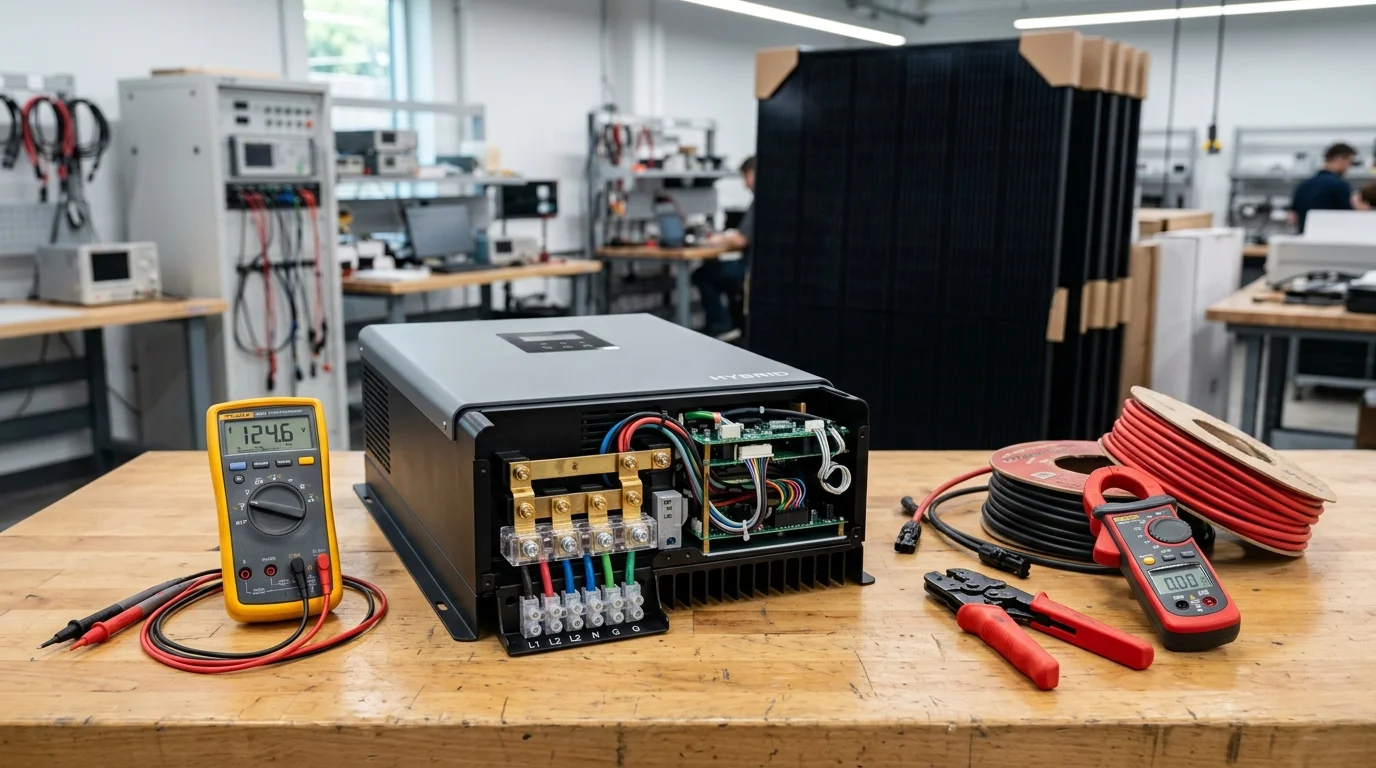
Figure 2: Balance-of-system hardware: heavy-duty Class-T fuses, DC disconnect switches, and Lynx busbars ensure safe power distribution between high-capacity batteries and inverters.
Balance of System (BOS): The Critical Safety Components
A reliable solar setup requires more than just the four primary components. Balance of System (BOS) hardware ensures fire safety, code compliance, and system longevity:
- DC Circuit Breakers & Disconnects: Placed between the solar array and the MPPT controller, allowing you to instantly isolate high-voltage DC arrays for maintenance without electrical arcing.
- Class-T Fuses: High-capacity lithium battery banks can deliver thousands of short-circuit amps in milliseconds. Fast-acting Class-T fuses (rated for 20,000A interrupt capacity) prevent catastrophic fire in the event of an accidental dead short.
- Copper Busbars & Heavy AWG Cables: Provide low-resistance central distribution points, preventing messy terminal stacking on battery posts. See our Solar Wire Gauge Sizing Guide.
- Shunt / Battery Monitor: Measures exact current flowing into and out of the battery bank via Coulomb counting, providing an accurate State-of-Charge (SOC) reading rather than relying on unreliable resting voltage.
Discrete Component Builds vs. All-In-One Solar Generators
For decades, off-grid builders had to wire every component individually. Today, the market offers two distinct approaches:
Units from EcoFlow, Anker, Bluetti, and Pecron integrate the MPPT controller, pure sine wave inverter, LiFePO4 battery, and BMS into a single portable chassis.
Best For: Emergency home backup, RVs, camping, and DIY builders who want zero electrical wiring complexity. Check top picks in our Best Power Stations Under $1500 review.
Custom installations using wall-mounted hybrid inverters (e.g. Sol-Ark, EG4) paired with 48V server rack batteries and external combiner boxes.
Best For: Whole-house backup, off-grid homesteads, and multi-kilowatt rooftop solar arrays. Explore modular hardware in our Best Server Rack Batteries Guide.
Frequently Asked Questions (FAQ)
Can I run appliances directly from solar panels without a battery?
Standard off-grid appliances cannot run directly from solar panels alone. Solar panel output fluctuates constantly based on passing clouds, sun angles, and shadows. Without a battery bank or grid connection to act as an energy buffer, sudden voltage drops would cause inverters and appliances to shut down repeatedly.
What is the difference between an inverter and a charge controller?
An MPPT charge controller regulates DC electricity from solar panels to safely charge a DC battery bank. An inverter takes DC power from the battery bank and converts it into 120V/240V alternating current (AC) to power standard household appliances.
In what order should I connect my solar components during installation?
Always connect the battery to the charge controller first, before connecting solar panels! Connecting solar panels to an MPPT controller without a connected battery can confuse the controller’s auto-voltage detection circuitry and potentially damage internal components. Disconnect solar panels first when servicing the system.
