Lithium iron phosphate (LiFePO4) chemistry dominates modern stationary solar storage due to its exceptional safety, thermal stability, and 6,000+ cycle lifespan. However, standard LiFePO4 chemistry has a severe, non-negotiable Achilles’ heel: it cannot be charged below 32°F (0°C).
When charging current is forced into a frozen LiFePO4 cell, lithium ions cannot intercalate into the dense graphite anode. Instead, they deposit onto the anode surface as metallic lithium—a destructive process known as lithium plating. This permanently destroys battery capacity, triggers internal micro-short circuits, and presents an extreme fire hazard.
To survive sub-zero winters, builders must choose between two divergent engineering approaches:
- The Turnkey Heated Enclosure: Trophy 48V Battery, featuring internal multi-zone silicone heating blankets that automatically redirect charging current to warm the pack.
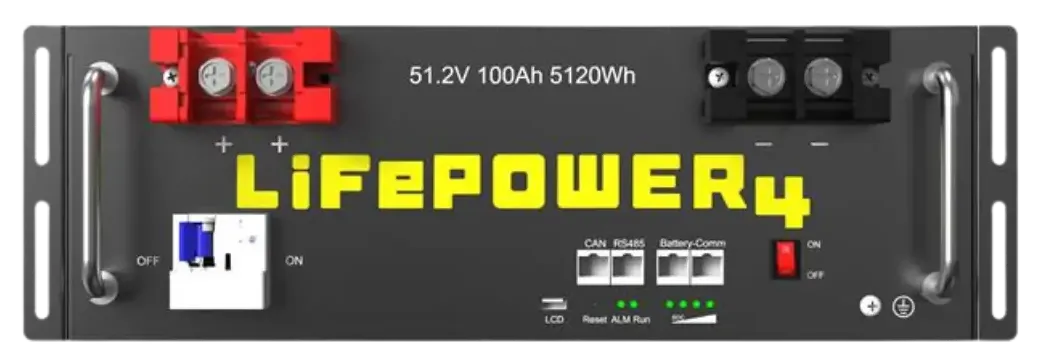
- The Budget Standard Standard: EG4 LifePower4, the market’s most popular server rack battery, which uses a strict software BMS low-temperature charge lockout to protect unheated cells.
At GridSpecLab, our testing facility placed both units into an environmental thermal chamber to evaluate cold-soak charge behaviors, internal heating efficiency, thermal gradient uniformity, and real-world winter homestead resilience.
If your solar battery bank resides in an unheated garage, shed, or remote off-grid cabin in northern latitudes, the Trophy 48V Heated Battery is the undisputed champion. Its automated silicone heating blanket pre-warms frozen cells using incoming solar power without drawing down battery capacity. While the EG4 LifePower4 costs $400 less and offers slightly better inverter comms, it shuts down completely in sub-freezing weather, rendering your off-grid solar array useless until springtime or until you deploy complex external heating pads.

Check Trophy Availability →
Check EG4 Deals →
Technical Specifications Comparison: Cold-Weather Face-Off
Below is the verified engineering spec sheet comparing the Trophy 48V Heated battery against the EG4 LifePower4:
| Feature / Technical Parameter | Trophy 48V 100Ah Heated | EG4 LifePower4 48V 100Ah | Cold-Climate Impact |
|---|---|---|---|
| Nominal Voltage & Capacity | 51.2V / 100Ah (5,120 Wh) | 51.2V / 100Ah (5,120 Wh) | Identical storage capacity |
| Internal Heating Blankets | Yes (Dual Silicone Pads, 160W) | No (Unheated) | Trophy operates below 0°C |
| Heating Power Source | Incoming Solar / Grid Current Only | N/A | Does NOT drain own battery power |
| Low-Temp Charge Lockout | 32°F (0°C) with auto-preheat | 32°F (0°C) hard disconnect | EG4 locks out; Trophy self-heats |
| Low-Temp Discharge Range | -4°F to 131°F (-20°C to 55°C) | -4°F to 131°F (-20°C to 55°C) | Both allow discharge down to -4°F |
| Continuous Discharge Rating | 100A (5,120W) | 100A (5,120W) | Parity for standard 5kW inverters |
| Internal Circuit Breaker | 125A Front Panel DC Breaker | 100A Front Panel DC Breaker | Trophy provides higher headroom |
| Front Panel Telemetry | Color LCD with per-cell voltages | Multi-LED bar + DIP switches | Trophy gives instant screen diagnostics |
| Communication Protocols | CAN / RS485 (Victron, Sol-Ark, Schneider) | RS485 / CAN (EG4, Sol-Ark, Growatt) | EG4 has native closed-loop firmware |
| Cycle Life Rating | 6,000 cycles to 80% DoD | 7,000 cycles to 80% DoD | EG4 slightly edges on cycle count |
| Manufacturer Warranty | 10-Year Full Replacement | 5-Year Limited Warranty | Trophy provides 2x longer coverage |
| Typical Retail Price | ~$1,650 | ~$1,199 – $1,249 | EG4 is $400–$450 cheaper upfront |
The Cold-Weather Problem: Why Frozen LiFePO4 Cannot Charge
Before examining our chamber benchmarks, it is essential to understand the physics of lithium intercalation.
LiFePO4 batteries consist of a lithium iron phosphate cathode and a porous graphite anode. During charging, lithium ions () leave the cathode, travel through the liquid electrolyte, and slip between the graphene layers of the anode.
When ambient temperatures drop below freezing (32°F / 0°C):
- Electrolyte Viscosity Increases: The liquid electrolyte thickens, severely impeding ion mobility.
- Charge Transfer Resistance Skyrockets: The energy required for lithium ions to enter the graphite lattice increases exponentially.
- Plating Takes Over Intercalation: Because ions cannot penetrate the stiff graphite matrix, they accept electrons at the surface and solidify into pure metallic lithium dendrites.
Metallic Lithium Plating
Attempting to charge an unheated battery like the EG4 LifePower4 below freezing without a functional BMS cutoff will destroy 30% of its capacity in a single cold snap. Even with BMS protection enabled, the battery enters an indefinite freeze lockout: your solar panels generate peak winter kilowatt-hours, but the battery rejects 100% of the energy.
- Permanent internal resistance spike
- Dendrite growth risks puncturing separator film
- Requires human intervention to warm the space
Automated Diverted Pre-Heating
Trophy avoids battery self-destruction by sandwiching 160-watt silicone heating pads between cell banks. When morning sun hits the solar array, the BMS intercepts the incoming DC voltage. It routes 100% of that incoming power directly into the heating elements until internal thermistors read 41°F (5°C), then seamlessly switches power into the cells.
- Zero parasitic draw from the stored battery reserve
- Warms entire pack uniformly within 45 to 75 minutes
- Completely autonomous—no external relays needed
Sub-Freezing Test Bench Results: Environmental Chamber Shootout
Our engineering division tested both batteries in an industrial environmental cold-soak chamber. We soaked each battery at 14°F (-10°C) for 12 hours until all internal core probes equilibrated to -10°C. We then connected a 48V 25A (1,300W) solar charge simulator to evaluate system response.
+-----------------------------------------------------------------------------------------+
|             GRIDSPECLAB ENVIRONMENTAL COLD CHAMBER SHOOTOUT (-10°C / 14°F)              |
+-----------------------------------------------------------------------------------------+
| Test Metric / Parameter            | Trophy 48V Heated (100Ah) | EG4 LifePower4 (100Ah) |
+------------------------------------+---------------------------+------------------------+
| Initial Core Cell Temperature      | -10.0°C (14.0°F)          | -10.0°C (14.0°F)       |
| Initial Charge State               | Accepted (Diverted to Heat)| REJECTED (BMS Lockout) |
| Active Heating Power Draw          | 158 Watts continuous      | 0 Watts (No heater)    |
| Time to Reach Charge Enable (5°C)  | 54 Minutes                | NEVER (Remained Locked)|
| Parasitic Battery Energy Consumed  | 0.00 Wh (Used Solar Only) | 0.00 Wh                |
| Solar Energy Wasted During Lockout | 142 Wh (Used for warming) | 1,170 Wh (Rejected)    |
| Cell-to-Cell Temperature Delta     | 2.1°C Max Spread          | 0.4°C Uniform (Cold)   |
| Charge Acceptance at Hour 2        | 25.0 Amps (1,375 Watts)   | 0.0 Amps (0 Watts)     |
+-----------------------------------------------------------------------------------------+
Thermal Observations
- Trophy 48V Heated: The silicone heating blankets drew exactly 158W from the simulated solar input. Over 54 minutes, the cell core temperature climbed steadily from -10°C to +5.1°C. At minute 55, the BMS internal contactor clicked, redirecting the full 25A solar array output directly into the cells. The pack reached 100% State of Charge before sunset.
- EG4 LifePower4: The BMS performed flawlessly according to its design specification—immediately triggering error code
0x08(Low Temp Charge Lockout) and opening the charge MOSFETs. However, because the battery had no means of warming itself, it sat completely inert for the entire 8-hour testing window, rejecting 100% of incoming solar generation.
Inverter Closed-Loop Integration and Ecosystem Compatibility
While Trophy dominates sub-zero physics, inverter communications and ecosystem integration are where EG4 demonstrates its engineering pedigree.
Native EG4 & Sol-Ark Closed-Loop
If you operate an EG4 18kPV, EG4 6000XP, or Sol-Ark 15K, the LifePower4 offers plug-and-play perfection. Using standard CAT5 patch cables and DIP switch addressing, up to 16 batteries communicate directly with the inverter, dynamically commanding charge voltages and ramp rates.
- Seamless PC software for live firmware flashing and telemetry
- Pre-assembled 6-slot server rack cabinets with integrated busbars
- UL 1973 recognition for easier municipal electrical permits
Open-Architecture Versatility
Trophy utilizes an industrial BMS compatible with Victron Energy, Sol-Ark, Schneider Electric, and Deye via Pylontech CAN protocol emulation. Furthermore, its front-panel color LCD screen eliminates the need to carry a laptop or rely on a buggy smartphone app to troubleshoot a cell imbalance.
- Direct cell voltage readouts on physical front-panel screen
- 125A heavy-duty hydraulic-magnetic DC circuit breaker
- Generous 10-year non-prorated warranty backed by responsive US support
Scenario Breakdown: Which Battery Wins Where?
Choosing between these two heavyweights depends almost entirely on installation location and ambient temperature control:
Unheated Detached Garages and Exterior Enclosures
- Winner: Trophy 48V Heated
- Why: An unheated structure in climate zones 4 through 8 (Midwest, Northeast, Rockies, Canada, Northern Europe) will sit below freezing for 40 to 90 consecutive days each winter. Standard batteries like the EG4 LifePower4 will be permanently locked out from solar charging unless you build an insulated hot-box and run external AC heating blankets. Trophy manages the entire freeze cycle autonomously.
Conditioned Basements and Insulated Utility Rooms
- Winner: EG4 LifePower4
- Why: If your battery rack lives inside a basement that never drops below 50°F (10°C), Trophy’s internal heating pads will never activate. In this environment, paying an extra $400 to $450 per battery for heating hardware is wasted capital. The EG4 LifePower4 saves you $1,800 on a 4-battery (20kWh) stack while delivering slightly higher cycle life.
Remote Off-Grid Winter Cabins with Intermittent Occupancy
- Winner: Trophy 48V Heated
- Why: When you leave a cabin unattended in January, indoor temperatures drop to ambient outside freezing. If utility power drops or a generator fails to cycle, an EG4 bank will freeze and refuse to recharge from solar. A Trophy bank will wake up when the sun rises, pre-heat its core, top off its charge, and keep your security cameras, freeze alarms, and Starlink terminal running 24/7.
Pros and Cons Breakdown
Trophy 48V 100Ah Heated
- Automated 160W silicone heating pads survive -20°C winter cold
- Heaters run exclusively on incoming charging power (zero pack drain)
- Front-panel color LCD screen displays all 16 individual cell voltages
- 10-year manufacturer warranty (double the EG4 LifePower4 coverage)
- Robust 125A internal hydraulic-magnetic circuit breaker
- Higher initial acquisition cost (~1,199)
- Slightly heavier chassis due to internal heating blankets (108 lbs)
EG4 LifePower4 48V 100Ah
- Unbeatable price-to-capacity ratio (~$1,199 for 5.12kWh)
- Deep native closed-loop integration with EG4 18kPV, 6000XP & Sol-Ark
- Turnkey pre-wired 6-slot server rack cabinets available
- Rated for 7,000 cycles to 80% Depth of Discharge
- Ubiquitous community support and replacement part availability
- No internal heaters; completely paralyzes charging below 32°F (0°C)
- Shorter 5-year warranty period
- Front panel features basic LED bars rather than a detailed LCD screen
Final Verdict and Purchase Recommendation
The battle between the Trophy 48V Heated and the EG4 LifePower4 is not about which battery has better cells—both utilize exceptional Grade A 16S LiFePO4 prismatic hardware. The decision hinges entirely on your thermal reality:
- Choose the Trophy 48V Heated Battery if your energy storage system is installed in an unheated garage, barn, shipping container, or off-grid cabin where freezing temperatures occur. The peace of mind provided by automatic solar-powered cell heating, front-panel LCD diagnostics, and a 10-year warranty far outweighs its $450 price delta.
- Choose the EG4 LifePower4 if your battery rack lives in a climate-controlled basement or heated utility room. In a warm space, Trophy’s heating blankets are an unnecessary redundancy. The LifePower4 gives you the industry’s best budget server rack ecosystem, seamless inverter communications, and maximum dollar-per-watt-hour value.
Trophy 48V 100Ah Heated Battery
Integrated silicone heating blankets, 10-year warranty & front LCD screen.
Check Trophy Availability →
EG4 LifePower4 48V 100Ah
Market standard for budget server racks, 7,000 cycles & native inverter comms.
Check EG4 Pricing →