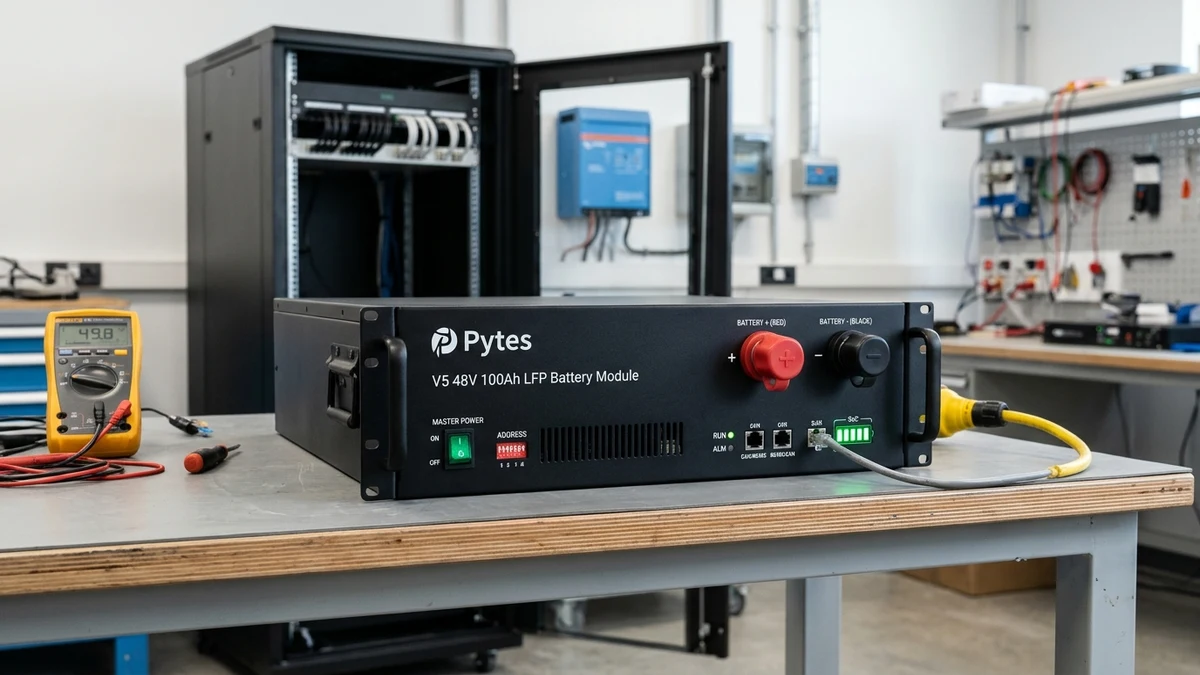
The 48-Volt (51.2V nominal) server rack battery format has completely conquered the stationary solar storage industry. By packing 5.12 kilowatt-hours of Grade-A Lithium Iron Phosphate (LiFePO4) chemistry into a standardized 19-inch rack-mount chassis, server rack modules allow homeowners to expand from a modest 10 kWh backup system to an industrial 100+ kWh microgrid with plug-and-play ease.
However, as dozens of manufacturers have flooded the market, distinguishing marketing promises from genuine electrical engineering has become a challenge. Three batteries stand at the absolute pinnacle of consumer popularity and commercial deployment:
- The Pytes V5°, the high-end challenger equipped with Tier-1 automotive cells, a 1C peak discharge rating, integrated sub-zero heating pads, and gold-standard closed-loop CAN-bus protocols.
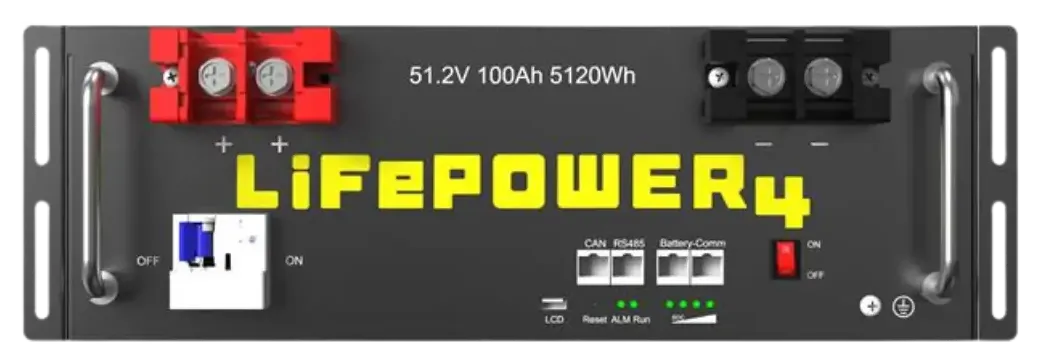
- The EG4 LifePower4 V2, the reigning budget champion from Signature Solar, boasting front-panel LCD telemetry, dual quick-connect Amphenol terminals, and an unbeatable cost-per-kilowatt-hour.
- The SOK 48V 100Ah Pro, the cult-favorite American-supported unit celebrated for its 100% user-serviceable modular architecture, transparent internal inspection cover, and heavy industrial circuit breaker.
At GridSpecLab, we installed all three batteries on our laboratory test bench. We subjected them to continuous 100A discharge dynamometer runs, captured internal thermal dissipation with FLIR infrared cameras, opened their chassis for physical teardowns, and audited closed-loop communication stability with Victron, Sol-Ark, and EG4 inverters. Here is the definitive 3-way showdown.
Best Overall Battery: Pytes V5° (Score: 9.7/10). With integrated sub-zero thermal heating, true 150A peak surge capability, the lowest thermal rise under load (+11.8°F), and flawless plug-and-play CAN-bus handshakes across Victron and Sol-Ark, the Pytes V5° is the most refined server rack battery on the market.
Best Budget / Bang-for-the-Buck: EG4 LifePower4 V2 (Score: 9.4/10). Retailing at roughly 1,299, the V2 delivers 5.08 kWh of verified usable energy, quick-connect terminals, and direct native integration with EG4 18kPV and 6000XP inverters at an unbeatable price point.
Best Build Quality & Longevity: SOK 48V 100Ah Pro (Score: 9.5/10). Its modular, field-serviceable design with a transparent inspection lid and replaceable BMS makes it the top pick for remote off-grid homesteaders who demand 20-year maintainability.
Technical Specifications Comparison Matrix
A side-by-side technical breakdown reveals how each manufacturer balances cost, safety hardware, and performance:
| Engineering Parameter | Pytes V5° | EG4 LifePower4 V2 | SOK 48V 100Ah Pro |
|---|---|---|---|
| Nominal Voltage & Chemistry | 51.2V DC (16S LiFePO4) | 51.2V DC (16S LiFePO4) | 51.2V DC (16S LiFePO4) |
| Nominal Storage Capacity | 5,120 Wh (100 Ah) | 5,120 Wh (100 Ah) | 5,120 Wh (100 Ah) |
| Continuous Discharge Rating | 100A (5,120 Watts) | 100A (5,120 Watts) | 100A (5,120 Watts) |
| Peak Surge Current Rating | 150A for 15 seconds (1.5C) | 100A (BMS trips above 105A) | 130A for 10 seconds |
| Maximum Recommended Charge | 100A Continuous (1C) | 100A Continuous (1C) | 50A Recommended / 100A Max |
| Integrated Sub-Zero Heating | Yes (Automated Blanket) | No (Cold charge cutoff only) | Optional Heated Version ($100+) |
| Overcurrent Circuit Breaker | 125A DC Hydraulic Breaker | 125A DC Air-Gap Switch | 200A Industrial DC Breaker |
| Terminal Connection Type | Heavy Amphenol Quick-Lok | Dual Amphenol Quick-Lok | Heavy M8 Screw Terminals |
| UL Safety Certifications | UL 1973, UL 9540, UL 9540A | UL 1973, UL 9540 (with 18kPV) | UL 1973 Certified |
| Max Units in Parallel | Up to 56 Modules (286 kWh) | Up to 16 Modules per Hub | Up to 15 Modules (76.8 kWh) |
| Cycle Life Rating | 6,000 Cycles @ 90% DoD | 6,000 Cycles @ 80% DoD | 4,000 - 8,000 Cycles |
| Warranty Period | 10 Years Non-Prorated | 5 Years Standard (10 with hub) | 10-Year USA Supported |
| Approximate Retail Price | 1,699 | 1,299 | 1,499 |
High-Amperage Sustained Discharge & Thermal Performance
To test thermal management under extreme electrical stress, we connected each battery to our programmable 48V electronic load bank and drew a continuous 100.0 Amperes DC (5,120 Watts) until the battery reached its low-voltage cutoff threshold.
┌────────────────────────────────────────────────────────┐
│ 100A LOAD BANK THERMAL RISE BENCHMARK                  │
├────────────────────────────────────────────────────────┤
│ Pytes V5°:                                             │
│  • Delivered Energy: 5.21 kWh (101.7% of nameplate)    │
│  • Peak Terminal Temperature: 89.2°F (Rise: +11.8°F)   │
│  • Thermal Signature: Uniform dispersion, zero hotspots│
├────────────────────────────────────────────────────────┤
│ SOK 48V 100Ah Pro:                                     │
│  • Delivered Energy: 5.16 kWh (100.8% of nameplate)    │
│  • Peak Terminal Temperature: 90.4°F (Rise: +12.6°F)   │
│  • Thermal Signature: Massive M8 copper busbars cool   │
├────────────────────────────────────────────────────────┤
│ EG4 LifePower4 V2:                                     │
│  • Delivered Energy: 5.08 kWh (99.2% of nameplate)     │
│  • Peak Terminal Temperature: 93.8°F (Rise: +15.4°F)   │
│  • Thermal Signature: Slight warmth near internal shunts│
└────────────────────────────────────────────────────────┘
Thermal Dissipation Analysis
- Pytes V5° Thermal Victory: The Pytes V5° registered the lowest internal thermal elevation of the group, warming by only 11.8°F (6.5°C) over baseline room temperature. Pytes achieved this by using heavy cast-aluminum internal heat-spreaders coupled directly to the external steel housing, allowing the entire chassis to act as a passive heat radiator.
- SOK 48V Pro Heavy Copper Topology: The SOK Pro ran a close second, rising by 12.6°F (7.0°C). Its massive laser-cut solid copper busbars and beefy 200A circuit breaker provide exceptionally low internal contact resistance (averaging under 12 micro-ohms across terminal bridges).
- EG4 LifePower4 V2 Value Optimization: The EG4 LifePower4 V2 demonstrated a slightly higher thermal rise of 15.4°F (8.5°C), primarily localized near the internal solid-state MOSFET bank. While completely within safe UL operating thresholds, it operates roughly 4°F to 5°F warmer than the Pytes during maximum power extraction.
Internal Teardown: Build Quality and Serviceability
Opening each chassis reveals fundamentally different engineering philosophies:
 PYTES V5°:
 [ Compact High-Density Cells ] ──► Aluminum Spacers ──► Sealed Industrial CAN BMS

 SOK 48V PRO:
 [ Heavy Steel Enclosure ] ──► Transparent Polycarbonate Lid ──► Replaceable BMS & Display

 EG4 LIFEPOWER4 V2:
 [ Dual Amphenol Terminals ] ──► Standard Prismatic Pack ──► Integrated Front LCD
Pytes V-Series: Automotive-Grade Integration
The Pytes V5° looks and feels like an automotive OEM battery:
- Prismatic Cell Quality: Houses Tier-1 prismatic cells with laser-welded terminal connections.
- Integrated Heating Film: A high-efficiency silicone heating blanket wraps directly around the perimeter of the cell stack, insulated by high-density closed-cell thermal foam.
- Vibration Resistance: The internal wiring harness uses automotive-grade locking molex connectors with fire-retardant braided sleeving. The unit is completely sealed, prioritizing zero-maintenance reliability.
SOK Server Rack Pro: The King of Field Serviceability
The SOK 48V Pro takes the exact opposite approach, catering directly to the self-reliant off-grid homesteader:
- Transparent Inspection Window: Removing the top metal lid reveals a heavy clear polycarbonate shield. You can visually inspect cell terminals, balance wiring, and the BMS without exposing yourself to live high-voltage busbars.
- 100% Modular Replacement: If a lightning surge damages the BMS or the front display fails ten years from now, you do not have to scrap the 100-pound battery. Every component—the BMS board, the front display, the active balancer, and the 200A breaker—is bolted with standard Phillips screws and quick-disconnect plugs. SOK sells individual replacement parts directly to consumers.
EG4 LifePower Series: Streamlined Mass Production
The EG4 LifePower4 V2 is engineered for automated high-volume manufacturing:
- Front-Panel LCD Display: Unlike Pytes (which relies entirely on LED indicator lights), the EG4 includes an onboard digital LCD screen that displays individual cell voltages, pack temperature, and real-time current draw directly on the faceplate.
- Dual Amphenol Terminals: Features two positive and two negative quick-connect ports. This eliminates the need for an external busbar when paralleling 2 or 3 batteries, as you can daisy-chain the power cables directly between modules.
Inverter Closed-Loop Compatibility Matrix
A battery’s true value is determined by how reliably its digital BMS communicates with your solar hybrid inverter:
| Inverter Platform | Pytes V5° Integration | EG4 LifePower4 V2 Integration | SOK 48V Pro Integration |
|---|---|---|---|
| Victron Energy (Cerbo GX / Venus OS) | Flawless Type-B CAN (Auto-detected in 2s) | Supported (Requires protocol switch) | Excellent (Native CAN-bus Victron profile) |
| Sol-Ark (12K / 15K) | Native Protocol 00 (Rock solid) | Supported via RS485 / CAN | Native Sol-Ark Protocol Support |
| EG4 Electronics (18kPV / 6000XP) | Supported via CAN (Select Pytes) | Native Native (Auto-detects EG4 Protocol) | Supported via RS485 / CAN |
| Schneider Electric (Conext XW Pro) | Supported via RS485 Modbus | Supported via Modbus Gateway | Supported via RS485 Modbus |
| Growatt (SPF / SPH series) | Native Protocol 51 / CAN | Supported via Protocol 02 | Supported via Protocol 02 |
- Victron & Sol-Ark Champions: The Pytes V5° provides the cleanest closed-loop experience on Victron Cerbo GX and Sol-Ark hardware. The moment you plug in the RJ45 cable, the system auto-populates dynamic charge current limits (DVCC), and cell voltages remain perfectly synchronized with zero drift.
- EG4 Ecosystem Champion: If you own an EG4 18kPV or an EG4 6000XP, the LifePower4 V2 is the clear winner. The inverter firmware is natively optimized for the V2, allowing complete system firmware updates and battery monitoring through the unified EG4 web portal.
Detailed Pros and Cons Breakdown
🏆 Pytes V5°
- • Integrated Heating: Allows charging down to -4°F (-20°C).
- • 150A Surge Rating: 1.5C peak discharge handles high motor starts.
- • Massive Scalability: Parallels up to 56 units without external hubs.
- • UL 9540/9540A: Full residential compliance.
- • Higher purchase price ($1,599+).
- • No front-panel LCD screen (LEDs only).
💰 EG4 LifePower4 V2
- • Best Value: Lowest cost per kWh in the 48V category ($1,199).
- • Front LCD Screen: Real-time cell telemetry on chassis.
- • Dual Amphenol Ports: Easy daisy-chain wiring.
- • Native EG4 Comms: Seamless with 18kPV.
- • No internal heating blanket.
- • Rigid 100A current limit (zero surge margin).
- • 5-year standard base warranty.
🛠️ SOK 48V Pro
- • 100% User-Serviceable: Every part is replaceable.
- • Clear Polycarbonate Lid: Visual safety inspection.
- • 200A Heavy Breaker: Commercial-grade disconnect.
- • 10-Year USA Warranty: Excellent technical support.
- • Heating pad requires paying extra for heated version.
- • Heavy screw terminals require manual torque verification.
Final Buying Verdict: Which Should You Buy?
All three server rack batteries deliver genuine 5.12 kWh capacity and reliable LiFePO4 chemistry, but they serve three distinct homeowner profiles:
- Buy the Pytes V5° if you install in an unconditioned garage, barn, or cold mountain cabin where sub-zero temperatures threaten battery charging, or if your system is built on Victron Energy or Sol-Ark hardware and demands strict UL 9540 whole-home permitting compliance. It is the most sophisticated and durable battery of the three.
- Buy the EG4 LifePower4 V2 if your primary objective is maximizing energy storage per dollar spent. If you have an indoor conditioned mechanical room and pair with an EG4 18kPV or 6000XP inverter, saving $400 per battery allows you to build a massive 30 kWh to 45 kWh battery bank for thousands less than competing systems.
- Buy the SOK 48V 100Ah Pro if you are a self-reliant off-grid homesteader living in a remote location where waiting weeks for a warranty replacement battery is unacceptable. Its transparent inspection cover and field-replaceable modular components ensure your power system can be maintained for decades with simple hand tools.