For nearly a decade, Passivated Emitter and Rear Cell (PERC) technology was the uncontested monarch of the global solar industry. Replacing older aluminum back-surface field (Al-BSF) panels, P-type PERC pushed commercial panel efficiency from 16% up to 21%, dramatically lowering the cost of residential and commercial clean energy.
However, PERC has officially slammed into its theoretical physical efficiency ceiling (). Enter TOPCon (Tunnel Oxide Passivated Contact).
Built on an N-type silicon wafer base rather than traditional P-type wafers, TOPCon introduces an ultra-thin tunnel silicon oxide layer () capped with heavily doped polycrystalline silicon. This quantum passivation layer almost completely eliminates carrier surface recombination, boosting commercial module efficiencies past 22.5% to 23.5%.
While spec sheets show only a 1% to 2% difference in Standard Test Condition (STC) laboratory efficiency ratings, the real-world annual kilowatt-hour (kWh) yield gap between TOPCon and PERC is dramatically wider.
At GridSpecLab, we monitored identical 5kW rooftop arrays and ground-mount test strings of Tier-1 N-Type TOPCon and P-Type PERC modules over a 12-month cycle. We audited hot-weather thermal derating, low-light morning/overcast generation, rear-side bifacial albedo gain, and year-one degradation.
N-Type TOPCon is the decisive winner and represents the definitive new benchmark for residential, commercial, and off-grid solar. With zero boron-oxygen light degradation, an industry-leading -0.30%/°C temperature coefficient, and an 80%+ bifaciality factor, TOPCon generates between 4.8% and 7.6% more cumulative kilowatt-hours per year than equivalent wattage PERC panels. With the manufacturing price gap dropping below 2¢/Watt in 2026, buying older P-Type PERC is now a false economy.
Technical Specifications: Head-to-Head Comparison
Here is how N-Type TOPCon and P-Type PERC compare across critical electrical, thermal, and mechanical parameters:
| Engineering Parameter | N-Type TOPCon Modules | P-Type PERC Modules | Performance Advantage |
|---|---|---|---|
| Silicon Substrate Chemistry | N-Type (Phosphorus-doped) | P-Type (Boron-doped) | N-Type (Zero B-O Defects) |
| Passivation Technology | Tunnel Oxide () + Poly-Si | Dielectric Al2O3 + SiNx Rear Passivation | TOPCon (Higher V_oc) |
| Commercial Module Efficiency | 22.5% – 23.8% | 20.4% – 21.4% | +1.5% to +2.4% Absolute |
| Open-Circuit Voltage ( per cell) | 710mV – 735mV | 680mV – 695mV | Higher Voltage Density |
| Temperature Coefficient () | -0.30% / °C | -0.35% / °C | 14% Less Heat Loss |
| Bifaciality Factor () | 80% – 85% | 68% – 72% | +12% to +15% Rear Gain |
| First-Year Degradation (LID) | < 1.0% (Zero Boron LID) | 1.8% – 2.0% | Half the First-Year Loss |
| Annual Linear Degradation | 0.40% / year | 0.55% / year | 27% Slower Aging |
| 30-Year Warranted Output | 87.4% Power Retention | 84.8% (25-year typical) | +5 Additional Years Warranty |
| Low-Light Spectral Response | Superior blue/infrared absorption | Standard visible spectrum | Earlier Morning Startup |
| Average Cost per Watt (2026) | $0.26 – $0.32 / Watt | $0.24 – $0.28 / Watt | PERC (Marginal ~2¢ Capex Edge) |
The Silicon Physics: Why N-Type Eliminates LID
The fundamental advantage of TOPCon originates at the atomic level inside the silicon ingot crystal lattice:
Boron-Oxygen Defect Complex (BO-LID)
In standard P-type wafers, silicon is doped with boron (). During the Czochralski crystal pulling process, residual oxygen () dissolves into the molten silicon. When the completed panel is first exposed to sunlight on your roof, boron atoms combine with oxygen dimers to form boron-oxygen recombination centers.
These centers trap energized electrons, permanently destroying between 1.5% and 2.5% of the panel’s rated nameplate wattage within the first few weeks of operation.
Zero Boron Recombination Centers
TOPCon utilizes N-type wafers doped with phosphorus () instead of boron. Phosphorus has five valence electrons and does not form active recombination complexes with oxygen impurities.
As a result, Light-Induced Degradation (LID) and Light and Elevated Temperature-Induced Degradation (LeTID) are completely eliminated. The panel maintains 99%+ of its factory flash-test rating throughout year one.
Thermal Derating: Why TOPCon Dominates Hot Summer Climates
Solar panels are paradoxically less efficient as they get hot. Standard Test Conditions (STC) measure panel power at a cell temperature of (). But on a sunny () summer day, dark silicon panels absorbing radiant solar energy regularly heat up to to ( to ).
The power loss caused by elevated cell temperature is governed by the panel’s Maximum Power Temperature Coefficient ():
Empirical Heat Stress Calculation at Cell Temperature
Let us compare two 500W modules—one P-Type PERC and one N-Type TOPCon—operating under identical summer roof conditions where cell temperature reaches ():
-
P-Type PERC ():
-
N-Type TOPCon ():
The Result: At peak summer temperatures when your household air conditioner is drawing maximum power, the TOPCon module delivers an immediate 10 Watts extra per panel (+2.3% instantaneous power boost) purely due to superior thermal physics. On a typical 20-panel residential array, that represents 200 extra watts of continuous electricity.
Bifaciality Factor: Ground-Mount and Flat-Roof Albedo
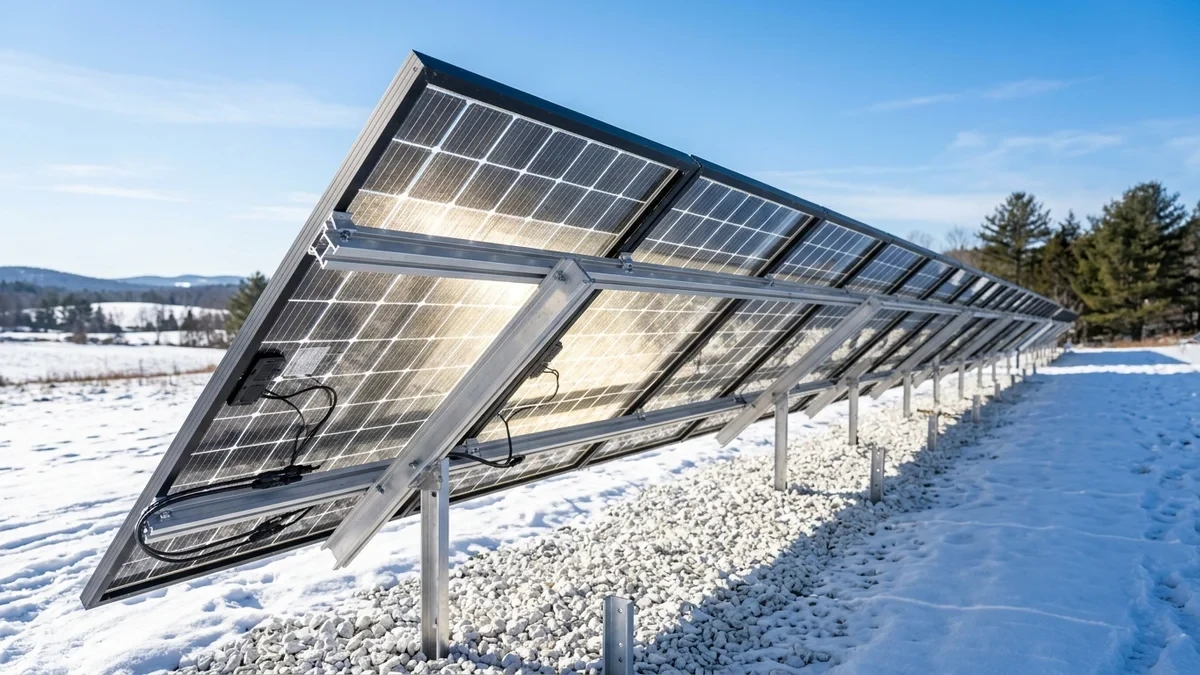
For ground-mount systems, carports, and flat commercial roofs with reflective membranes, bifacial panels generate power from both sides. However, the rear-side generation capability differs radically between cell architectures:
- P-Type PERC: The rear side of a PERC cell requires aluminum grid patterns that obscure up to 30% of the active silicon. Maximum bifaciality factor caps out at 68% to 70%.
- N-Type TOPCon: The symmetrical passivated contact structure allows near-identical light entry from front and back. Bifaciality factor reaches 80% to 85%.
⚡ Real-World Rear-Side Generation Comparison (500W Modules)
| Ground Surface (Albedo) | Surface Reflectance (α) | PERC (70% Bifacial) | TOPCon (82% Bifacial) | TOPCon Extra Output |
|---|---|---|---|---|
| Green Grass / Turf | 18% | 563W total (+12.6%) | 574W total (+14.8%) | +11W (+2.0%) |
| Light Gravel / Dry Dirt | 28% | 598W total (+19.6%) | 615W total (+23.0%) | +17W (+2.8%) |
| White TPO Membrane / Concrete | 60% | 710W total (+42.0%) | 746W total (+49.2%) | +36W (+5.1%) |
| Fresh Snow Cover | 82% | 787W total (+57.4%) | 836W total (+67.2%) | +49W (+6.2%) |
25-Year Levelized Cost of Energy (LCOE) Economics
When evaluating solar hardware, comparing initial purchase price alone ($0.28/W vs $0.26/W) is misleading. The true financial metric is Levelized Cost of Energy (LCOE)—the total lifetime cost divided by the total cumulative kilowatt-hours generated over 25 to 30 years:
10kW Array 25-Year Cumulative Generation Model
- System Size: 10.0 kW DC (20 modules @ 500W each)
- Average Solar Irradiance: 4.8 Peak Sun Hours / day
- P-Type PERC Cumulative 25-Year Generation:
- Year 1 Degradation: 2.0% (LID)
- Annual Linear Degradation: 0.55% / year
- 25-Year Output: 362,400 kWh
- N-Type TOPCon Cumulative 25-Year Generation:
- Year 1 Degradation: 0.8%
- Annual Linear Degradation: 0.40% / year
- Temperature & Bifacial Yield Premium: +4.5% annual average
- 25-Year Output: 389,800 kWh
Lifetime Energy Dividend: The TOPCon array produces 27,400 additional kilowatt-hours over 25 years. At an average utility electric rate of $0.22/kWh, those extra kilowatt-hours represent $6,028 in pure cash savings—dwarfing the initial $200 to $300 price difference between TOPCon and PERC hardware!
Pros and Cons: Engineering Perspective
✓ N-Type TOPCon Advantages
- Higher Module Efficiency (22.5%+): Generates up to 10% more power in the exact same roof footprint.
- Zero Boron-Oxygen LID: No sudden 2% drop in performance during the first month on your roof.
- Superior Temperature Coefficient: Loses 14% less energy to heat during extreme summer heat waves.
- 80%+ Bifaciality: Captures significantly more diffuse rear-side light on ground mounts and white roofs.
- Longer Warranty: Standard 30-year linear performance warranty with 87.4% guaranteed retention.
✓ P-Type PERC Considerations
- Lowest Immediate Upfront Capex: Bulk warehouse clearance pricing can occasionally save $20–$30 per pallet.
- Decade-Long Track Record: Billions of panels installed globally with fully understood field degradation baselines.
- Adequate for Unlimited Land: Perfectly suitable for off-grid ground mounts with excess acreage where space is free.
- Phased Out Manufacturing: Major manufacturers (Jinko, Trina, LONGi) are retiring PERC production lines in favor of 100% TOPCon.
Frequently Asked Questions (FAQ)
Can I mix N-Type TOPCon and P-Type PERC panels on the same string?
We strongly advise against it. While electrically possible if both panels have identical Imp (Current at Maximum Power), differences in temperature coefficients and voltage responses will cause significant string mismatch losses, dragging the entire series string down to the efficiency of the weakest panel. Always keep strings homogenous.
Is TOPCon better than HJT (Heterojunction) or IBC (Interdigitated Back Contact)?
HJT and IBC panels offer slightly better temperature coefficients (-0.26%/°C) and higher theoretical efficiencies, but they carry a 20% to 35% higher cost per watt. TOPCon hit the commercial sweet spot: it delivers 95% of HJT’s performance benefits at virtually the same manufacturing cost as older PERC. For 90% of buyers, TOPCon represents the optimal balance of price and yield.
How do I verify if a panel is genuinely N-Type TOPCon?
Look at the manufacturer’s spec sheet under Cell Type. It should explicitly state “N-type Monocrystalline” or “TOPCon”. Additionally, check the temperature coefficient of Pmax: if it is -0.30%/°C or -0.29%/°C, it is TOPCon. If it is -0.35%/°C or -0.38%/°C, it is older P-type PERC.
Final Purchasing Verdict
The debate between P-Type PERC and N-Type TOPCon is fundamentally over. TOPCon has achieved manufacturing parity while delivering superior physics across every critical metric: higher efficiency, zero boron LID, superior summer heat tolerance, higher rear-side bifaciality, and slower 30-year degradation.
Unless you are buying discounted liquidation pallets of PERC panels for under $0.18 per Watt for an unshaded ground array, N-Type TOPCon is the only solar panel technology you should purchase for new residential, commercial, or off-grid installations in 2026.