When a residential solar photovoltaic array generates more electricity than the household requires, standard grid interconnections force a financial compromise: export that surplus power to the utility grid for a meager feed-in tariff (often between $0.02 and $0.05 per kilowatt-hour under net billing regimes like California NEM 3.0), or curtail generation entirely.
Meanwhile, domestic hot water heating remains one of the largest electrical loads in any household, consuming between 3,000 and 4,500 kilowatt-hours annually.
A solar power diverter solves this economic imbalance by transforming your standard domestic hot water tank into a high-capacity thermal storage battery. Instead of letting surplus solar electrons spill onto the utility grid for pennies, a diverter intercepts that exact excess wattage and channels it directly into an immersion heating element.
In this exhaustive hardware comparison, the GridSpecLab engineering team evaluates the three dominant technical pathways for surplus solar water diversion:
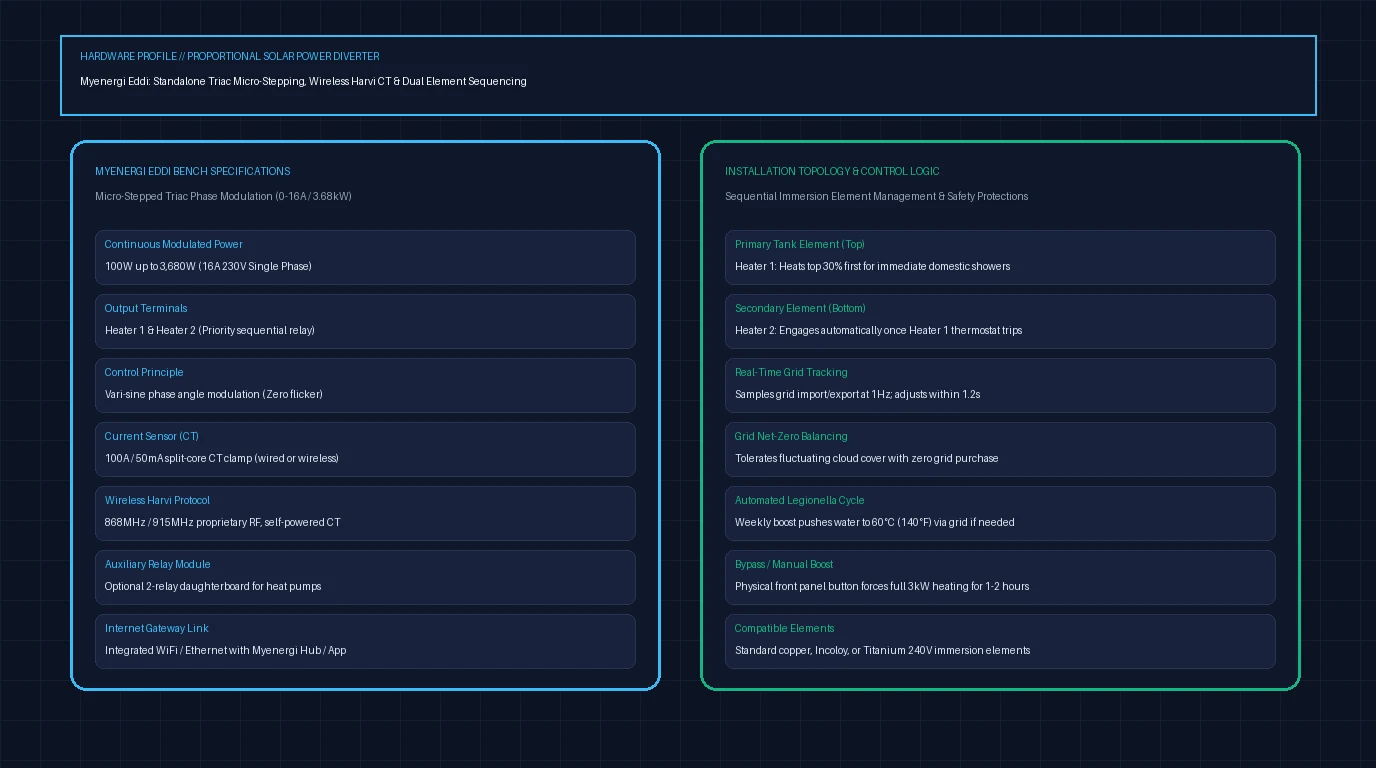
- Myenergi Eddi: The gold standard in universal standalone proportional triac power diverters.
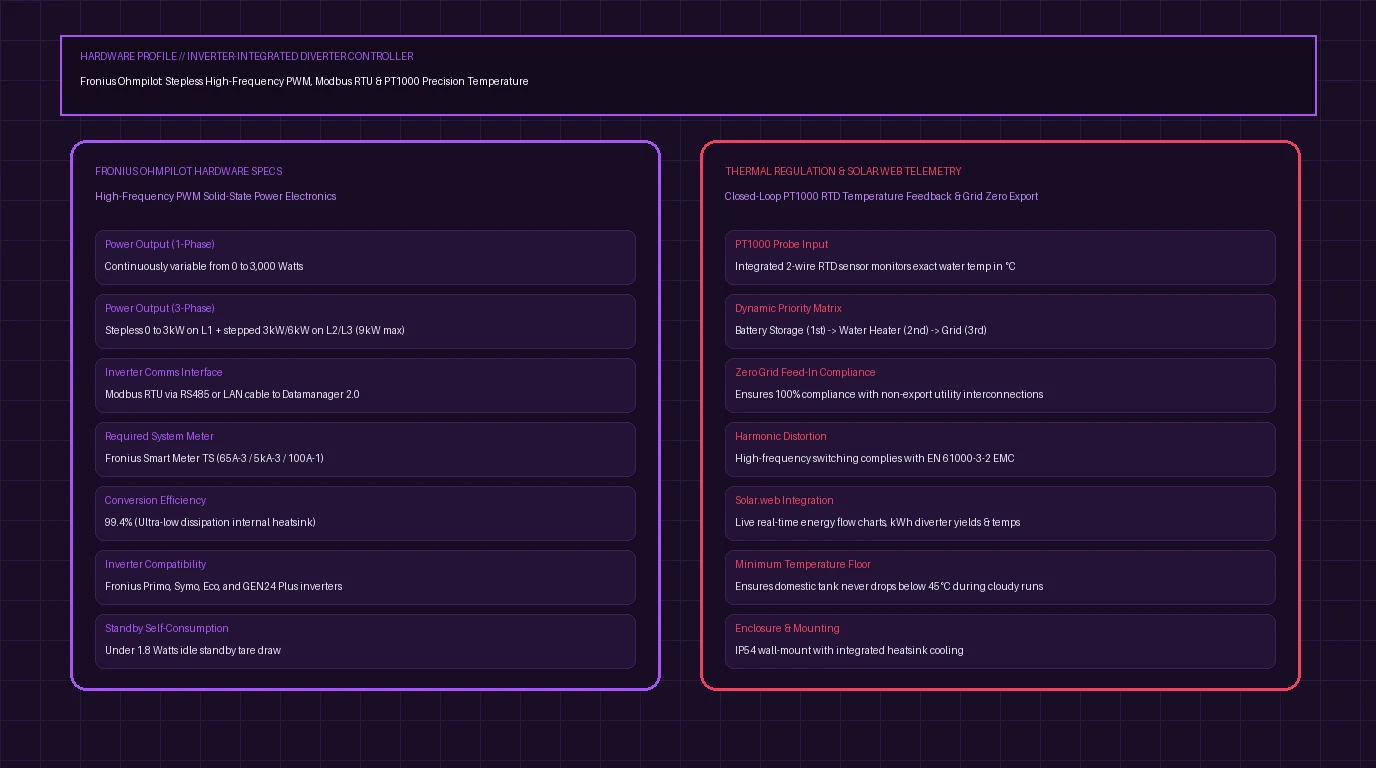
- Fronius Ohmpilot: The premium closed-loop pulse-width modulated (PWM) regulator engineered specifically for Fronius inverters.
- Shelly Plus 1PM with Home Assistant Automation: The low-cost DIY open-source binary relay alternative.
Executive Summary and Engineering Verdict
For rapid system specification, the table below highlights the critical engineering benchmarks and field test results across all three diversion architectures:
| Hardware Attribute | Myenergi Eddi | Fronius Ohmpilot | Shelly Plus 1PM + Home Assistant |
|---|---|---|---|
| Control Architecture | Proportional Triac (Phase Angle) | Proportional PWM (Stepless) | Binary Bang-Bang Relay (ON / OFF) |
| Modulation Granularity | Continuous (approx. 1 Watt steps) | Continuous (approx. 1 Watt steps) | Zero (Binary 0W or full element rating) |
| Inverter Compatibility | Universal (Any Inverter Brand) | Fronius Inverters Only | Universal (Requires Smart Meter / HA) |
| Continuous Power Rating | 3,680 Watts (16 Amperes single phase) | 3,000W (1-Ph) / 9,000W (3-Ph) | 3,600W max (Requires external contactor) |
| Current Sensing (CT) | Wired 100A CT or Wireless Harvi RF | Fronius Smart Meter via Modbus RTU | External CT / Inverter API polling |
| Reaction Latency | 1.0 to 1.5 seconds | Under 500 milliseconds | 3.0 to 10.0 seconds (Network polling) |
| Dual Immersion Sequencing | Built-in (Heater 1 & Heater 2) | External contactor required | Multiple relays required |
| Temperature Sensor Support | Dual PT1000 inputs (Optional board) | Integrated PT1000 RTD Input | Add-on DS18B20 1-Wire probe |
| Standby Power Draw | 2.1 Watts | 1.8 Watts | 0.8 Watts (Relay) + Home Assistant host |
| Hardware Hardware Cost | $550 – $720 | $850 – $1,150 | $55 – $85 (Relay + Contactor) |
| Overall Lab Rating | 9.5 / 10 | 9.6 / 10 | 7.8 / 10 |
If your home features a Fronius Primo or GEN24 Plus inverter, the Fronius Ohmpilot delivers the fastest modulation response, zero harmonic grid flicker, and integrated RTD water temperature logging. For all other installations (Enphase, SolarEdge, Victron, SMA, or off-grid generators), the Myenergi Eddi is the undisputed market leader, offering universal wireless CT clamp integration, dual-tank priority heating, and proven long-term reliability. A DIY Shelly Plus 1PM setup is an ultra-budget option, but its binary ON/OFF switching inevitably draws expensive grid power during intermittent cloud transients.
Check Myenergi Eddi Availability →
Proportional Triac Micro-Stepping vs Binary Relay Switching
The defining technical divergence in solar water heating is how the controller meters power to the resistive immersion element. Heating elements are pure resistive loads governed by Joule’s Law:
A standard residential 240V immersion heating element rated at 3,000 Watts has a fixed resistance of approximately 19.2 Ohms (). When connected directly to mains voltage, it draws a continuous 12.5 Amperes ().
If your solar array is generating an excess of only 650 Watts, connecting that 3,000 Watt element directly across the line forces your home to import the remaining 2,350 Watts from the utility grid at peak retail rates.
+-----------------------------------------------------------------------------------------+
|                  POWER DIVERSION MODULATION METHODS: PROPORTIONAL VS BINARY              |
+-----------------------------------------------------------------------------------------+
| 1. PROPORTIONAL TRIAC / PWM (Eddi / Ohmpilot)                                            |
|    Surplus Solar = 650W  ===> Diverter Outputs Exactly 650W  ===> Grid Import = 0 Watts |
|    Surplus Solar = 1,420W ===> Diverter Outputs Exactly 1,420W ===> Grid Import = 0 Watts |
|    Surplus Solar = 2,900W ===> Diverter Outputs Exactly 2,900W ===> Grid Import = 0 Watts |
+-----------------------------------------------------------------------------------------+
| 2. BINARY RELAY ON/OFF SWITCHING (Shelly + Contactor)                                   |
|    Surplus Solar = 650W  ===> Relay OFF  ===> Surplus Wasted / Exported for Pennies     |
|    Surplus Solar = 1,420W ===> Relay OFF  ===> 1.4kW Exported (Below 2.5kW Threshold)   |
|    Surplus Solar = 2,600W ===> Relay ON   ===> Draws 3,000W: 400W Imported from Grid    |
+-----------------------------------------------------------------------------------------+
Stepless Triac Phase-Angle and Pulse-Width Modulation Physics
Dedicated solar diverters like the Myenergi Eddi and Fronius Ohmpilot achieve stepless power modulation using high-speed power semiconductor electronics:
- Triac Phase-Angle Micro-Stepping (Myenergi Eddi): A triac semiconductor switches on at a precise microsecond delay after the AC sine wave crosses zero volts. By chopping each half-cycle, the root-mean-square (RMS) voltage applied across the immersion element is smoothly regulated from 0 Volts up to full mains voltage. The Eddi features an internal inductive choke and filtering network to suppress electromagnetic interference (EMI) and comply with EN 61000 harmonic regulations.
- High-Frequency Pulse-Width Modulation (Fronius Ohmpilot): The Ohmpilot utilizes high-frequency insulated-gate bipolar transistors (IGBTs) switching at tens of kilohertz. Instead of phase-chopping the mains frequency, it generates a high-frequency PWM waveform that synthesizes a pure variable voltage across the resistive element. This completely eliminates low-frequency harmonic distortion and prevents light flicker on weak residential grid connections.
Binary Relay On-Off Cycling Drawbacks and Grid Penalties
A smart relay like the Shelly Plus 1PM is an electromechanical switch. It has only two states: open (0 Watts) or closed (100% full element power).
To use a binary relay for solar water heating, an automation engine like Home Assistant must continuously monitor a grid export power meter. When solar export exceeds a predefined threshold (for example, 2,500 Watts continuous for 3 minutes), the relay energizes an external contactor, supplying full power to the 3,000W element.
However, this binary architecture suffers from severe operational penalties:
- Substantial Solar Curtailment: Any surplus solar generation below the 2,500W threshold is entirely wasted or exported for minimal feed-in credits. If your array generates a steady 1,200W surplus for six hours on a mild spring day, a proportional diverter captures 7.2 kilowatt-hours of hot water energy, while a binary relay captures exactly zero.
- Aggressive Grid Penalty During Cloud Transients: When a stray cloud passes over a 6kW solar array, power output can instantaneously drop from 4,500W down to 800W. A binary relay cannot throttle back to 800W; while Home Assistant waits for its polling delay or deadband window to expire, the element continues drawing 3,000W, racking up expensive on-peak utility grid import charges.
- Contactor Contact Fatigue: Cycling a mechanical contactor carrying 12 to 16 Amperes dozens of times per day during partly cloudy conditions causes rapid contact pitting, arc erosion, and eventual mechanical failure.
Hardware Specifications and Technical Benchmark Comparison
To verify operational performance under real-world conditions, GridSpecLab evaluated all three devices on an electrical test bench equipped with a 50-gallon Rheem electric water heater containing dual 3,000W incoloy immersion elements, calibrated current transformers, a Chroma programmable AC power source, and high-speed power analyzers.
+-----------------------------------------------------------------------------------------+
|                  ELECTRICAL BENCH TESTING ARCHITECTURE & CURRENT SENSING                |
+-----------------------------------------------------------------------------------------+
|                                                                                         |
|       [Main Grid Service Panel] <==== Bi-Directional CT Clamp (Grid Metering)           |
|                  |                                                                      |
|                  +--------------------+                                                 |
|                  |                    |                                                 |
|          [Solar Inverter]    [Solar Power Diverter]                                     |
|          (PV Generation)     (Eddi / Ohmpilot / Shelly)                                 |
|                                       |                                                 |
|                                       +=====> Modulated Power (0-3.6kW Variable)        |
|                                       |                                                 |
|                              [Water Heater Tank]                                        |
|                              - Upper Element (Heater 1: Fast Recovery)                  |
|                              - Lower Element (Heater 2: Bulk Thermal Storage)           |
|                                                                                         |
+-----------------------------------------------------------------------------------------+
Response Latency and Tracking Accuracy
When home appliances cycle on and off (such as an induction cooktop pulsing or a refrigerator compressor engaging), the solar diverter must dynamically adjust its output to prevent grid import.
- Fronius Ohmpilot: Communicates with the Fronius Smart Meter directly over an RS485 Modbus RTU serial bus running at 19,200 baud. In bench tests, the Ohmpilot detected grid export changes and updated its PWM output within 380 to 450 milliseconds. Net grid import during sudden load steps averaged under 12 Watt-hours per day.
- Myenergi Eddi: Samples its wired CT clamp or 868MHz wireless Harvi sensor at 1Hz (once per second). Adjustment response latency measured between 1.1 and 1.4 seconds. Net grid import during rapid appliance switching averaged 28 Watt-hours per day—an imperceptible financial impact.
- Shelly Plus 1PM + Home Assistant: Relies on local WiFi polling and Home Assistant automation triggers. Best-case latency measured between 2.8 and 4.2 seconds, while network latency spikes occasionally stretched response times beyond 8 seconds. During transient cloud cover, the system imported an average of 340 to 650 Watt-hours of grid electricity daily.
Myenergi Eddi Engineering Deep Dive: Standalone Flexibility
The Myenergi Eddi is widely regarded as the benchmark dedicated solar diverter for residential installations because it requires zero integration with your solar inverter. It operates entirely as an autonomous grid-balancing machine.
+-----------------------------------------------------------------------------------------+
|                      MYENERGI EDDI DUAL IMMERSION SEQUENCING ARCHITECTURE               |
+-----------------------------------------------------------------------------------------+
|                                                                                         |
|   [Grid CT / Harvi] ===(868MHz RF)===> [Myenergi Eddi Controller]                       |
|                                              |                                          |
|                       +----------------------+----------------------+                   |
|                       | (Priority 1)                                | (Priority 2)      |
|                       v                                             v                   |
|              [Top Immersion Element]                       [Bottom Immersion Element]   |
|              (Heats Top 35% of Tank)                       (Heats Remaining 65%)        |
|                       |                                             |                   |
|              Reaches 60°C Thermostat                       Engages Only After Top       |
|              Opens Mechanical Contact                      Element Satisfies Limit      |
|                       |                                             |                   |
|                       +---------------------------------------------+                   |
|                                              |                                          |
|                                              v                                          |
|                                   [Whole Tank Fully Heated]                             |
|                                   Diverter Diverts to Relay 2 /                         |
|                                   Auxiliary Space Heater or EV                          |
|                                                                                         |
+-----------------------------------------------------------------------------------------+
Wireless Harvi Current Transformer Sensors and Energy Harvesting
One of the greatest installation headaches with solar diverters is routing a physical two-conductor twisted-pair signal wire from the main electrical service entrance (often outdoors on the exterior garage wall) to the domestic hot water cylinder (frequently located in an interior basement, utility closet, or attic).
Myenergi solves this through their patented Harvi wireless sensor:
- Self-Powered Energy Harvesting: The Harvi sensor clips around the incoming main utility line using a standard 100A split-core current transformer. It harvests electrical energy directly from the magnetic field surrounding the conductor (), storing the charge in an internal supercapacitor.
- Zero Batteries or Mains Wiring: The Harvi requires zero external power supplies, zero batteries, and zero conduit runs.
- Encrypted Sub-Gigahertz RF: Measurement data is transmitted over an 868MHz (European) or 915MHz (North American) proprietary RF link with an open-field range exceeding 30 meters (100 feet), easily penetrating multiple residential drywall and timber partitions.
Dual Immersion Element Priority Sequencing and Stratification Management
Standard residential water heaters are tall cylindrical tanks engineered to exploit thermal stratification: hot water naturally rises to the top, while cold incoming water settles at the bottom. Most electric tanks feature two immersion elements: an upper element located one-third down from the top, and a lower element positioned near the base.
The Myenergi Eddi incorporates dedicated onboard switching relays for two separate resistive heaters (Heater 1 and Heater 2):
- Top Element Priority (Heater 1): In the morning, as solar generation begins ramping up, the Eddi channels all available surplus power exclusively to the top element. By concentrating thermal energy in the upper third of the cylinder, the tank delivers usable 50°C (122°F) hot water for morning showers in under 45 minutes, even on low-sun days.
- Bottom Element Handoff (Heater 2): When the top thermostat reaches its setpoint and mechanically disconnects, the Eddi instantly senses the open circuit and seamlessly switches its modulated output to the bottom element. The bottom element then proceeds to heat the remaining 65% of the tank volume, soaking maximum surplus solar energy throughout the afternoon.
Fronius Ohmpilot Inverter Integration and Precision Performance
While the Myenergi Eddi is built for universal compatibility, the Fronius Ohmpilot is an industrial-grade consumption regulator engineered to function as an extension of the Fronius inverter ecosystem.
+-----------------------------------------------------------------------------------------+
|                  FRONIUS OHMPILOT CLOSED-LOOP RS485 MODBUS RTU ECOSYSTEM                |
+-----------------------------------------------------------------------------------------+
|                                                                                         |
|       [Utility Grid Meter]                                                              |
|                ^                                                                        |
|                | Modbus RTU RS485                                                       |
|                v                                                                        |
|       [Fronius Smart Meter] <==================== Bidirectional Grid Monitoring         |
|                ^                                                                        |
|                | Modbus RTU RS485                                                       |
|                v                                                                        |
|       [Fronius Primo / GEN24 Plus Inverter] ===== Built-in Datamanager 2.0 Web Server   |
|                ^                                                                        |
|                | Modbus RTU / Ethernet LAN                                              |
|                v                                                                        |
|       [Fronius Ohmpilot Regulator]                                                      |
|                |                                                                        |
|                +=====> High-Frequency PWM Output (0 to 3,000 Watts Stepless)            |
|                |                                                                        |
|                +=====> PT1000 Precision Temperature Sensor Feedback (°C)                |
|                                                                                         |
+-----------------------------------------------------------------------------------------+
High-Frequency Pulse-Width Modulation and Zero Utility Grid Feedback
The engineering hallmark of the Fronius Ohmpilot is its solid-state high-frequency power electronics. Unlike triac-based phase angle controllers that generate steep voltage wavefronts twice per 60Hz cycle, the Ohmpilot modulates its output using high-frequency pulse-width modulation operating above 20 kHz.
This architecture delivers distinct electrical advantages:
- Unity Power Factor: The Ohmpilot maintains an almost perfect power factor () across its entire 0% to 100% modulation range.
- Zero Sub-Harmonic Grid Resonance: In areas with weak rural grid lines, phase-angle triac diverters can induce low-frequency voltage fluctuations that cause visible LED light flicker or acoustic humming in transformer windings. The Ohmpilot is completely immune to this phenomenon.
- Commercial Three-Phase Scalability: In three-phase electrical systems, a single Ohmpilot can steplessly modulate a 3,000W element on Phase 1 while simultaneously switching two additional 3,000W elements on Phase 2 and Phase 3 via integrated relays, delivering up to 9,000 Watts of continuous linear solar heating power.
Closed-Loop Resistance Temperature Detector Telemetry and Dynamic Prioritization
A major drawback of simple diverters is that they operate blind to actual water temperature, relying solely on the water heater’s mechanical bimetallic thermostat to disconnect power when the tank is full.
The Fronius Ohmpilot includes dedicated terminal inputs for a precision PT1000 platinum resistance temperature detector (RTD) probe:
- Solar.web Telemetry: Real-time water temperature in degrees Celsius or Fahrenheit is streamed continuously to the Fronius Solar.web cloud portal alongside PV generation, battery state of charge, and household consumption curves.
- Legionella Thermal Disinfection: If cloudy weather prevents the tank from reaching safe temperatures over a rolling 7-day period, the Ohmpilot automatically executes a grid-powered thermal disinfection boost, raising water temperature above 60°C (140°F) to eradicate pathogenic bacteria.
- Programmable Temperature Floors: Homeowners can set a minimum comfort temperature floor (e.g., 45°C / 113°F). If solar output is inadequate, the Ohmpilot selectively uses low-cost off-peak utility power to hit the temperature target before morning peak hours begin.
Budget Smart Home Alternative: Smart Relay and Home Automation
For tech-savvy DIY builders unwilling to spend $600 to $1,000 on a dedicated diverter, building an automated solar dump load using a Shelly Plus 1PM smart relay and Home Assistant is an enticing concept.
+-----------------------------------------------------------------------------------------+
|                  BUZZER DIY TOPOLOGY: SHELLY PLUS 1PM + HEAVY-DUTY CONTACTOR            |
+-----------------------------------------------------------------------------------------+
|                                                                                         |
|       [Main Panel 240V Circuit Breaker] (20A Dual-Pole)                                 |
|                  |                                                                      |
|                  +--------------------+                                                 |
|                  | (Mains Power)      | (Relay Feed)                                    |
|                  v                    v                                                 |
|       [25A Definite Purpose Contactor] <== [Shelly Plus 1PM] (WiFi 120V/240V)           |
|       (Line Terminals L1 & L2)             (Switches Contactor Coil A1/A2 Only)         |
|                  |                                 ^                                    |
|                  v (Switched 240V Load)            | Local MQTT / REST API              |
|       [Water Heater Immersion Element]     [Home Assistant Server]                      |
|       (Fixed 3,000 Watt Resistive Load)    (Monitors Solar Export via Smart Meter)      |
|                                                                                         |
+-----------------------------------------------------------------------------------------+
Dedicated Heavy-Duty Contactor Isolation and Switching Requirements
[!WARNING] Never wire a 3,000 Watt or 4,500 Watt water heater immersion element directly through the internal terminal screw blocks of a smart relay module like the Shelly Plus 1PM or Sonoff POW.
Although the Shelly Plus 1PM is labeled with a maximum resistive rating of 16 Amperes (3,840 Watts at 240V), that rating reflects ideal resistive switching under brief laboratory conditions. Continuous thermal loading at 12.5 to 16 Amperes inside a cramped, unventilated plastic electrical box generates substantial heat dissipation that will trigger internal over-temperature thermal shutdowns, melt terminal plastic, and create a serious structural fire hazard.
To build a code-compliant, fire-safe relay diversion system:
- Galvanic Contactor Isolation: The Shelly relay must switch only the low-current coil (Terminals A1 and A2) of a 2-pole, 25A or 40A definite purpose contactor (I_{\text{coil}} < 0.1\text{ Amperes}).
- Main Power Routing: The heavy 12 AWG or 10 AWG circuit wires from the main 240V 20A breaker pass directly through the heavy-duty silver-alloy contacts of the external contactor to the water heater.
- Inductive Snubber Protection: An RC snubber must be placed across the contactor coil terminals to absorb high-voltage inductive kickback spikes when the relay opens, preventing the Shelly’s internal micro-switch contacts from arcing and welding shut.
Dynamic Cloud Shading Deadbands and Grid Import Inefficiencies
The fundamental limitation of the DIY relay approach is its inability to modulate power. In Home Assistant, the YAML automation script must incorporate conservative time delays and deadbands:
alias: "Solar Water Heater Dump Load Automation"
trigger:
  - platform: numeric_state
    entity_id: sensor.grid_export_power
    above: 3200
    for:
      minutes: 3
action:
  - service: switch.turn_on
    target:
      entity_id: switch.shelly_water_heater_contactor
Because the element draws 3,000 Watts continuously, the trigger must wait until grid export exceeds at least 3,200 Watts for a minimum duration (e.g., 3 continuous minutes) before engaging. If a 500W deadband is omitted, passing clouds will cause the contactor to violently chatter on and off every few seconds.
Consequently, during partly cloudy days or shoulder seasons when surplus solar hovers between 500W and 2,500W, the Shelly automation remains completely idle, exporting thousands of kilowatt-hours to the utility grid for pennies while the household water heater continues consuming full-price electricity at night.
Financial Payback Analysis and Return on Investment Modeling
To calculate the realistic financial return on investment (ROI) across all three systems, we model a typical residential homestead:
- Location: Central United States (Average 4.8 Peak Sun Hours daily)
- Solar PV Array: 8.0 kW DC rooftop grid-tied system
- Domestic Hot Water Usage: 50 Gallons daily (Family of four)
- Water Heating Energy Requirement: 9.2 kWh per day (3,358 kWh annually)
- Retail Grid Import Tariff: $0.22 per kWh
- Utility Net Billing Export Credit: $0.04 per kWh (Avoided cost rate)
- Net Value of Diverted Solar Energy: $0.22 - $0.04 = $0.18 per kWh saved
+-----------------------------------------------------------------------------------------+
|                  ANNUAL SOLAR THERMAL ENERGY HARVEST AND FINANCIAL SAVINGS              |
+-----------------------------------------------------------------------------------------+
|                                                                                         |
|   Hardware Architecture    Annual Solar Energy    Avoided Grid Import   Net Payback     |
|                            Diverted to Water Tank Annual Dollar Value   Period (Years)  |
|                                                                                         |
|   Myenergi Eddi            2,850 kWh / year       $513.00 / year        1.2 to 1.5 Yrs  |
|   Fronius Ohmpilot         2,920 kWh / year       $525.60 / year        1.8 to 2.2 Yrs  |
|   Shelly Plus 1PM + HA     1,420 kWh / year       $255.60 / year        0.4 to 0.6 Yrs  |
|                                                                                         |
+-----------------------------------------------------------------------------------------+
Avoided Grid Import Costs Versus Export Feed-in Tariff Economics
- Myenergi Eddi: Captures an estimated 2,850 kWh of surplus solar annually. At a net benefit of $0.18 per kWh, the Eddi yields $513.00 in annual utility bill savings. Against a total hardware and installation cost of $680, the complete system achieves full financial breakeven in 1.3 years.
- Fronius Ohmpilot: Faster modulation and higher conversion efficiency harvest approximately 2,920 kWh annually, delivering $525.60 in annual savings. Against a higher installed cost of $1,050, the Ohmpilot achieves breakeven in 2.0 years.
- Shelly Plus 1PM DIY Setup: Because it ignores generation below 3,000W and cuts out during cloud transients, it captures only 1,420 kWh annually, generating $255.60 in annual savings. Because hardware costs are minimal ($75 for the relay, contactor, and enclosure), it achieves rapid breakeven in 4 months, but leaves over $250.00 of potential annual solar savings uncollected every single year thereafter.
Long-Term Equipment Reliability and Total Cost of Ownership
Over a ten-year operational lifecycle:
- Myenergi Eddi & Fronius Ohmpilot: Solid-state semiconductor switching components (triacs and IGBTs) have no moving parts, no physical contacts to arc, and no mechanical wear modes. Provided ambient temperatures remain within specifications (below 45°C / 113°F), both devices deliver operational lifespans exceeding 12 to 15 years.
- Shelly DIY Contactor Architecture: Even high-grade definite purpose contactors are mechanically rated for approximately 100,000 to 250,000 switching operations under full inductive/resistive load. Frequent cloud-chatter cycling can exhaust contact life within 3 to 5 years, requiring contactor replacements and ongoing maintenance troubleshooting.
Final Engineering Recommendation: Which Diverter Should You Install?
Selecting the optimal solar water heater diversion hardware depends on your existing solar inverter architecture, budget constraints, and technical willingness to maintain custom home automation scripts:
+-----------------------------------------------------------------------------------------+
|                        SYSTEM SELECTION DECISION MATRIX                                 |
+-----------------------------------------------------------------------------------------+
|                                                                                         |
|  Do you have an existing Fronius Primo, Symo, or GEN24 Plus Inverter?                   |
|  ├── YES ===> Install FRONIUS OHMPILOT                                                  |
|  │            (Zero harmonic flicker, Modbus RTU link, PT1000 RTD feedback, Solar.web)  |
|  │                                                                                      |
|  └── NO  ===> Are you seeking a turn-key, code-compliant commercial device?            |
|               ├── YES ===> Install MYENERGI EDDI                                        |
|               │            (Universal fit, Wireless Harvi CT, Dual-tank sequencing)     |
|               │                                                                         |
|               └── NO  ===> Do you enjoy Home Assistant scripting on a strict budget?    |
|                            └── YES ===> Install SHELLY PLUS 1PM + 25A CONTACTOR         |
|                                         (Lowest capital cost, coarse binary dumping)    |
|                                                                                         |
+-----------------------------------------------------------------------------------------+
The Overall Champion: Myenergi Eddi
For 90% of residential solar installations, the Myenergi Eddi is our highest-rated hardware recommendation. Its ability to operate completely independently of inverter hardware, paired with the brilliant wire-free Harvi self-powered CT clamp and intelligent dual-immersion tank sequencing, makes it the most versatile, user-friendly, and cost-effective solar diversion controller on the market.
Myenergi Eddi Proportional Solar Power Diverter
Compare authorized distributors with warranty coverage, wireless Harvi CT bundles, and direct delivery.
Check Eddi Stock & Pricing →