For decades, the standard renewable energy engineering doctrine was crystal clear: if you wanted electricity, you installed photovoltaic (PV) panels; if you wanted hot water, you installed solar thermal collectors.
The thermodynamic logic was unimpeachable: early solar PV panels converted a meager 12% to 15% of incoming solar photons into electricity, while evacuated tube solar thermal collectors converted a massive 65% to 75% of solar radiation directly into hot water. In the year 2005, using expensive PV panels to generate electricity, run it through an inverter, and power an electric water heater was dismissed as financially reckless and thermodynamically absurd.
Fast forward to 2026, and that entire engineering paradigm has collapsed.
Driven by global silicon manufacturing scale, monocrystalline solar PV panel prices have plummeted by more than 90%—dropping below thirty cents per Watt. Simultaneously, residential heat pump technology underwent a massive efficiency leap: modern hybrid heat pump water heaters operate with a Coefficient of Performance (COP) between 3.5 and 4.2, effectively multiplying every kilowatt-hour of solar electricity into four kilowatt-hours of thermal heat.
Today, off-grid homesteaders, ranchers, and rural builders face a decisive choice:
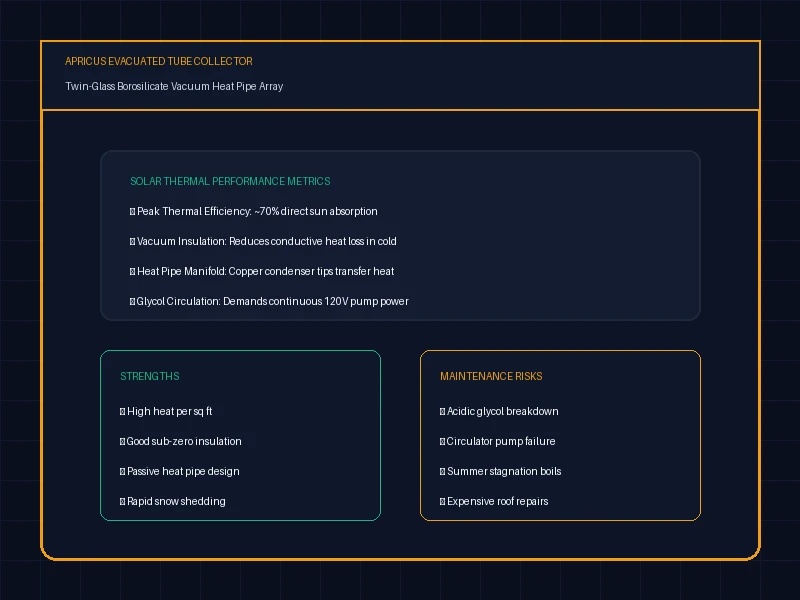
- Evacuated Tube Solar Thermal: Twin-glass borosilicate vacuum tubes circulating a pressurized propylene glycol fluid loop through copper roof plumbing to an internal tank heat exchanger.
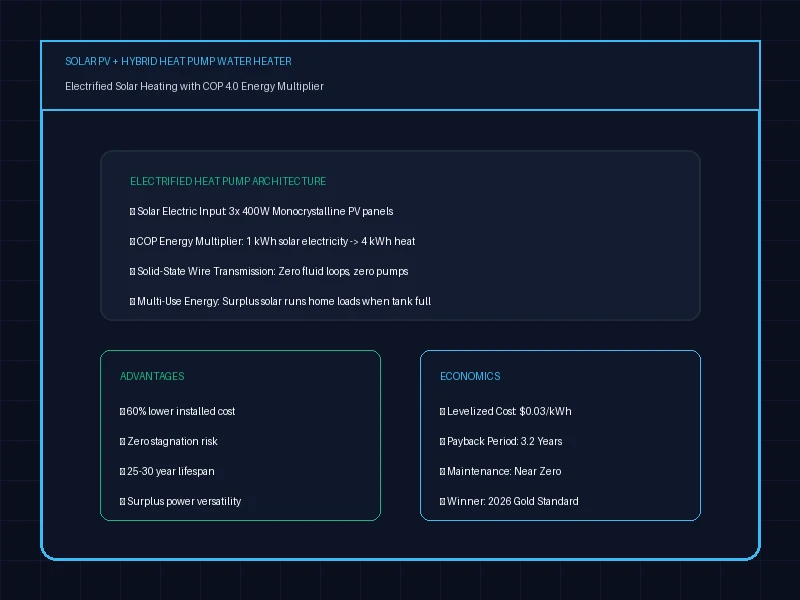
- Solar PV Direct with Hybrid Heat Pump: Standard monocrystalline solar panels connected via solid-state 10 AWG copper wire to a vapor-compression heat pump water heater.
At GridSpecLab, our energy systems engineering team conducted an exhaustive thermodynamic, mechanical, and 10-year Total Cost of Ownership (TCO) audit comparing these two architectures. Here is the mathematical reality for 2026 homestead water heating.
The classic solar thermal economic advantage is officially dead. While evacuated tubes capture more heat per square foot of roof space, Solar PV paired with a Hybrid Heat Pump delivers an equivalent end-to-end solar-to-thermal efficiency of 76% to 84% at roughly half the installed capital cost. More importantly, PV systems completely eliminate pressurized glycol loops, circulation pump failures, summer stagnation boiling, and freezing risks. When the water tank is hot, surplus PV electricity powers your home; a solar thermal collector simply sits on your roof cooking itself in the sun.
Technical Specifications Comparison Matrix
The table below contrasts the thermodynamic, mechanical, and economic parameters of both solar water heating architectures for a standard 4-person homestead (60 Gallons/Day):
| Engineering Parameter | Apricus Evacuated Tube Solar Thermal | Solar PV Array + Hybrid Heat Pump |
|---|---|---|
| Gross Collector Efficiency | 65% to 72% (Direct solar-to-thermal) | 21% to 22% (Photovoltaic module efficiency) |
| Energy Conversion Multiplier | 1.0 (Direct heat transfer) | COP 3.8 to 4.2 (Vapor-compression cycle) |
| Net Solar-to-Water Efficiency | 60% to 68% (After pipe insulation losses) | 76% to 84% (PV Efficiency × Heat Pump COP) |
| Roof Transmission Medium | Pressurized Propylene Glycol in Copper Pipes | Solid-State 10 AWG Copper Electrical Wire |
| Summer Stagnation Behavior | Severe risk: 350°F+ (Acidifies glycol fluid) | Zero risk: PV panels enter open-circuit () |
| Sub-Zero Winter Freezing Risk | High if glycol degrades or pump loses power | Zero: Solid-state PV voltage actually rises in cold |
| Surplus Energy Utilization | None: Trapped as excess heat (Requires dump load) | Versatile: Powers household appliances or battery |
| Moving Parts / Wear Items | Circulator pump, check valves, expansion tank | Hermetic rotary compressor, small sealed fan |
| Average Hardware Life | 10 to 15 Years (Manifold seals & pipes) | 25+ Years (Panels) / 10–12 Years (Water Heater) |
| 10-Year Maintenance Cost | $1,400 to $2,200 (Fluid flush, pumps, leaks) | <$150 (Air filter & sacrificial anode) |
| Complete Turnkey System Cost | $6,200 – $8,500 (Installed with tank) | $2,900 – $3,800 (Installed with tank) |
The Dramatic Price Inversion: How Cheap PV Broke Solar Thermal
To understand why solar thermal lost its market dominance, one must look at the historical trajectory of photovoltaic module manufacturing costs:
+-------------------------------------------------------------------------------+
|                 HISTORICAL HARDWARE CAPITAL EXPENDITURE TREND                 |
+-------------------------------------------------------------------------------+
|                                                                               |
|   Cost per Watt ($)                                                           |
|   $6.00 ^                                                                     |
|         |  [ 2005: PV Panels $5.50/W ]                                        |
|   $4.00 |     \                                                               |
|         |      \      Solar Thermal Cost Curve: Flat ($1.50 - $2.00/W equiv)  |
|   $2.00 |       \-----------------------------------------------------------> |
|         |         \                                                           |
|   $0.30 |          \------> [ 2026: Monocrystalline PV Panels $0.25/Watt! ]   |
|         +------------------------------------------------------------------>  |
|           2005       2010       2015       2020       2025       2026         |
|                                                                               |
+-------------------------------------------------------------------------------+
The Economic Tipping Point
- In 2005, a 2,000-Watt solar photovoltaic array cost over $11,000 for the panels alone. Investing in expensive PV solely to heat water with an electric element made zero economic sense compared to a $3,500 solar thermal system.
- By 2026, Tier-1 monocrystalline solar panels cost roughly $0.25 to $0.30 per Watt. A 1,200-Watt solar array (three 400W commercial panels) costs less than $350 total.
- Meanwhile, solar thermal collectors—which are heavy assemblies of borosilicate glass tubes, copper heat pipes, insulated aluminum headers, and specialized glycol fluid—have seen minimal cost reductions because their price is bound to the raw commodity prices of copper, glass, and specialized manual plumbing labor.
Thermodynamic Showdown: Collector Efficiency vs PV Plus Heat Pump COP
Solar thermal advocates frequently cite collector efficiency: evacuated tubes absorb roughly 70% of solar energy, whereas PV panels convert only 21% of solar photons into electricity. On paper, it appears evacuated tubes capture three times more energy per square foot.
However, that comparison fundamentally ignores the physics of the vapor-compression heat pump:
+-------------------------------------------------------------------------------+
|                       THERMODYNAMIC EFFICIENCY AUDIT                          |
+-------------------------------------------------------------------------------+
|                                                                               |
|  1. EVACUATED TUBE SOLAR THERMAL PATH:                                        |
|     1,000W Solar Irradiance ---> [ Vacuum Tube (70% Eff) ] ---> 700W Thermal  |
|     Minus Pipe Line Loss (10%) = 630W Net Heat Delivered to Water             |
|     --> NET SYSTEM EFFICIENCY: ~63%                                           |
|                                                                               |
|  2. SOLAR PV + HYBRID HEAT PUMP PATH:                                         |
|     1,000W Solar Irradiance ---> [ Monocrystalline PV (21% Eff) ] ---> 210W   |
|     210W Electric Input ---> [ Hybrid Heat Pump (COP 3.9) ]                   |
|     210W * 3.9 = 819W Net Heat Pumped into Water!                             |
|     --> NET SYSTEM EFFICIENCY: ~82%                                           |
|                                                                               |
+-------------------------------------------------------------------------------+
The COP Force Multiplier
A heat pump does not create heat from electrical resistance; it uses electricity to drive a compressor that pumps ambient heat from the surrounding air into the water.
- A modern hybrid heat pump water heater operating in a 65°F (18°C) basement or utility room achieves a Coefficient of Performance of 3.9.
- For every 1 kilowatt-hour of solar electricity fed into the compressor, the unit moves 3.9 kilowatt-hours of heat into the water tank.
- Multiplying the 21% electrical efficiency of the PV panel by the 3.9 COP of the heat pump yields an effective 81.9% solar-to-thermal capture efficiency—exceeding the net thermal delivery of an evacuated tube array!
Maintenance Realities: Glycol Plumbing vs Solid-State Copper Wires
For remote homesteaders and off-grid property owners, equipment reliability is not an academic metric—it is a daily operational reality:
+-------------------------------------------------------------------------------+
|                        MAINTENANCE AUDIT & FAILURE MODES                      |
+-------------------------------------------------------------------------------+
|                                                                               |
|  Apricus Evacuated Tube System:                                               |
|  - Glycol fluid turns acidic every 3-5 years (pH testing & flush mandatory)   |
|  - Roof plumbing penetrations expand/contract, risking attic leaks            |
|  - Mechanical circulator pump (120V AC) can seize or lose prime               |
|  - Pressure relief valves spew hot glycol during summer stagnation (350°F)    |
|                                                                               |
|  Solar PV + Heat Pump System:                                                 |
|  - Two flexible 10 AWG copper wires inside conduit (Zero fluid leaks)         |
|  - Zero roof valves, zero pressure vessels on roof, zero gelling fluids       |
|  - When tank is full, PV array simply stays at Voc with zero wear             |
|  - Standard residential water heater parts available at any hardware store    |
|                                                                               |
+-------------------------------------------------------------------------------+
The Stagnation Nightmare
The fatal flaw of solar thermal collectors is summer stagnation:
- When a family goes on vacation for a week in July, no hot water is consumed.
- The evacuated tubes continue absorbing solar radiation, pushing manifold temperatures past 350°F (177°C).
- The propylene glycol fluid boils, causing pressure relief valves to vent. Repeated boiling breaks down the chemical corrosion inhibitors in the glycol, transforming it into an acidic sludge that corrodes copper pipe walls and gums up heat exchangers.
- With Solar PV, stagnation does not exist. When the heat pump satisfies its thermostat, the compressor shuts off. The solar panels simply enter open-circuit standby (). No fluid boils, no pressure builds, and zero degradation occurs.
Sub-Zero Winter Performance: Vacuum Tubes vs Cold PV Generation
In northern climates, winter water heating is the most demanding test of any renewable energy platform:
How Evacuated Tubes Behave in Winter
- Vacuum Insulation: The twin-glass vacuum envelope provides near-perfect thermal insulation against ambient sub-zero air. Once sunlight hits the internal absorber plate, the heat pipe transfers thermal energy to the header without conductive heat loss.
- The Snow Problem: Because the vacuum insulation is so effective, virtually zero heat escapes through the outer glass tube. Consequently, evacuated tubes cannot melt snow. If heavy wet snow coats the tubes, they can remain buried for weeks until manual clearing occurs.
How Solar PV Behaves in Winter
- Negative Temperature Coefficient: Silicon photovoltaic cells become more efficient in sub-zero temperatures. A 400W solar panel operating at 15°F (-9°C) will produce 430W to 440W of peak power under clear blue winter skies.
- Snow Shedding: Photovoltaic panels are mounted as continuous, smooth dark glass sheets. As soon as the morning sun strikes the dark silicon, the dark surface warms slightly, causing accumulated snow sheets to break loose and slide off cleanly.
- Ambient Air Source: Even in an unheated 40°F (4°C) basement, a hybrid heat pump extracts abundant thermal energy, maintaining a COP above 2.8 and providing hot water effortlessly.
Ten-Year Total Cost of Ownership (TCO) Financial Breakdown
To quantify the long-term economic difference, we modeled the complete 10-year Total Cost of Ownership for a 4-person household consuming 60 gallons of domestic hot water per day:
+-------------------------------------------------------------------------------+
|                    10-YEAR TOTAL COST OF OWNERSHIP (TCO)                      |
+-------------------------------------------------------------------------------+
|                                                                               |
|  Cost Category               Apricus Evacuated Tube    Solar PV + Heat Pump   |
|  --------------------------------------------------------------------------   |
|  Hardware Purchase Cost            $4,800                    $2,100           |
|  Plumbing & Electrical Install     $2,400                      $950           |
|  Pump & Controller Station           $650                    Included         |
|  Glycol Flushes (Years 3, 6, 9)      $900                        $0           |
|  Circulator Pump Replacement         $350                        $0           |
|  Air Filter & Anode Maintenance      $120                      $120           |
|  --------------------------------------------------------------------------   |
|  TOTAL 10-YEAR EXPENDITURE         $9,220                    $3,170           |
|                                                                               |
|  --> 10-Year Homestead Savings with PV + Heat Pump: $6,050 (65% Lower Cost!)  |
|                                                                               |
+-------------------------------------------------------------------------------+
The Versatility Bonus
Beyond the $6,000 direct cash savings, the PV system offers an invaluable operational advantage: energy versatility.
- An evacuated tube collector can only produce hot water. Once your tank reaches 140°F, 100% of the additional solar energy hitting your roof is wasted.
- With Solar PV, when your heat pump compressor shuts down, that 1,200 Watts of solar electricity is automatically redirected by your home electrical panel to power refrigerators, charge home backup batteries, run well pumps, or power tools.
Pros and Cons Breakdown
- ✓65% Lower 10-Year TCO: Drastically lower equipment and installation costs (9,220).
- ✓Zero Plumbing on Roof: Flexible 10 AWG electrical cable replaces toxic glycol copper piping loops.
- ✓No Stagnation Boiling: When tank is hot, panels enter open-circuit standby with zero physical stress.
- ✓Surplus Power Versatility: Excess solar electricity runs household loads, freezers, and batteries.
- ✓25-Year Panel Lifespan: Solid-state PV panels outlast fragile evacuated glass tubes and copper headers.
- ✓Higher Heat per Square Foot: Requires less physical roof footprint if space is severely constrained.
- ✓Extreme High-Temp Output: Can deliver 180°F+ water for industrial processes or district heating.
- ✓Near-Zero Electric Demand: Only requires a modest 60W circulator pump (no 400W compressor).
- ✓Hydronic Floor Compatibility: Integrates directly into existing closed-loop glycol radiant floor heating.
Final Verdict and Recommendation for Modern Homesteaders
The verdict of our 2026 engineering audit is unequivocal: the era of residential solar thermal plumbing is over.
While evacuated tube collectors represent an ingenious piece of thermodynamic engineering, they have been decisively overtaken by the dual forces of plummeting photovoltaic manufacturing costs and high-COP vapor-compression heat pumps.
The Modern Homestead Recommendation:
- Install three or four 400W monocrystalline solar panels on your roof, barn, or ground mount.
- Pair them with an ENERGY STAR certified hybrid heat pump water heater (such as the Rheem ProTerra or AO Smith Voltex) located in your basement, garage, or utility room.
- Enjoy unlimited domestic hot water backed by solid-state electrical simplicity, zero toxic glycol maintenance, and thousands of dollars in lifetime savings.