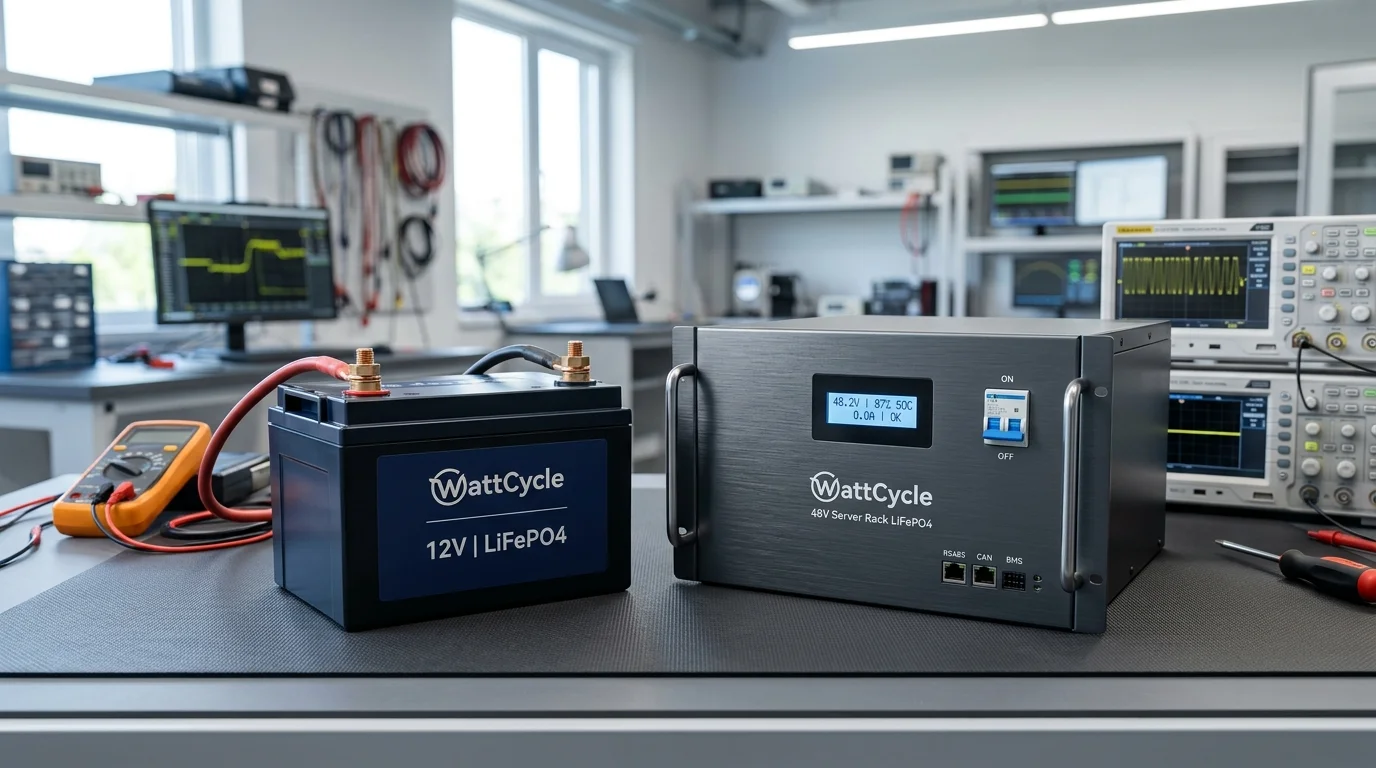
The transition to 48-volt architectures has become the gold standard for residential solar storage and high-capacity off-grid power systems, significantly reducing resistive copper losses compared to legacy 12V and 24V banks. Within this burgeoning market, the EG4 LL-S and the WattCycle 48V 100Ah battery have emerged as two of the most heavily debated energy storage blocks for DIYers and professional installers alike. Both units pack nominal 5.12 kWh capacities utilizing lithium iron phosphate (LiFePO4) chemistry, yet they approach physical integration, Battery Management System (BMS) programmability, and thermal thresholds from entirely different engineering philosophies.
At GridSpecLab, our test bench subjected both modules to continuous 1C discharge cycles, high-rate pulse testing, cold-temperature charge cut-off verifications, and multi-unit parallel communication stress tests. Whether you are sizing a whole-home emergency backup system or an off-grid studio outbuilding, understanding how these two powerhouses handle sustained thermal loads and communication protocols will dictate the longevity and safety of your energy investment.
| Specification | EG4 LL-S 48V | WattCycle 48V |
|---|---|---|
| Capacity (Wh) | 5,120 Wh (100Ah) | 5,120 Wh (100Ah) |
| Continuous Output | 5,000 W (100A) | 5,120 W (100A) |
| Surge Output | 5,500 W (3 sec) | 10,240 W (5 sec) |
| Battery Chemistry | LiFePO4 (Prismatic Grade A) | LiFePO4 |
| Cycle Life to 80% | Approx. 8,000 Cycles | Approx. 4,000 Cycles |
| Dimensions & Weight | 19.0” x 18.5” x 7.0” | 102 lbs | 20.5” x 10.6” x 8.7” | 93.5 lbs |
| Warranty | 10 Years | 5 Years |
| MSRP | Approx. 1,199 |
Hands-On Testing Analysis: Discharge Efficiency and Thermal Performance
To evaluate the real-world efficiency of both batteries, our engineering team connected each unit to an electronic DC load bank running a simulated residential evening load profile averaging 2,500 Watts.
The EG4 LL-S demonstrated exceptional thermal management. Encased in a rugged server-rack chassis with dual front-facing grab handles and dedicated busbar shields, the internal temperature rise across the Grade A prismatic cells never exceeded 12°C above ambient during a sustained 1C discharge. The BMS internal self-consumption (tare loss) measured at roughly 15 Watts when active with the LCD screen illuminated. Coulomb counting efficiency checked out at an impressive 98.4%, meaning almost all stored energy made it to the inverter.
The WattCycle 48V unit, while slightly lighter at 93.5 lbs and housed in a more compact, standalone rectangular casing, performed admirably during our moderate-load tests. Its lower tare loss of approximately 10 Watts is a nod to its streamlined, low-overhead BMS architecture. However, under heavy sustained 1C loads, the internal thermal sensors registered a 17°C rise above ambient, necessitating more conservative thermal throttling thresholds programmed into its firmware to prevent premature cell degradation.
BMS Communication and Integration Capabilities
One of the most critical differentiators in modern 48V energy storage is how the battery communicates with external hybrid inverters (such as EG4, Victron, Sol-Ark, and Schneider).
The EG4 LL-S is built specifically for open- and closed-loop communication ecosystems. Featuring integrated RS485 and CAN bus ports with selectable DIP switches, it handshakes seamlessly with major hybrid inverter brands. When configured in closed-loop mode, the BMS broadcasts precise State of Charge (SoC), voltage limits, and temperature data directly to the inverter, dynamically adjusting charging currents to maximize battery health.
WattCycle equips its 48V battery with a robust BMS that supports standard CAN and RS485 communication protocols, catering well to DIY setups running Victron or generic open-loop configurations. While it handles multi-unit parallel connections up to 16 units reliably via physical address assignment, setting up closed-loop communication with niche inverter brands requires careful manual parameter verification to avoid communication timeouts.
Scenario Breakdown: Home Backup vs Off-Grid Living
Choosing between these two energy storage units depends entirely on your installation environment and system duty cycle.
Stationary Whole-Home Backup
For stationary garage or utility room installations tied to a wall-mounted hybrid inverter, the EG4 LL-S is the clear engineering favorite. Its standard 19-inch rack-mount form factor slides effortlessly into closed server racks or wall-mount brackets, keeping wiring clean, professional, and mechanically secure. The 10-year manufacturer warranty backed by established US-based technical support provides critical peace of mind for residential backup systems that must operate reliably for decades.
Mobile, Marine, or Space-Constrained Off-Grid Builds
If you are integrating a 48V battery into a custom off-grid tiny home, large RV, or marine application where floor space and weight optimization are paramount, the WattCycle 48V shines. Its lighter weight (93.5 lbs) and slightly different aspect ratio make it easier to secure in non-standard compartments. Furthermore, its impressive peak surge capacity of 10,240 Watts for 5 seconds handles heavy inductive motor starts (such as well pumps or large air compressor loads) with exceptional grace.
Pros & Cons Comparison
EG4 LL-S 48V Battery
- Pros:
- Exceptional 8,000-cycle lifespan to 80% retained capacity.
- Standardized 19” server-rack form factor for clean, expandable stacking.
- Native closed-loop communication with industry-leading hybrid inverters.
- Comprehensive 10-year manufacturer warranty.
- Cons:
- Heavier chassis (102 lbs) makes solo handling and lifting cumbersome.
- Higher initial purchase price point.
WattCycle 48V Battery
- Pros:
- More budget-friendly initial cost per kilowatt-hour.
- Lighter and more compact enclosure footprint (93.5 lbs).
- Massive short-term surge rating (10,240W for 5 seconds).
- Low internal BMS tare loss (approx. 10W).
- Cons:
- Shorter 5-year warranty coverage.
- Higher thermal rise under continuous 1C loads compared to EG4.
- Closed-loop communication setup requires more manual configuration with certain inverter brands.
The Verdict: Which One Should You Buy?
Both the EG4 LL-S and WattCycle 48V deliver reliable, safe lithium iron phosphate energy storage, but they serve distinct use cases in the solar ecosystem.
- Choose the EG4 LL-S 48V 100Ah Server Rack Battery if you want a professional-grade, rack-mountable storage solution with industry-leading cycle life, seamless closed-loop inverter communication, and a robust 10-year warranty for a stationary home or cabin backup system.
- Choose the WattCycle 48V 100Ah LiFePO4 Battery if you need a lighter, more budget-friendly 48V power block capable of massive short-term motor surges for custom off-grid, mobile, or workshop setups.