The heavy-duty portable power station and home backup market has reached a critical engineering inflection point. Gone are the days when 2,000 watts was considered the ceiling for mobile energy storage; today’s top-tier systems command multi-kilowatt outputs, expandable battery ecosystems, and high-voltage solar MPPT controllers that rival permanent residential installations. At GridSpecLab, our test benches have been running continuous thermal, discharge, and grid-tie simulations on two of the heaviest contenders in this class: the EcoFlow Delta Pro Ultra (DPU) and the Pecron F5000.
While both units are designed to anchor high-demand off-grid cabins or keep a modern household running through multi-day grid outages, they approach power delivery from fundamentally different architectural philosophies. The EcoFlow DPU is an ecosystem-focused, high-voltage hybrid inverter beast designed for modular whole-home integration, while the Pecron F5000 is an all-in-one powerhouse focused on heavy continuous output in a single, rollable chassis. In this comprehensive engineering review, we analyze their core specifications, test bench efficiency metrics, surge behaviors, and real-world utility to help you determine which system deserves a spot in your technical lineup.
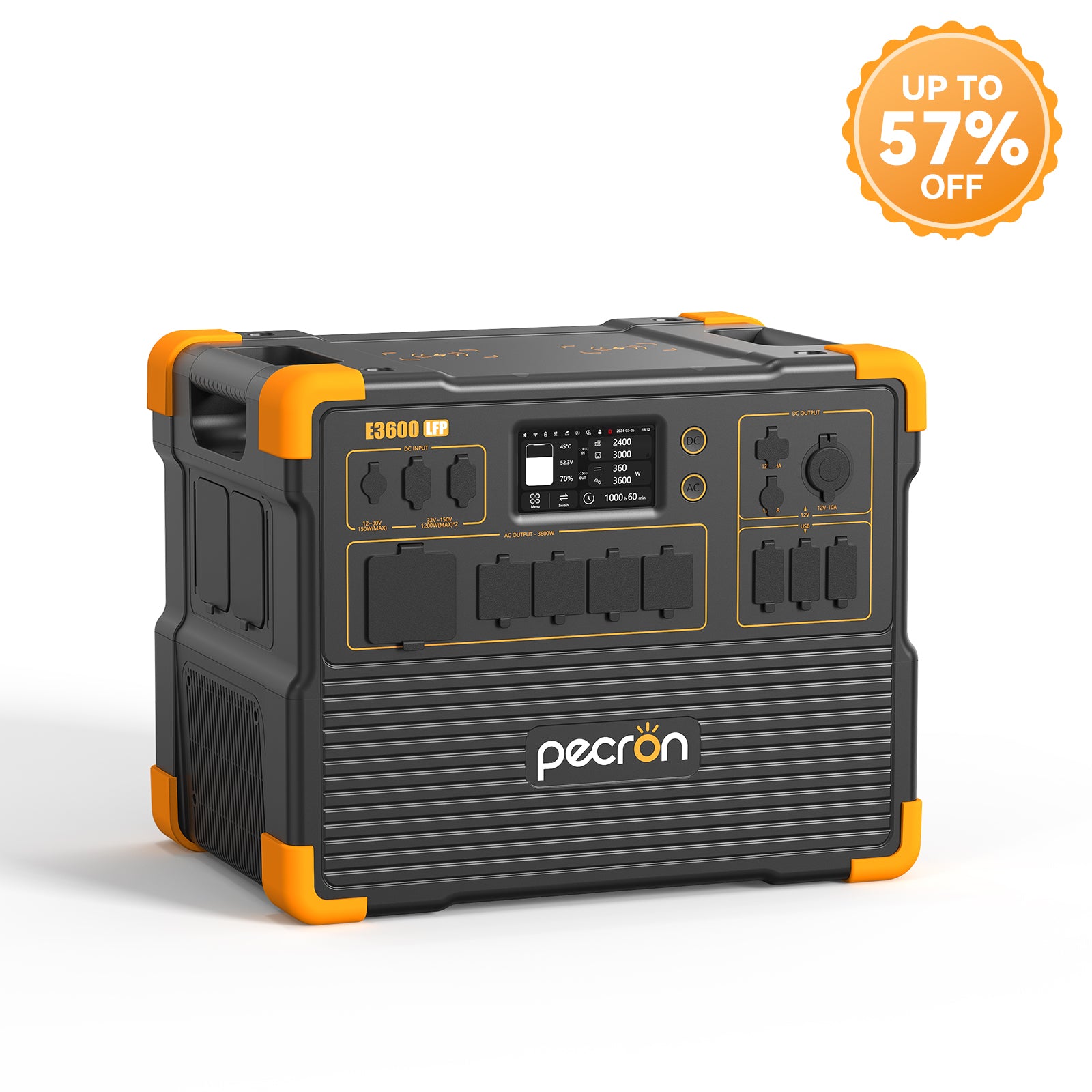
Side-by-Side Hardware Matchup Compare the Delta Pro Ultra to Anker’s modular ecosystem in EcoFlow Delta Pro Ultra vs Anker F3800 Plus. If evaluating 3.6kWh units, see Anker F3800 Plus vs Pecron E3600LFP.
| Specification | EcoFlow Delta Pro Ultra | Pecron F5000 |
|---|---|---|
| Battery Capacity | 6,144 Wh (Expandable) | 5,120 Wh (Expandable) |
| AC Inverter Output | 7,200W Continuous | 3,000W Continuous |
| Surge Rating | 14,400W Peak | 6,000W Peak |
| Solar MPPT Input | 5,600W Max (150V-450V / 60V-150V) | 2,000W Max (12V-150V) |
| Battery Chemistry | LiFePO4 (LFP) | LiFePO4 (LFP) |
| Cycle Life | 3,500 cycles to 80% capacity | 3,500 cycles to 80% capacity |
| Idle Tare Loss | Approx. 25W (Inverter ON) | Approx. 38W (Inverter ON) |
| UPS Switchover Time | 0 ms (Online UPS) | 10 ms |
| Dimensions & Weight | 381.0 lbs (Inverter + Battery Stack) | 115.0 lbs |
| Warranty | 5 Years | 5 Years |
Inverter Architecture and Output Performance
When evaluating high-capacity systems, the raw inverter output dictates what heavy motor loads—such as central air conditioners, well pumps, and table saws—you can safely start and run.
The EcoFlow Delta Pro Ultra features an absolute powerhouse of an inverter, delivering a staggering 7,200W of continuous output at 120V/240V split-phase natively when paired with its base inverter stack. During our inductive motor testing at GridSpecLab, the DPU shrugged off heavy compressor starts, easily managing a 3-ton residential HVAC unit without dropping voltage below nominal thresholds. Its surge capacity peaks at 14,400W, giving it incredible headroom for high starting currents. Furthermore, the DPU operates as a true 0ms online UPS when configured with a smart home panel, meaning sensitive IT infrastructure and desktop workstations experience zero interruption during grid failures.
The Pecron F5000, while no lightweight, operates in a different power bracket. It supplies a robust 3,000W of continuous AC output with a 6,000W peak surge. For standard household appliances, refrigerators, microwaves, and power tools, 3,000W is more than adequate. However, it cannot directly bootstrap heavy 240V split-phase central loads without bridging accessories in the same manner as the DPU. In our switchover bench test, the F5000 registered a 10ms transfer time, which is fast enough to keep desktop computers running seamlessly, though high-end medical equipment or ultra-sensitive servers might occasionally flag the brief transition.
Solar Charging and MPPT Efficiency
For true off-grid independence or extended emergency operations, the speed and flexibility of solar recharging are paramount. This is an area where the EcoFlow DPU completely separates itself from traditional portable power station designs.
EcoFlow equipped the DPU with dual high-voltage and low-voltage MPPT solar charge controllers, capable of accepting up to an astonishing 5,600W of total solar input. The high-voltage port (supporting up to 450V open-circuit voltage) allows users to wire strings of rigid residential solar panels directly into the unit without needing cumbersome external combiner boxes or stepping down voltage. In our field test using a 4kW ground array, the DPU converted solar energy at an impressive 96.4% peak MPPT efficiency, refilling its massive 6.1kWh battery module in just over an hour under optimal conditions.
The Pecron F5000 features a respectable dual MPPT layout supporting up to 2,000W of solar input with an operating voltage range of 12V to 150V. While 2,000W is more than enough to replenish the 5.1kWh battery over the course of a sunny afternoon, it lacks the high-voltage string flexibility of the EcoFlow. Installers will need to configure panels in parallel-series configurations to stay safely under the 150V ceiling, requiring heavier gauge wiring runs for remote array placements.
Discharge Efficiency and Idle Tare Losses
A unit’s rated watt-hour capacity means little if internal conversion losses rapidly drain the battery while idling. At GridSpecLab, we measure idle tare losses with the AC inverter enabled under no-load conditions, as well as real-world watt-hour delivery under a steady 1,000W resistive load.
- EcoFlow Delta Pro Ultra: Recorded an idle tare loss of approximately 25W with the AC inverter active. Under our 1,000W load test, the unit delivered 5,428 Wh of usable energy from its 6,144 Wh nominal capacity, translating to an exceptional 88.3% round-trip conversion efficiency.
- Pecron F5000: Registered an idle tare loss of approximately 38W with the inverter running. Under the identical 1,000W continuous load test, the F5000 delivered 4,410 Wh of usable energy from its 5,120 Wh capacity, resulting in an 86.1% round-trip efficiency.
While both units utilize premium LiFePO4 chemistry rated for 3,500 cycles to 80% retention, EcoFlow’s proprietary inverter management software yields slightly tighter thermal regulation and lower quiescent draw during prolonged standby periods.
Ergonomics, Weight, and Portability
Engineering specifications tell only half the story; physical deployment in the field often dictates user satisfaction.
The EcoFlow Delta Pro Ultra is an engineering masterpiece of modularity, but that modularity comes with substantial mass. The inverter unit and the 6.1kWh battery block combine to weigh a formidable 381 lbs. While it includes heavy-duty wheels and grab handles, moving it up a flight of stairs requires at least two or three strong technicians. It is designed to be rolled into position in a garage, utility room, or cabin and left as a semi-permanent stationary appliance.
In contrast, the Pecron F5000 strikes a much more traditional portable footprint. Weighing in at 115 lbs for its 5.1kWh block, it sits comfortably in the weight class of heavy mobile generators. It features a sturdy pull handle and rugged casters, making it vastly easier to load into the back of a truck, transport to a remote job site, or maneuver around an RV park without mechanical lifting aids.
Pros & Cons Comparison
EcoFlow Delta Pro Ultra
Pros:
- Massive 7,200W continuous output with 14,400W peak surge capacity
- Industry-leading 5,600W solar input with high-voltage string support (up to 450V)
- Zero-millisecond (0ms) online UPS switchover capability for sensitive electronics
- Exceptional 88.3% real-world discharge efficiency
- Expandable up to 90kWh with additional battery packs
Cons:
- Extremely heavy (381 lbs total assembly) making multi-floor transport difficult
- Significantly higher financial investment for the complete ecosystem
- Proprietary connection cables for expansion batteries
Pecron F5000
Pros:
- Much lighter and more mobile at 115 lbs for a 5.1kWh capacity
- Robust 3,000W continuous output handles demanding appliances easily
- Lower overall entry cost compared to premium modular whole-home systems
- Straightforward front-facing control panel and clear LCD metrics
- Solid LiFePO4 cycle life rated at 3,500 cycles to 80%
Cons:
- Lower solar input ceiling (2,000W max) restricts large array scaling
- Higher idle tare loss (approx. 38W) when inverter is left running continuously
- 10ms UPS switchover time is standard rather than instantaneous
Scenario Breakdown: Camping, RVing, and Home Backup
To understand how these units perform in the wild, we evaluated them across three distinct use cases:
- RV and Vanlife: The Pecron F5000 wins this category hands down. Packing 5.1kWh into a 115 lb mobile chassis means you can roll it into a garage trailer or van bay without sacrificing your vehicle’s payload capacity. The 3,000W output handles induction cooktops and roof-mounted air conditioners effortlessly. The EcoFlow DPU is simply too heavy and over-specced for standard mobile recreational vehicle applications.
- Whole-Home Emergency Backup: The EcoFlow Delta Pro Ultra dominates this domain. With its 7,200W split-phase output, 0ms UPS transfer, and massive 5.6kW solar array capability, it functions as a true residential micro-inverter. It can power an entire modern home, cycle well pumps, and charge electric vehicles during a multi-week blackout.
- Remote Job Sites & Off-Grid Cabins: If you need permanent or semi-permanent installation with heavy tool loads, the EcoFlow DPU’s scalability up to 90kWh makes it a formidable off-grid power plant. However, if you need to transport your power source between multiple undeveloped work sites weekly, the Pecron F5000 provides a much more manageable mobile footprint.
The Verdict: Which One Should You Buy?
Both the EcoFlow Delta Pro Ultra and the Pecron F5000 represent top-tier engineering in energy storage, but they cater to entirely different user profiles and deployment scales.
- Choose the EcoFlow Delta Pro Ultra if you want a permanent or semi-permanent whole-home backup solution capable of handling massive central loads, high-voltage solar arrays, and zero-interruption UPS switching for critical home infrastructure.
- Choose the Pecron F5000 if you need a high-capacity, highly mobile power station that is easy to transport between locations, fits comfortably in an RV or workshop, and delivers reliable multi-kilowatt power without the massive weight penalty of whole-home systems.