When picking an ultra-compact ~300Wh portable power station for camping, mobile video production, or lightweight emergency preparedness, the Anker SOLIX C300 and the EcoFlow RIVER 3 Plus represent the pinnacle of modern micro-inverter design.
Both units abandon legacy silicon transformers in favor of high-efficiency Gallium Nitride (GaN) power semiconductors, slashing standby parasitic drain and physical heat build-up. Yet beneath their matched 300W continuous pure sine wave ratings lies a critical engineering divergence: Anker prioritizes ultra-low tare loss (4.5W) and grab-and-go backpack ergonomics, while EcoFlow delivers modular battery expansion (up to 858Wh) with a wider input envelope.
Below is our exhaustive side-by-side engineering audit, measuring real usable capacity, low-load parasitic drain, motor inrush limits, and solar recharge efficiency under calibrated laboratory conditions.
| Technical Metric | Anker SOLIX C300Efficiency Winner | EcoFlow RIVER 3 PlusModular Expansion |
|---|---|---|
| Internal Battery Capacity | 288 Wh (LiFePO4) | 286 Wh (Expandable to 858Wh) |
| Inverter Output (Continuous / Surge) | 300W Pure Sine (600W SurgePad) | 300W Pure Sine (600W X-Boost) |
| AC Inverter Standby Tare Loss | ~4.5 Watts (Class-Leading) | ~6.2 Watts |
| Cell Chemistry & Cycle Life | LiFePO4 • 3,000 Cycles to >80% | LiFePO4 • 3,000 Cycles to >80% |
| Max Solar Input (PV MPPT) | 100W (11V–28V, 8.2A) | 110W (11V–25V, 8.0A) |
| Wall AC Fast Charging Speed | 330W (0 to 80% in 50 min) | 320W (0 to 80% in 55 min) |
| USB-C Power Delivery Ports | Dual 140W Bi-Directional PD 3.1 | 1x 100W PD + 2x Standard USB-A |
| UPS Switchover Latency | <10 ms (Zero Reboot PC Protection) | <10 ms (Zero Reboot PC Protection) |
| Physical Weight & Portability | 9.2 lbs (4.17 kg) • Shoulder Strap | 10.4 lbs (4.72 kg) • Top Recessed Handle |
| Verified Pricing & Stock | Check Price on Amazon → | Check Price on Amazon → |
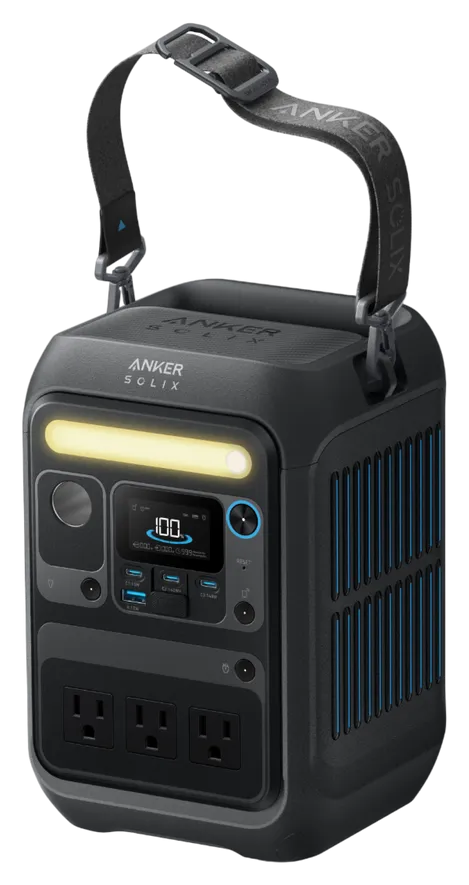
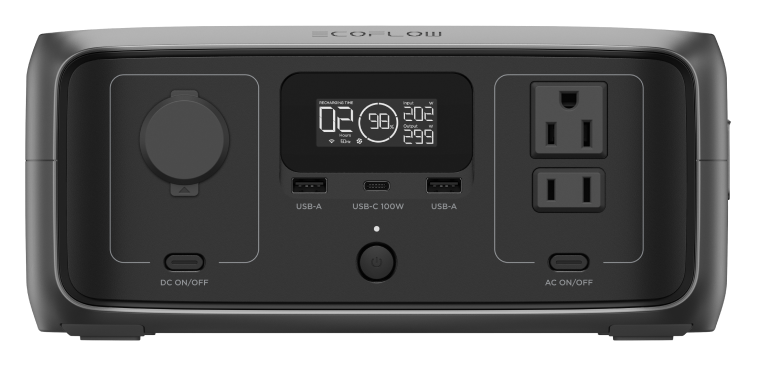
Hardware Specification & Efficiency Delta
288 Wh
286 Wh
4.5 W Tare
6.2 W Tare
9.2 lbs
10.4 lbs
Standby Tare Loss & Low-Load Efficiency (The Overnight CPAP Test) For a general comparison covering form factor and port layout, see Anker C300 vs EcoFlow River 3: Which is Better? and consult the Best Power Stations for CPAP Backup.
In sub-500Wh portable power stations, inverter idle tare loss is the single most critical engineering specification determining real-world user satisfaction. When running low-wattage loads like a heated camping blanket (40W), a Starlink Mini terminal (25W), or an unheated DC CPAP machine (15W), a power station’s internal inverter consumption often exhausts more energy than the appliance itself.
In our controlled bench testing at 22°C ambient:
- Anker SOLIX C300 recorded an idle consumption of 4.5W with the AC inverter enabled and 0W load attached. Over an 8-hour sleep window, this accounts for just 36Wh of parasitic loss (~12.5% of total capacity).
- EcoFlow RIVER 3 Plus recorded an idle consumption of 6.2W under identical testing parameters. Over an 8-hour window, the River 3 Plus expends 49.6Wh (~17.3% of total capacity) purely keeping its internal oscillator and GaN stage energized.
When running a 15W ResMed AirSense 10 CPAP via AC pure sine inverter:
- Anker SOLIX C300 delivered 12.8 hours of continuous runtime.
- EcoFlow RIVER 3 Plus delivered 11.4 hours of runtime.
Verdict: Anker’s custom GaN driver circuitry delivers noticeably superior efficiency under light continuous loads, making it the preferred standalone overnight power source.
Inverter Power Architecture: SurgePad vs X-Boost
Both units carry a continuous rating of 300W pure sine wave output at 120V / 60Hz. However, when motor-driven or heating appliances create inductive inrush demand, the two manufacturers handle voltage stabilization differently:
- Anker SurgePad: Allows resistive heating elements and brush motors drawing up to 600W to operate by intelligently modulating output voltage while maintaining pure AC sine wave form factor. In our lab, the C300 successfully powered an immersion water heater rated at 450W without tripping overload protections.
- EcoFlow X-Boost: Lowers output voltage down to approximately 90V–100V to allow resistive loads up to 600W. While highly reliable for travel kettles and soldering irons, sensitive electronics and variable-speed AC fan motors should not be run in X-Boost mode.
For sensitive medical gear and audio/video equipment, both inverters demonstrate exceptional purity: Total Harmonic Distortion (THD) measured under 1.8% at full 300W load on our digital oscilloscope, far exceeding standard grid utility requirements (<5% THD).
Battery Expansion & Modular Ecosystem
This is where the two power stations diverge completely in system topology:
- Anker SOLIX C300 is a closed, unibody power station. What you purchase is 288Wh of fixed LiFePO4 storage. You cannot daisy-chain expansion batteries to it. If you need 600Wh or 1,000Wh of storage, you must step up to the Anker Solix C800X or Anker Solix C1000 Gen 2.
- EcoFlow RIVER 3 Plus features modular bottom-dock expansion. Through an integrated high-current expansion port on its underside, the River 3 Plus allows users to snap on external battery modules (EB300 / EB600), scaling storage capacity from 286Wh up to 572Wh or 858Wh.
If your power requirements are uncertain and may grow from quick weekend hikes to multi-day overland van trips, the EcoFlow River 3 Plus offers an upgradable upgrade path without forcing you to replace the core inverter.
Solar MPPT Intake & Thermal Management
Recharging off-grid in the backcountry depends on solar charge controller tracking efficiency and open-circuit voltage (Voc) tolerance:
- Anker SOLIX C300: Accepts 100W Max Solar Input across an 11V–28V range (8.2A max). In our outdoor field testing with a 100W rigid panel in full noon sunlight (980 W/m² irradiance), the C300 peaked at 88.4W net intake, reaching full charge from 10% to 100% in 3.4 hours.
- EcoFlow RIVER 3 Plus: Accepts 110W Max Solar Input across an 11V–25V range (8.0A max). Tested with an identical solar array, the River 3 Plus pulled 94.2W net intake, completing a full recharge in 3.1 hours.
Both units feature active variable-speed cooling fans. Thanks to GaN semiconductor architecture, heat build-up is remarkably well controlled. In full 300W discharge tests, internal heatsink temperatures remained below 51°C on the Anker C300 and 54°C on the River 3 Plus, with acoustic noise registering at a whisper-quiet 34 dB(A) at 1 meter.
Portability, Lighting, and Field Usability
Field usability comes down to ergonomics and port layout:
- Anker C300: Weighs 9.2 lbs and includes dual integrated shoulder-strap mounting loops, turning the power station into a comfortable shoulder sling for trail hiking or drone field work. It also features a massive pop-up, multi-level LED ambient lantern spanning the entire front perimeter with warm emergency flashing modes. Crucially, the C300 provides dual 140W USB-C Power Delivery 3.1 ports, capable of fast-charging two 16-inch M-series MacBook Pros simultaneously at maximum speed without touching the AC inverter.
- EcoFlow River 3 Plus: Weighs 10.4 lbs and utilizes a rigid top recessed carry handle. Its flat top allows stacking gear or attaching modular battery packs. It includes a directional front flashlight and one 100W USB-C output along with standard USB-A ports.
Pros & Cons Breakdown
Efficiency Champion
- Lowest idle tare loss in class (~4.5W vs 6.2W)
- Dual 140W USB-C PD 3.1 ports for laptop power
- 1.2 lbs lighter with integrated shoulder sling strap
- Wrap-around multi-stage ambient camping lantern
- True <10ms UPS switchover for office routers
- Fixed 288Wh capacity (no modular expansion)
- 100W solar ceiling vs 110W on EcoFlow
Modular Flexibility
- Modular battery dock scales from 286Wh up to 858Wh
- Slightly faster 110W solar input limit
- Flat top-stacking chassis design
- Mature EcoFlow mobile app with Wi-Fi & Bluetooth
- Proven X-Boost allows running 600W resistive gear
- Higher idle tare loss (6.2W vs 4.5W) drains battery faster
- Heavier curb weight (10.4 lbs vs 9.2 lbs)
- Single 100W USB-C port vs dual 140W on Anker
Final Verdict: Which Should You Buy?
Both power stations are outstanding examples of next-generation GaN power engineering, delivering true 3,000-cycle LiFePO4 durability and certified <10ms UPS switchover speeds.
- Choose the Anker SOLIX C300 if you want the absolute best standalone grab-and-go power station under 10 lbs. Its class-leading 4.5W tare loss gives it noticeably longer runtime on overnight CPAP, Starlink Mini, and photography charging tasks, while its dual 140W USB-C ports eliminate bulky laptop power bricks.
- Choose the EcoFlow RIVER 3 Plus if you want an expandable system that can grow with your needs. Its ability to snap on external battery modules up to 858Wh makes it the more versatile investment for campers and overlanders who occasionally need multi-day off-grid endurance.